
The Statute of Anne (c.19), an act…
1709 CE
The Statute of Anne (c.19), an act of the Parliament of Great Britain, is the first statute to provide for copyright regulated by the government and courts, rather than by private parties.
Prior to the statute's enactment in 1710, copying restrictions were authorized by the Licensing Act.
These restrictions were enforced by the Stationers' Company, a guild of printers that in 1556 had been given the exclusive power to print—and the responsibility to censor—literary works.
The censorship administered under the Licensing Act had led to public protest; as the act had to be renewed at two-year intervals, authors and others sought to prevent its reauthorization.
Parliament in 1694 had refused to renew the Licensing Act, ending the Stationers' monopoly and press restrictions.
The Stationers over the next ten years had repeatedly advocated bills to reauthorize the old licensing system, but Parliament had declined to enact them.
Faced with this failure, the Stationers had decided to emphasize the benefits of licensing to authors rather than publishers, and the Stationers succeeded in getting Parliament to consider a new bill.
This bill, which after substantial amendments is granted Royal Assent on April 5, 1710, becomes known as the Statute of Anne due to its passage during the reign of Queen Anne.
The new law prescribes a copyright term of fourteen years, with a provision for renewal for a similar term, during which only the author and the printers they choose to license their works to could publish the author's creations.
Following this, the work's copyright would expire, with the material falling into the public domain.
Despite a period of instability known as the Battle of the Booksellers when the initial copyright terms under the Statute began to expire, the Statute of Anne will remain in force until the Copyright Act 1842 repeals it.
Under the statute, copyright is for the first time vested in authors rather than publishers; it also includes provisions for the public interest, such as a legal deposit scheme.
The Statute will influence copyright law in several other nations, including the United States.
Regions
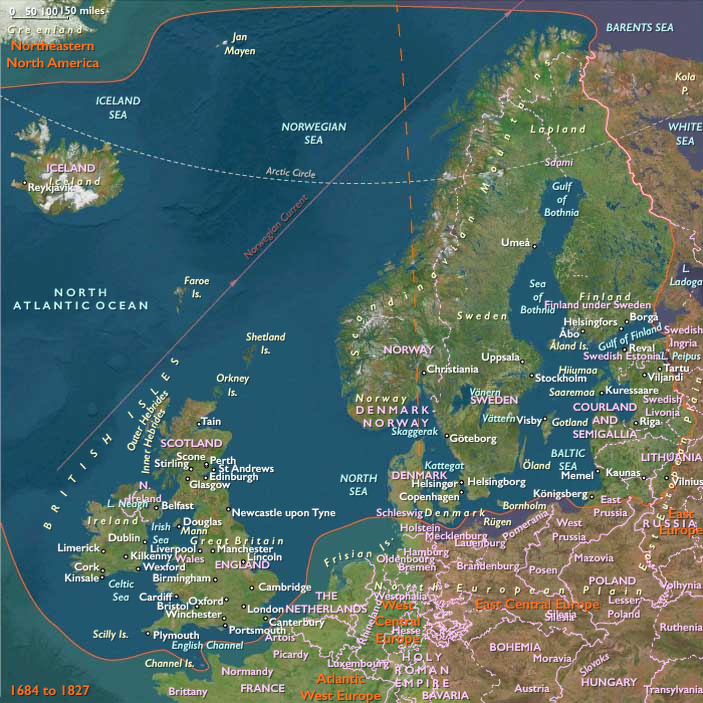
North Europe
View →Subregions
