
The succession to the throne of the …
Years: 1312 - 1312
The succession to the throne of the Kingdom of Hungary had become contested, after the senior line of the Árpád dynasty died out in 1301, by several foreign monarchs and other runners-up, among them Charles Robert of Anjou, the Pope's champion.
Over several years Charles Robert has driven his foreign opponents out of the country and installed himself on the Hungarian throne.
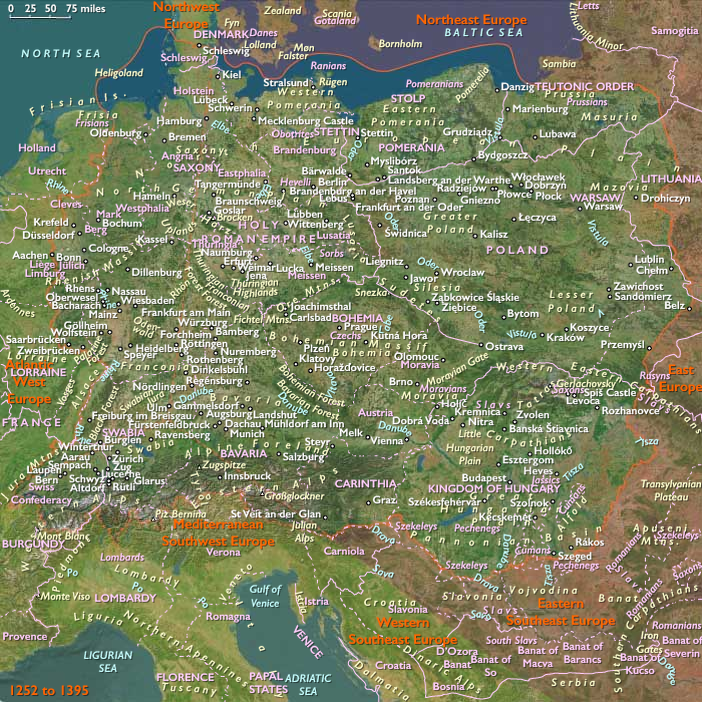
Hungary at this time is a confederation of small kingdoms, principalities and dukedoms.
Angevin rule remains nominal in many parts of the Kingdom, however, because several powerful magnates, local kings, dukes and princes still do not recognize him as the supreme king.
Charles Robert's chief adversary initially is Máté Csák, who controls several counties in western and northern parts of the Hungary.
He allies himself eventually with the Aba family, which rules the eastern Hungarian Kingdom.
Charles Robert besieges Sáros Castle, (now part of Slovakia—Šariš Castle) controlled by the Abas, in 1312m but after the Abas receive additional reinforcement from Máté Csák (according to Chronicon Pictum almost Máté's entire force as well as seventeen hundred mercenary spearmen), he is forced to retreat to the loyal Szepes county (Spiš), whose German inhabitants subsequently reinforce his own troops.
The Abas' benefit from the his retreat.
They decide to use the gathered opposition forces to attack the town of Kassa (today Košice) because of its strategic importance, and partially due to the fact that just few months before Charles had had Amadeus Aba assassinated by the Kassa's German colonists, who comprise the ruling classes of most cities in present-day Slovakia.
Charles Robert marches on Kassa and engaged his adversaries.
The opposition forces abandons the siege of Kassa and position their troops on a hill near the Tarca (Torysa river).
Charles Robert is forced to position his troops in flat agricultural land under this hill.
Although the numbers are uncertain, the king's army consists of his own men, an Italian unit of Knights Hospitaller, and a one thousand-men strong infantry unit of Carpathian Germans.It is not clear to what extent the Aba family was helped by Máté Csák's forces, as there are contradicting versions in contemporary chronicles.
The battle commences when the rebels make a surprise attack during or just after the Mass in the king's camp.
A bloody mêlée follows, causing heavy casualties among knights on both sides.
Even the king's battle standard is lost at one point, and Charles Robert himself has to fight under the standard of the Knights Hospitaller.
A reinforcement from Kassa comes in the crucial moment of the battle and saves the king's cause.
The rebel army, after it loses its commanders in the battle, is routed.
Part of the Aba domain is divided between the King and his loyal followers.
Máté Csák's loss of his key ally is also an important blow to his cause.
He will manage to control much of his territories until his death in 1321, but his power starts to decline just after the battle and he will never again be able to launch any major offensive against the king.
The immediate consequence is that Charles Robert gains control over the northeastern part of the country, but the long-term consequences of the victory are even more important.
The battle drastically reduces the magnates' opposition against him.
The King extends his power base and prestige.
The position of Charles as King of Hungary is now secured militarily and resistance against his rule comes to its end.
Locations
People
Groups
- Hungarian people
- Papal States (Republic of St. Peter)
- Christians, Roman Catholic
- Carpathian Germans
- Hungary, Kingdom of
- Knights Hospitaller (of Rhodes), Order of the
Topics
Commodoties
Subjects
Regions
Subregions

Related Events
Showing 10 events out of 44843 total
Years: 1312 - 1312
Locations
People
Groups
- Hungarian people
- Papal States (Republic of St. Peter)
- Christians, Roman Catholic
- Carpathian Germans
- Hungary, Kingdom of
- Knights Hospitaller (of Rhodes), Order of the
Topics
Commodoties
Subjects
Regions
Subregions