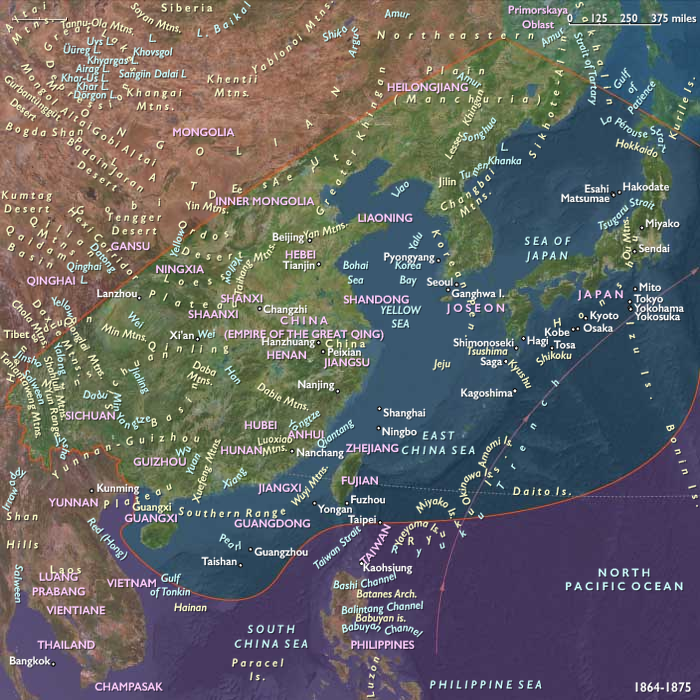
The Taiping Rebellion, a quasi-Christian religious movement…
February 1864 CE
The Taiping Rebellion, a quasi-Christian religious movement led by the "Heavenly King" Hong Xiuquan beginning in 1851, has raided roughly a third of Chinese territory for over a decade.
Arguably one of the largest wars in the nineteenth century in terms of troops involvement, there has been massive loss of life, with a death toll of about twenty million.
British and French troops, equipped with modern weapons, had come to the assistance of the Qing imperial army.
In June, 1863, Imperial Chinese army General Bao Chao had taken Jiufu Island and the Taiping Army had lost the control of the entire northern shore of the Yangtze River.
Bao had subsequently led his force across the Yangtze River and camped on the southern bank of Yangtze River outside the Shence Gate of Nanjing, the capital of the Taiping.
In September, 1863, Zeng Guofan's younger brother, a general of Imperial Army, General Zeng Guoquan, had led his force in attacking and capturing the Upward Bridge region to the southeast of the city, and the Eastern Riverine Bridge region to the southwest of the city.
General Zeng Guoquan had continued his quest in the suburbs of Nanking and by early November 1863 had succeeded in taking regions including Upward Gate, High Bridge Gate, Twin Bridge Gate, Seventh Bridge Jar, Muling Pass, and Central Peace Bridge.
The Taiping Army had therefore lost all of its positions in the southwestern part of Purple Gold Mountain.
By mid November, regions including Chunhua, Jiexi, Longdu, Hushu, and Tree Branches Town had fallen under the Imperial Chinese army's control.
At the same time, the Imperial navy, commanded by Imperial admiral Peng Yulin and his deputy, Yang Yuebin (also known as Yang Zaifu) had taken such important regions as Gaochun ) and Eastern Dam with the help of Bao Chao's forces.
By late November, the Taiping garrison at Lishui had surrendered to Imperial Chinese army.
As a result, the Taiping army had been evicted from the vast region within fifty miles of Nanking.
On November 25, 1863, Zeng Guoquan and his subordinate, general Xiao Qingyan, had deployed troops at Piety Tomb.
The only links to the outside remaining are the Shengce Gate and Taiping Gate.
On December 20, 1863, Li Xiucheng had returned to Nanking from Danyang and urged Hong Xiuquan to abandon the Taiping capital the very next day.
However, this suggestion is not followed by Hong Xiuquan, who had then assumed overall command of the defenses.
Hong had declared that anyone who disobeyed him and God would be immediately executed.
This had doomed the Taiping army and Nanking by creating widespread discontent, and, coupled with other factors, eventually, over two hundred thousand Taiping troops will leave Nanking and surrender to the Imperial Chinese army during the entire course of the battle.
For those who refuse to surrender but are also upset by Hong's decisions, choose to break out while they still can, when the siege is still incomplete.
Hong, Li and others are unable to stop such acts.
On February 28, 1864, Tianbao Castle at the highest peak of Purple Gold Mountain falls under the Imperial Chinese army's control.
Groups
Topics
Regions
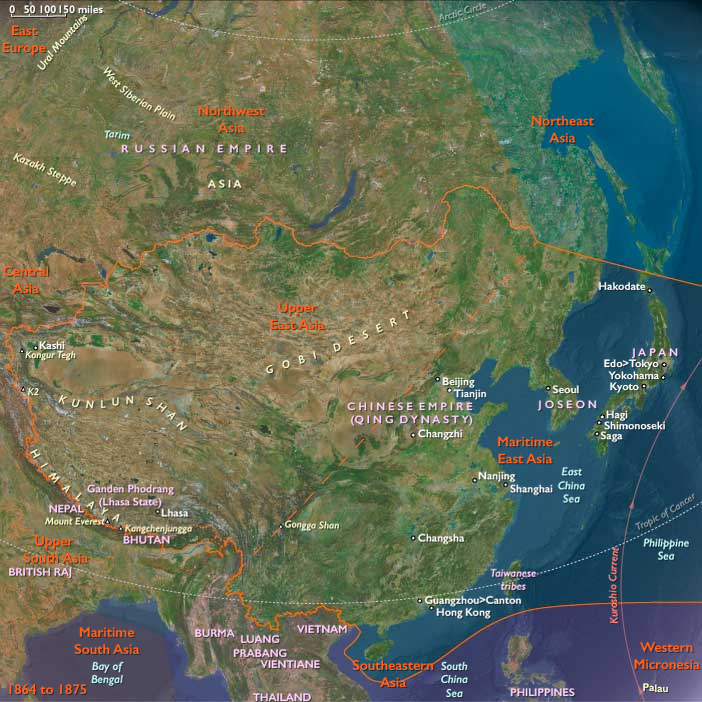
East Asia
View →Subregions