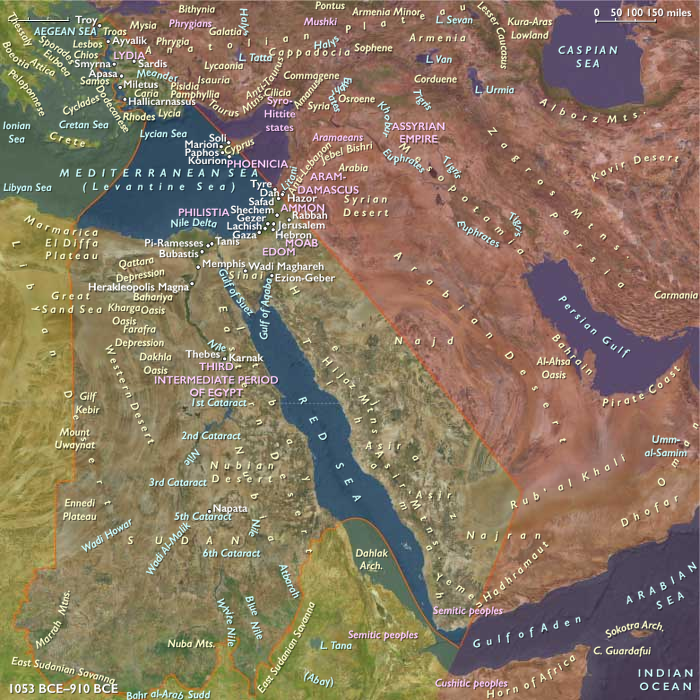
The Third Intermediate Period refers to the…
1053 BCE to 910 BCE
The Third Intermediate Period refers to the time in Ancient Egypt from the death of Pharaoh Ramesses XI in 1070 BCE to the foundation of the Twenty-Sixth Dynasty by Psamtik I in 664 BCE, following the expulsion of the Nubian rulers of the Twenty-Fifth Dynasty.
This period is characterized by the country's fracturing kingship.
Even in Ramesses XI's day, the Twentieth dynasty of Egypt was losing its grip on power in the city of Thebes, whose priests were becoming increasingly powerful.
After his death, his successor Smendes I rules from the city of Tanis, and the High Priests of Amun at Thebes rule the south of the country in the period of the Twenty-first dynasty of Egypt.
This division is less significant than it seems, since both priests and pharaohs come from the same family.
The country is firmly reunited by the Twenty-Second Dynasty founded by Sheshonk I in 945 BCE (or 943 BCE), who descends from Meshwesh immigrants, originally from Libya.
This brings stability to the country for well over a century.
Sheshonk pursues an aggressive foreign policy in the adjacent territories of the Middle East, towards the end of his reign.
This is attested, in part, in three ways.
A statue base from the Lebanese city of Byblos bears his name, part of a monumental stela from Megiddo bears his name, and a list of cities in the region comprising Syria, Philistia, Phoenicia, the Negev and the Kingdom of Israel are among various topographical lists inscribed on the walls of temples of Amun at al-Hibah and Karnak.
There is no mention of either an attack or tribute from Jerusalem, which has led some to suggest that Sheshonk was not the Biblical Shishak.
The fragment of a stela bearing his cartouche from Megiddo has been interpreted as a monument Shoshenq erected there to commemorate his victory.
Some of these conquered cities include Ancient Israelite fortresses such as Megiddo, Taanach, and Shechem.
Locations
People
Groups
Subjects
Regions
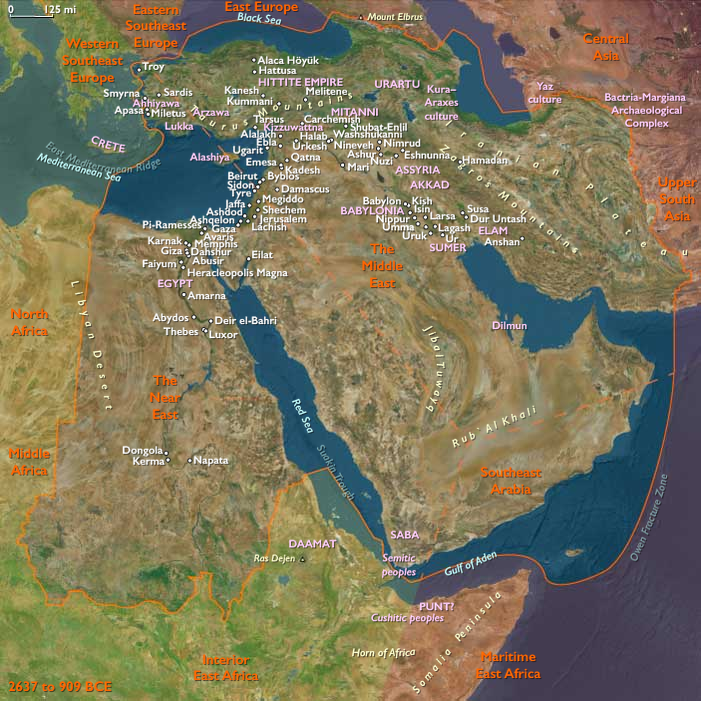
The Near and Middle East
View →Subregions