Many of the disturbances are so fleeting…
1828 CE to 1839 CE
Many of the disturbances are so fleeting they were all but forgotten.
For example, in Rio de Janeiro alone there are five uprisings in 1831 and 1832.
Another eight of the more famous revolts in the 1834-49 period include the participation of lower-class people, natives, free and runaway blacks, and slaves, which accounts for their often fierce suppression.
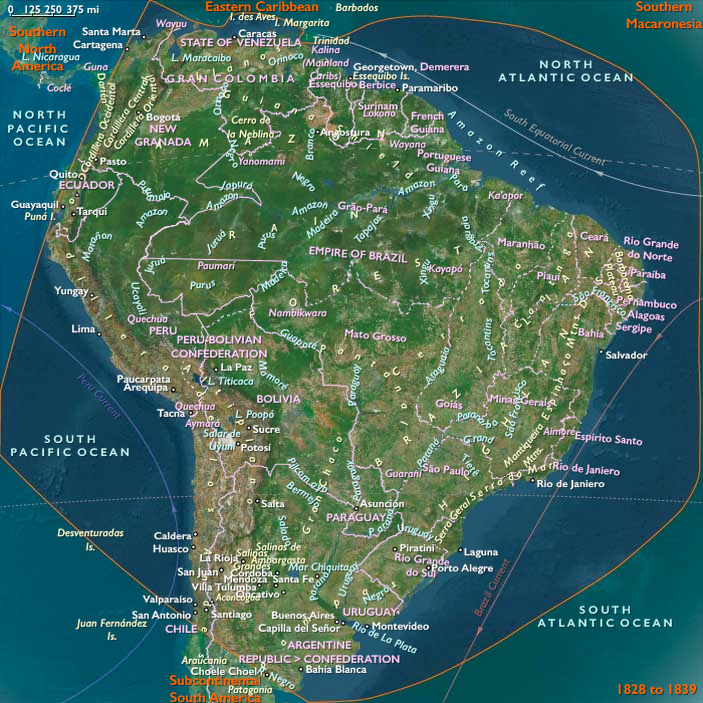
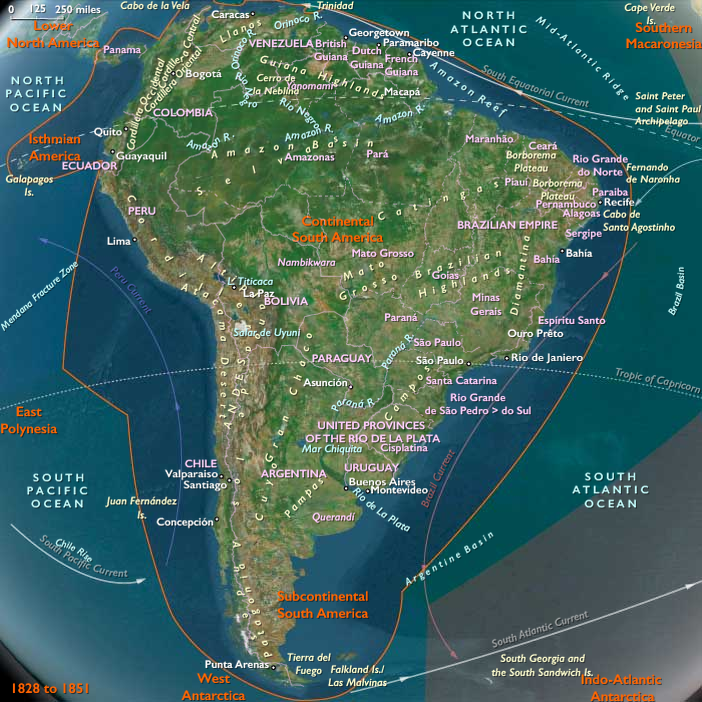
Republican objectives are apparent in some of these revolts, such as the War of the Farrapos (ragamuffins), also known as the Farroupilha Rebellion (1835-45), in Santa Catarina and Rio Grande do Sul.
Others, such as the Cabanagem in Para in 1835-37, the Sabinada in Salvador in 1837-38, the Balaiada Rebellion in Maranhao in 1838-41, and the ones in Minas Gerais and Sao Paulo in 1842, are propelled simultaneously by antiregency and promonarchial sentiments.
Such unrest dispels the notion that the history of state formation in Brazil was peaceful.
Instead, it shows the confrontation between the national government and the splintering pátrias, which would continue in varying degrees for the next century.
Groups
Commodities
Regions
South America
View →Subregions