
The Tibetan people known as the Pyu…
796 CE to 807 CE
The Tibetan people known as the Pyu have, for the past two centuries, migrated into the valleys of the upper Irrawaddy River and its Chindwin tributary.
Rather than push southward, the Pyu halt there in the northern Burmese dry zone.
The Pyu establish overland commercial and cultural contacts with such Indian border centers as Chittagong.
Regions
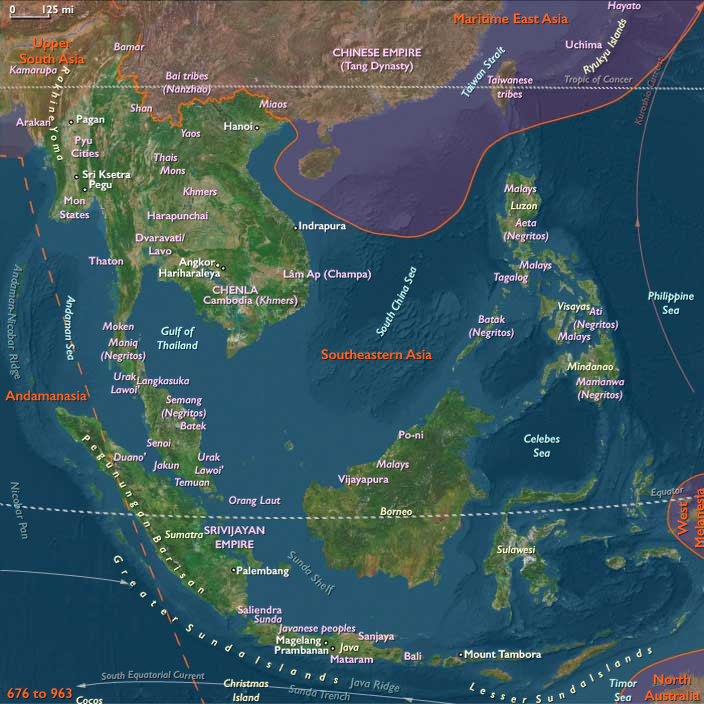
Southeast Asia
View →Subregions
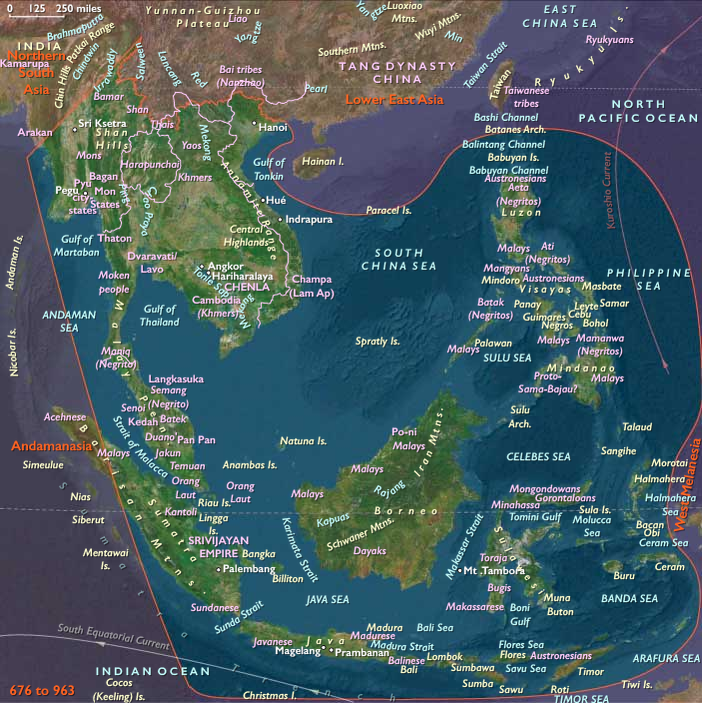
Southeastern Asia
View →Related Events
Showing 10 events out of 27 total
The kingdom of Poland, which had been growing in strength under the rule of the Piast dynasty, had In in 1138 encountered an obstacle that impeded its development for nearly two hundred years.
In the will of King Bolesław Krzywousty, Poland had been divided into five provinces—Silesia, …
…Mazovia with Cuiavia, …
…Greater Poland, the part of Pomerania around the City of Gdańsk, …
…the Sandomierz Region, and …
…Lesser Poland, the 'senior palatinate', comprising the areas around Kraków, Łęczyca, and Sieradz.
To prevent his four sons from quarreling, Bolesław had granted one province to each of them, and the fifth one, the senior palatinate, was to be given to the eldest brother on the grounds of primogeniture.
The reason for such a decision was not only to forestall dynastic feuds, but also to prevent the disintegration of the kingdom.
However, it had soon proved an inadequate solution, and started nearly two centuries of what it had sought to counteract -- constant fighting and disorder.
The Order of the Teutonic Knights of St. Mary's Hospital in Jerusalem, formed at the end of the twelfth century in Acre, in the Levant, had played an important role in Outremer, controlling the port tolls of Acre.
After Christian forces were defeated in the Middle East, the Order had moved to Transylvania in 1211 to help defend Hungary against the Cumans.
They had been expelled in 1225 after allegedly attempting to place themselves under Papal instead of Hungarian sovereignty.
Following the Golden Bull of Rimini, Grand Master Hermann von Salza and Duke Konrad I of Masovia had made a joint invasion of Prussia in 1230 to Christianize the Baltic Old Prussians in the Northern Crusades.
The knights were then accused of cheating Polish rule and creating an independent monastic state.
Once established in Prussia, the Order had become involved in campaigns against its Christian neighbors, the Kingdom of Poland, the Grand Duchy of Lithuania, and the Novgorod Republic (after assimilating the Livonian Order in 1237).
The neighboring country of Lithuania having accepted Christianity in the second half of the thirteenth century, the Order’s main purpose in Europe is lost.
The Teutonic Knights have a strong economic base.
Hiring mercenaries from throughout Europe to augment their feudal levies, they have become a naval power in the Baltic Sea.
At the beginning of the fourteenth century, Pomerania, a neighboring region to the Ordensstaat, or Monastic state of the Teutonic Knights, had plunged into war with Poland and Brandenburg to the west.
Brandenburg's rulers, who had ruled Pomerelia (Eastern Pomerania) in the 1250s, enter into a treaty on August 8, 1305 with Wenceslaus III of Bohemia, promising the March of Meissen to the Bohemian crown in exchange for Pomerelia.
Pomerania, the region on both sides of the Oder River, bounded by the Baltic Sea in the north and the Vistula River in the south, had been split during the twelfth century between Poland and the Holy Roman Empire; the eastern part has become known as Pomerelia.
The expansionist Brandenburg state having conquered the region, Lokietek, in mounting a recovery effort, agrees to ask for help the Teutonic Knights.
The Knights oblige, repulsing the Brandenburgers and seizing the city of Danzig in November 1308.
Some historians claim that, based on the subsequent stagnation and reversal in the development of Danzig, all the inhabitants of the city, Polish and German, were slaughtered.
This massacre is, however, disputed by other historians.
The Teutonic Knights having moved their operations to the Baltic area, the Order’s grand master establishes his residence at Marienburg (Malbork) castle near Danzig.
Margrave Waldemar of Brandenburg sells his claim to the territory to the Teutonic Order in September 1309, for the sum of ten thousand marks, inaugurating what will be a series of conflicts between Poland and the Teutonic Knights as the Order continues to incorporate territories into its domain.
Brandenburg’s Ascanian dynasty, established by Albert the Bear, becomes extinct in 1320 with the death of Margrave Henry II.
Henry's parents were Margrave Henry I of Brandenburg-Stendal and Agnes, a daughter of the Wittelsbach duke Louis II of Bavaria.
Henry II has three older sisters.
In 1319, at the age of eleven, Henry II was to succeed his cousin, Margrave Waldemar, who had died childless.
The Pomeranian duke Wartislaw IV had taken the occasion to set himself up as regent and uses this position to promote his own interests in the longtime Brandenburg–Pomeranian conflict.
In turn, Henry's Ascanian relative, Duke Rudolph I of Saxe-Wittenberg, intervenes and tries to take over the regency.
King Louis IV, half-brother of Henry's mother Agnes, finally declares him an adult, though he does not enfeoff him with Brandenburg.
Henry's early death in 1320 prevents him from acting independently, moreover, it also meas the end of the Brandenburg line of the Ascanian dynasty.
As a completed fief, the Margraviate falls back to the Wittelsbach king Louis IV, who will enfeoff his eldest son Louis V (called "the Brandenburger") with Brandenburg in 1323.