
The title and territories of the Rhenish…
1222 CE
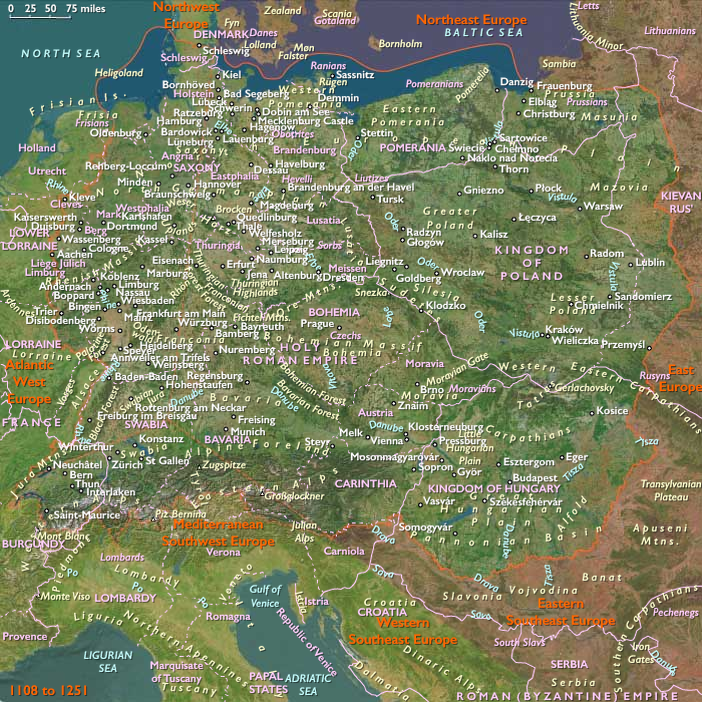
The title and territories of the Rhenish Palatinate pass to the Wittelsbach family in 1222 when sixteen-year-old Duke Otto II of Bavaria, a son of Louis I and Ludmilla of Bohemia and grandson of the dynasty’s founder, Otto I, gains the lands through marriage to Agnes of Palatinate, a granddaughter of Duke Henry the Lion and Conrad of Hohenstaufen.
From this point, the lion becomes a heraldic symbol in the coat of arms for Bavaria and the Palatinate.
The Palatinate will remain a Wittelsbach possession until 1918.
People
Groups
Subjects
Regions
Central Europe
View →Subregions

West Central Europe
View →Related Events
No active filters.
Showing 10 events out of 47175 total
Genghis Khan had directed his Mongol forces as far west as the Persian Gulf in 1222 before turning them north toward Tabriz, entering the Russian steppes north of the Caucasus region.
After making it through the Caucasus, the Mongols are met by an alliance consisting of the Lezgians, the Alans and the Cherkesses, tribes who are living north of the Caucasus who have mustered an army of around fifty thousand men.
They are joined by the Cumans, a Turkish people who own an expansive khanate stretching from Lake Balkhash to the Black Sea.
The Cumans have also convinced the Volga Bulgars to join.
The Cuman Khan, Koten, places his army under the command of his brother, Yuri, and his son, Daniel.
The first battle between the league and the Mongols is indecisive, but the Mongols manage to persuade the Cuman to abandon the alliance by reminding them of the Turkish-Mongol friendship and promising them a share of the booty gained from the Caucasian tribes.
With this arrangement settled, the Mongols attack the alliance's army and rout it.
The Mongols then proceed to attack the Cumans, who had split into two separate groups as they were returning home, destroying both armies and executing all the prisoners before sacking Astrakhan.
The Mongols begin pursuing the Cumans as they flee in a northwesterly direction.
The Venetians send a delegation to the Mongols, and they conclude an alliance in which it is agreed that the Mongols will destroy any other European trading post they came across.
As the Mongols pursue the Cumans, Jebe sends a detachment to Crimea, where the Republic of Genoa has trading stations.
The Mongols capture and plunder the Genoese city of Soldaia (Sudak) Sudak on the Crimean peninsula, which has become an important location for trading on the Silk Road despite attacks by the Kipchaks in the eleventh century.
Meanwhile, …
…Koten flees to the court of his son-in-law, Prince Mstislav the Bold of Galich.
He warns Mstislav: "Today the Mongols have taken our land and tomorrow they will take yours".
Andrew has come into increasing conflict with the powerful Hungarian magnates, who are in turn embroiled in a struggle with the emerging lower nobility.
In early 1222, the latter faction, to protect their social and economic position, rebels and, coming to Andrew's court in a large body, forces Andrew to issue a Golden Bull (from the Latin “bulla,” meaning "seal," an important document with a gold seal attached).
This agreement, similar to England's Magna Carta, enumerates the rights and privileges of the nobility, including the right to disobey the King if he acts not in line with the provisions of the Golden Bull (ius resistendi), and compels the king to share his powers with them in a national Diet, or assembly.
Béla, the eldest son of Andrew II of Hungary, had in 1220 married Maria Laskarina, a daughter of the Emperor Theodore I Laskaris of Nicaea, and his father had entrusted him with the government of Slavonia.
However, the king, who had arranged Béla's marriage during his return from the Crusade, persuades Béla to separate from his wife in 1222.
The southern Slavs had in 1219 acknowledged the Empire of Nicaea as the heir to the Roman Empire and the center of Eastern Orthodoxy.
Rastko organizes the Serbian church, with its seat at Zica, near modern Kraljevo, into bishoprics headed by his former monastic colleagues and students.
He now embarks on a cultural and ecclesiastical renaissance that includes the establishment of schools and the beginnings of a medieval Serbian literature; he personally contributes a chronicle of his father's reign.
The writings of Stefan II and his brother are considered as the first works of Serbian literature.
Robert, surrounded by enemies, has appealed for help to Pope Honorius III and to King Philip II of France; but meanwhile his lands are falling into the hands of the rival Despotate of Epirus and Empire of Nicaea.
After the Nicaeans take Seleucia from the Latins in 1222, the Latin Empire consists only of Constantinople and its environs.
Theodore negotiates a settlement with Robert, to whom he betroths his daughter Eudocia.
Theodore's surviving brothers, Alexios and Isaac, protest the succession, and civil war breaks out.
Rastko upon returning to Serbia crowns his brother again with a crown from the Nicaean Empire, which serves to reaffirm Serbia's eastern orthodox religious and cultural orientation.
This close alliance between secular and sacred power gives the Nemanjic state much of its strength and stability.
The Serbian church thus separates from ...
…the Bulgarian-influenced archbishopric of Ohrid.
Saint-Étienne, located in southeastern central France, about thirty miles (fifty kilometers) southwest of Lyon, had been settled around 1195.
Named after Saint Stephen, the city first appears in the historical record in the Middle Ages as Saint-Étienne de Furan (after the River Furan, an affluent of the Loire).
On the upper reaches of the Furan near the Way of St. James, the Abbey of Valbenoîte is founded by the Cistercians in 1222.