
The Turkic dynasts eventually to be known…
1300 CE
The Turkic dynasts eventually to be known as the Ottomans had in their initial stages of expansion been leaders of the Turkish warriors for the faith of Islam, known as ghazis, who fought against the shrinking Christian Greek state.
The ancestors of Osman (Arabic: Uthman), the founder of the Osmanli, or Ottoman dynasty, had been members of the Kayi tribe who had entered Anatolia along with a mass of Turkmen Oguz nomads.
These nomads, fleeing from pressures in East and Central Asia, overwhelmed Constantinople’s eastern domains after the Battle of Manzikert (1071) and occupied eastern and central Anatolia during the twelfth century.
The ghazis fought against the Greeks and then the Mongols, who invaded Anatolia following the establishment of the Il-Khanid (Ilhanid) empire in Iran and Mesopotamia in the last half of the thirteenth century.
With the disintegration of Seljuq power in 1293 and its replacement by Mongol suzerainty, enforced by direct military occupation of much of eastern Anatolia, independent Turkmen principalities—one of which is led by Osman—emerge in the remainder of Anatolia.
Osman is prince (bey) of the border principality centered at Sögüt, founded by his father, Ertugrul, that has taken over the imperial province of Bithynia in northwestern Anatolia around Bursa, commanding the ghazis against the imperial forces in that area.
Hemmed in on the east by the more powerful Turkmen principality of Germiyan, Osman concentrates his attacks on imperial territories bordering the Bosporus and the Sea of Marmara to the west.
Locations
People
Commodities
Subjects
Regions
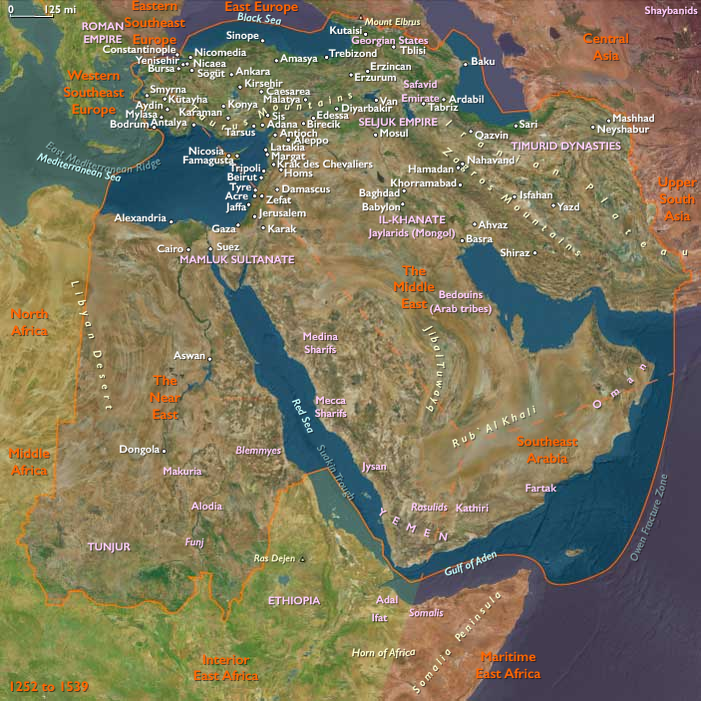
The Near and Middle East
View →Subregions
