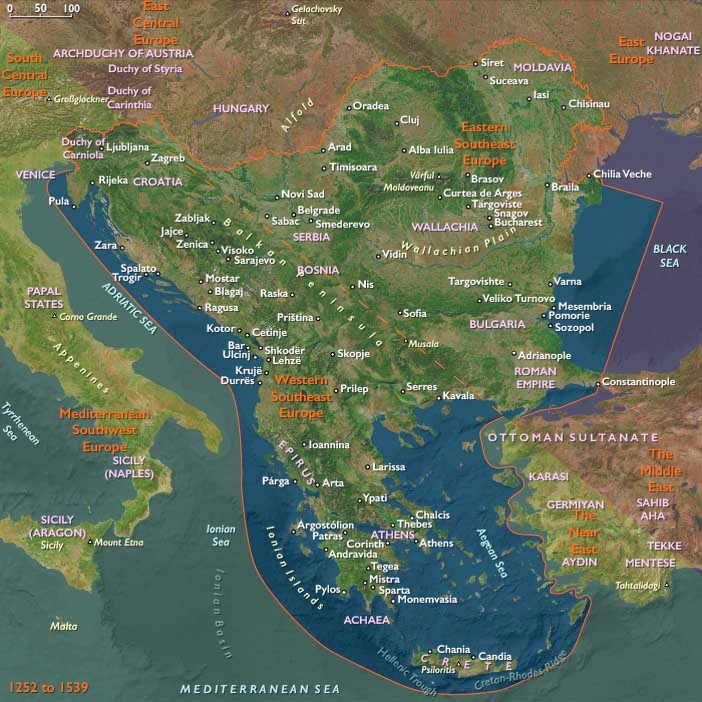
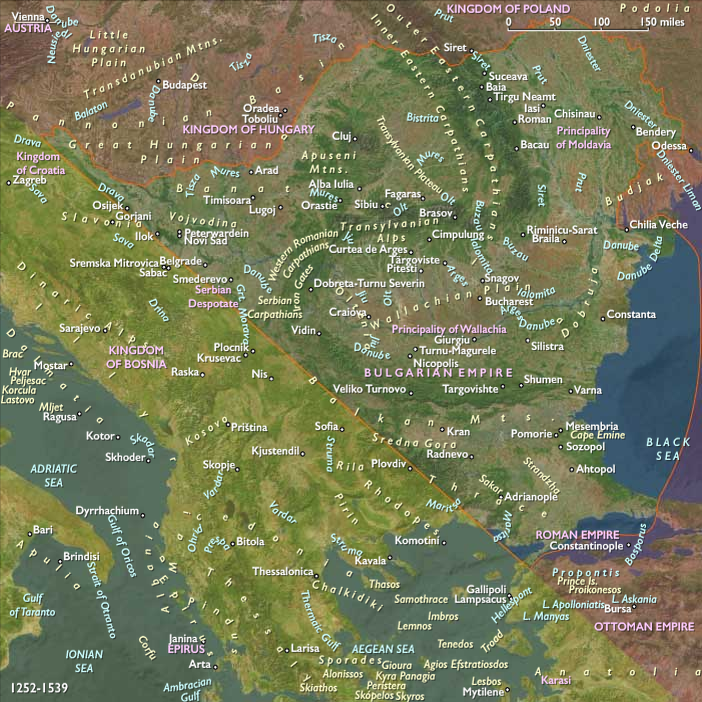
…the Turks besiege the fortress of Guns …
Years: 1532 - 1532
…the Turks besiege the fortress of Guns (Koszeg) during the month of August, but fail to reduce the Austrian stronghold, the Turkish army then stages destructive raids around Belgrade, but finally heads for home, ending what was to be a second great Ottoman campaign as a mere foray into Austrian border territories.
Locations
People
Groups
Topics
Commodoties
Subjects
Regions
Subregions
Related Events
Filter results
Showing 10 events out of 37914 total
The siege of Vienna has frightened the other states of Europe sufficiently for them to agree to a Roman Catholic–Protestant truce (1532), but the result is only temporary, and Ferdinand can never be certain of the support of the independent German princes and the other European rulers who promise help.
Even Charles V is too preoccupied with the problems of the Reformation and with France to devote much attention to the Ottomans.
Thus, when Süleyman embarks on his second Austrian campaign (1532), he is unable to draw the imperial army into conflict and has to content himself with devastating large areas of the Habsburg realm.
Nikola Jurišić, born in Senj, Croatia, is first mentioned in 1522 as an officer of Ferdinand I of Habsburg's troops deployed in Croatian forts in defense against the invasion of the Ottoman Empire under Suleiman I, advancing towards Vienna.
He obtained knighthood between 1522 and 1526.
After the Battle of Mohács in 1526, the king made him the supreme army commander of the armed forces defending the borders (supremus capitaneus, Veldhauptmann unseres Kriegsfolks wider Turken).
Jurišić in turn had helped Ferdinand of Habsburg become the king of Croatia by brokering the 1527 election in Cetin.
Jurišić had been sent to Constantinople in 1530 to negotiate with the Ottomans for peace.
Suleiman leads one hundred and twenty thousand to one hundred and forty thousand troops on another campaign against Vienna in 1532, but it never truly materializes as his force is stalled by the Croatian Captain Nikola Jurišić during the Siege of Güns (Kőszeg) in western Hungary during the month of August.
Jurišić, with only seven hundred to eight hundred Croatian soldiers, manages to delay his force until winter closes in.
Charles V, now largely aware of Vienna's vulnerability and weakened state, assembles eighty thousand troops to confront the Ottoman force.
The Ottoman force, instead of going ahead with a second siege attempt, turns back, laying waste to the southeastern Austrian state of Styria in their retreat.
The two Viennese campaigns in essence mark the extreme limit of Ottoman logistical capability to field large armies deep in central and western Europe at this time.
Henry VIII, having commissioned Thomas Cranmer to carry out his plan to obtain the opinion of the canonists and the universities of Europe to strengthen the English king’s biblically-derived position in his divorce proceedings, sends Cranmer to Germany in 1532 to win the support of the Protestant princes.
In January 1532, Cranmer was appointed the resident ambassador at the court of the Holy Roman Emperor, Charles V. As the emperor travels throughout his realm, Cranmer has to follow him to his residence in Ratisbon (Regensburg).
He passes through the Lutheran city of Nuremberg and sees for the first time the effects of the Reformation.
When the Imperial Diet is moved to Nuremberg in the summer, he meets the leading architect of the Nuremberg reforms, Andreas Osiander.
They become good friends, and during this July Cranmer takes the surprising action of marrying Margarete, the niece of Osiander's wife.
This is all the more remarkable given that the marriage requires him to set aside his priestly vow of celibacy.
He does not take her as his mistress, as is the prevailing custom with priests for whom celibacy is too rigorous.
Scholars note that Cranmer had moved, however moderately at this stage, into identifying with certain Lutheran principles.
This progress in his personal life, however, cannot be matched in his political life as he is unable to persuade Charles, Catherine's nephew, to support the annulment of his aunt's marriage.
Lucas Cranach the Elder, towards the end of his life, after Luther's initial hostility to large public religious images had softened, paints a number of "Lutheran altarpieces" of the Last Supper and other subjects, in which Christ is shown in a traditional manner, including a halo, but the apostles, without halos, are portraits of leading reformers.
He also produces a number of violent anti-Catholic propaganda prints, in a cruder style, directed against the Papacy and the Catholic clergy.
His best known work in this vein is a series of prints for the pamphlet Passional Christi und Antichristi, where scenes from the Passion of Christ are matched by a print mocking practices of the Catholic clergy, so that Christ driving the money-changers from the Temple is matched by the Pope, or Antichrist, signing indulgences over a table spread with cash.
Cranach is equally successful in somewhat naive mythological scenes, in which at least one slim female figure, naked except for a transparent drape, and perhaps for a large hat, nearly always features.
These are mostly in narrow upright formats; examples are several of Venus, alone or with Cupid, who has sometimes stolen a honeycomb, and complains to Venus that he has been stung by a bee (Weimar, 1530; Berlin, 1534).
Diana with Apollo, shooting a bow, and Hercules sitting at the spinning-wheel mocked by Omphale and her maids are other such subjects.
A similar approach was taken with the biblical subjects of Salome and Adam and Eve.
These subjects were produced early in his career, when they show Italian influences including that of Jacopo de' Barberi, who was at the court of Saxony for a period up to 1505.
They then become rare until after the death of Frederick the Wise.
The later nudes are in a distinctive mannerist-derived delicate, curvilinear style that abandons Italian influence for a revival of Late Gothic style, with small heads, narrow shoulders, high breasts and waists.
The poses become more frankly seductive and even exhibitionist.

Süleyman, angered and humiliated by his unsuccessful siege of Vienna, mounts another attempt to crush the Austrians.
Leaving Constantinople early in summer 1532, …
The claim by King Min Bin of Mrauk-U that all of Bengal belonged to ancient Arakanese kingdoms, though without foundation, is nonetheless used by Min Bin as the pretext to exploit the growing weakness of Bengal, a sultanate in long decline due to its wars with the Delhi Sultanate and the Ahom Kingdom.
Leading a combined invasion force of twelve thousand (three armies of eleven thousand men in a three-pronged attack, and a flotilla of war boats carrying one thousand troops), he invades Bengal on October 7, 1532.
According to Arakanese chronicles, the combined invasion force defeated an Bengal army of ten thousand men and took Chittagong.
The Arakanese armies now press on toward Dhaka on December 1, 1532.
The Bengal army makes a last stand outside Dhaka but is defeated.
The sultan's defenses collapse afterwards, and Arakanese forces enter Dhaka on December 11, 1532, without a fight.
Afghan warrior Farid Khan, a horse breeder’s son who had begun his military career as a private in the army of Jamal Khan, the governor of Jaunpur, soon proved to be a brave and brilliant leader.
He had accompanied Babur from Kabul to victory in India.
Later, while in the service of the Mughal king of Bihar, he had been awarded the title Sher Khan, Sher meaning "tiger."
Humayun picks a quarrel with Sher Khan, governor of the vassal Bihar state, by failing to capture his fortress at Chunar in 1532, thus earning Sher Khan’s undying rivalry.
The Waldenses, who had withdrawn into Alpine valleys in northern Italy after the burning of eighty of their number at Strasbourg in 1211, have continued to lead a marginal existence.
When the news of the Reformation reached the Waldensian Valleys, the Tavola Valdese decided to seek fellowship with the nascent Protestantism.
A meeting held in 1526 in Laus, a town in the Chisone valley, and decided to send envoys to examine the new movement.
In 1532 they met with German and Swiss Protestants and ultimately adapted their beliefs to those of the Reformed Church.
The Swiss and French Reformed churches had sent William Farel and Anthony Saunier to attend the meeting of Chanforan, which convened on October 12, 1532.
Farel had invited them to join the Reformation and to emerge from secrecy.
A Confession of Faith, with Reformed doctrines, is formulated and the Waldensians decide to worship openly in French.