The United Provinces are another ally of…
April 1667 CE
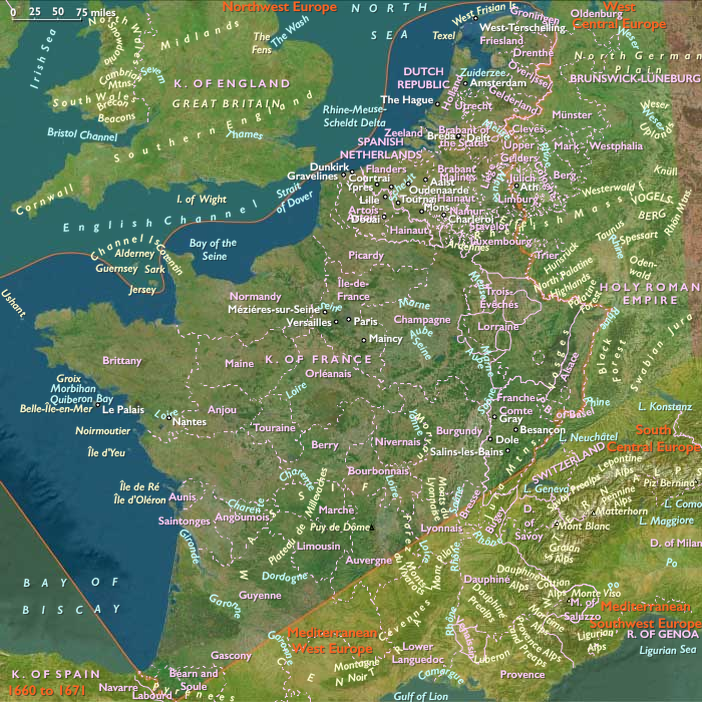
The United Provinces are another ally of France.
After France had for a long time supported the Dutch in their war with Spain, both countries had entered into a defense alliance in 1662.
Louis XIV is anxious to gain the support of the United Provinces for a conquest of the Spanish Netherlands and therefore enters into negotiations.
The United Provinces are at this time at war with England (the Second Anglo–Dutch War), and in the States-General there are fears of a rapprochement between England and France, if they do not take up the French offers.
The influential Grand Pensionary Johan de Witt suggests that the Spanish Netherlands be mutually divided.
Such plans were already being debated from 1663 onward, but the share that Louis XIV had demanded for himself alienates de Witt, and the deal had never been concluded.
At the same time, the Spanish had suggested setting up a combined army if the French invaded.
De Witt believes Spanish military power to be weak however, and the French emissary declares candidly that a Dutch alliance with Spain would amount to a declaration of war on France.
Although the Franco-Dutch negotiations have not led to tangible results, Louis XIV is convinced of the benevolence of the United Provinces.
He promises them that he will mediate in the conflict with England and in the end himself declares war on England, although the French navy will never be engaged to a very large extent.
Therefore, the only remaining potential obstacle to French expansion is the Holy Roman Empire.
As part of the Burgundian Circle, the Spanish Netherlands are subject of a special defense guarantee by the Empire, according to the agreement of Augsburg of 1548 between the Empire and Charles V, Holy Roman Emperor (who was also King of Spain).
In the event of an attack, the Imperial States of the Reichstag could declare an imperial war on France.
The French diplomats however are very intent on eliminating this threat: to this end, they avail themselves of the members of the League of the Rhine.
Bilateral treaties are concluded with the Prince-Bishopric of Münster, the Archbishopric of Mainz, Palatinate-Neuburg, the Electorate of Brandenburg, and the Electorate of Cologne, in which these Imperial States pledge to deny their territories to foreign troops and to push for imperial neutrality in the Reichstag.
Thus, the planned French campaign is also protected against intervention of the Empire from the East.
Locations
Groups
Commodities
Subjects
Regions
West Europe
View →Subregions