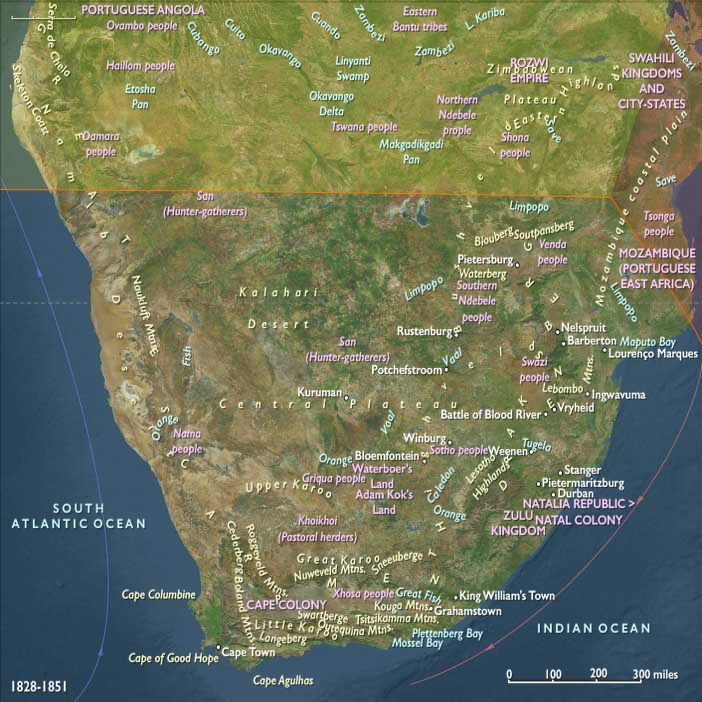
The present Lesotho, originally called Basutoland, had…
1840 CE to 1851 CE
Moshoeshoe, a son of Mokhachane, a minor chief of the Bakoteli lineage, had formed his own clan and became a chief around 1804.
Between 1821 and 1823, he and his followers had settled at the Butha-Buthe Mountain, joining with former adversaries in resistance against the Lifaqane associated with the reign of Shaka Zulu from 1818 to 1828.
Subsequent evolution of the state hinges on conflicts between British and Dutch colonists leaving the Cape Colony following its seizure from the French-allied Dutch by the British in 1795, and subsequently associated with the Orange River Sovereignty and subsequent Orange Free State.
Missionaries invited by Moshoeshoe I, Thomas Arbousset, Eugène Casalis and Constant Gosselin from the Paris Evangelical Missionary Society, placed at Morija, develop orthography and print works in the Sesotho language between 1837 and 1855.
Casalis, acting as translator and providing advice on foreign affairs, helps to set up diplomatic channels and acquire guns for use against the encroaching Europeans and the Griqua people.
Trekboers from the Cape Colony had shown up on the western borders of Basutoland and claimed land rights, beginning with Jan de Winnaar, who had settled in the Matlakeng area in May–June 1838.
As more Boers were moving into the area they tried to colonize the land between the two rivers, even north of the Caledon, claiming that it had been abandoned by the Sotho people.
Moshoeshoe subsequently signs a treaty with the British Governor of the Cape Colony, Sir George Thomas Napier, that annexes the Orange River Sovereignty that many Boers had settled.
These outraged Boers are suppressed in a brief skirmish in 1848.
In 1851 a British force as defeated by the Basotho army at Kolonyama, touching off an embarrassing war for the British.
Groups
Commodities
Regions
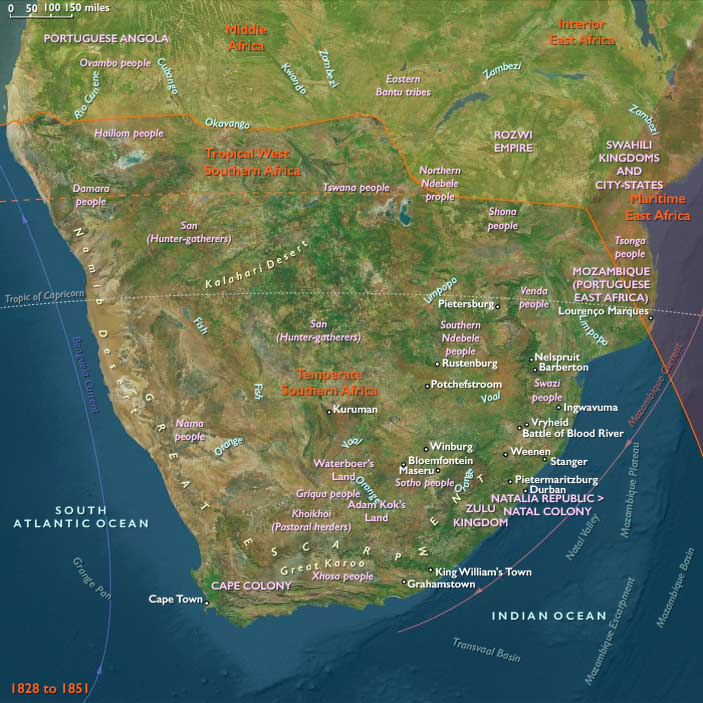
Southern Africa
View →Subregions