The Webster-Ashburton Treaty establishes the United States–Canada…
August 1842 CE
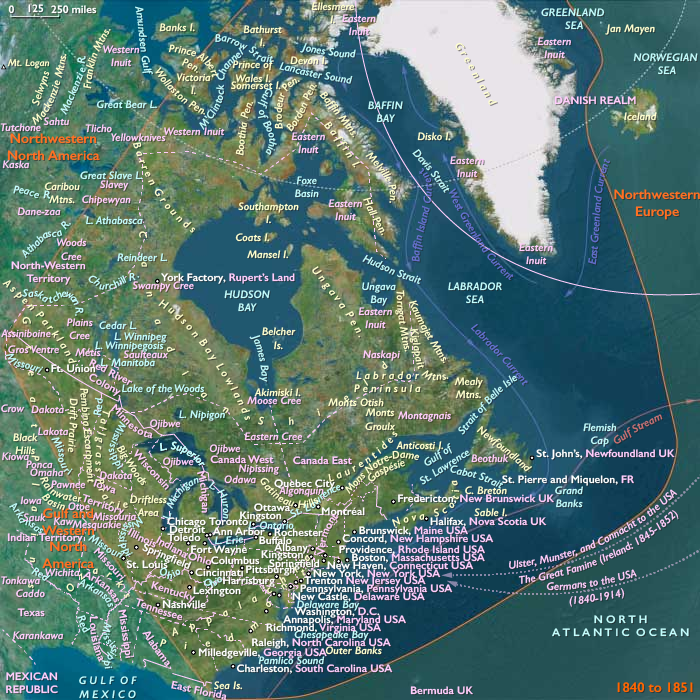
The Webster-Ashburton Treaty establishes the United States–Canada border east of the Rocky Mountains.
Passed by Britain and the United States in 1842 and signed in Washington on August 9, the treaty settles the dispute over the location of the Maine-New Brunswick border between the United States and Canada.
It also establishes the details of the border between Lake Superior and the Lake of the Woods, originally defined in the Treaty of Paris (1783); reaffirms the location of the border (at the 49th parallel) in the westward frontier up to the Rocky Mountains, originally defined in the Treaty of 1818; calls for a final end to the slave trade on the high seas, to be enforced by both signatories; and agrees on terms for shared use of the Great Lakes.
This treaty marks the end of unofficial fighting (known informally as the Aroostook or Lumberjack's War) along the Maine-New Brunswick border and resolves issues that had led to the Indian Stream conflict as well as the Caroline Affair.
The border is fixed with the disputed territory divided between the two nations.
The British acquire the Halifax-Quebec route they desire.
Also, as a result of this treaty, portions of the western U.S.-Canada border are adjusted so as to be consistent.
It gives the U.S. negligibly more land to the north.
The Creole case is passed over by both nations.
Ultimately, the only "losers" are the original Brayon (and Native) inhabitants of the region, whose homeland and people are now split between the American state of Maine and the British colony of New Brunswick.
Groups
Subjects
Regions
Northern North America
View →Subregions