
The wider debate over the end of …
Years: 1917BCE - 1774BCE
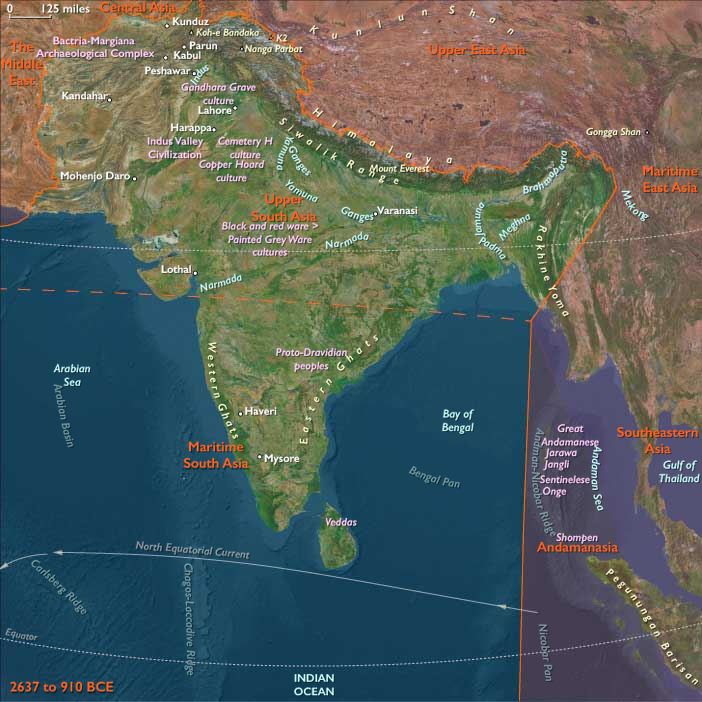
The wider debate over the end of Indus civilization continues, but evidence gathered by the archaeological Survey of India appears to point to natural catastrophes, specifically floods and storms as the source of Lothal's downfall.
A powerful flood submerged the town and destroyed most of the houses, with the walls and platforms heavily damaged.
The acropolis and was leveled (2000-1900 BCE), and inhabited by common tradesmen and newly built makeshift houses.
The worst consequence was the shift in the course of the river, cutting off access to the ships and dock.
The people built a new but shallow inlet to connect the flow channel to the dock for sluicing small ships into the basin.
Large ships were moored away.
Houses were rebuilt, yet without removal of flood debris, which made them poor-quality and susceptible to further damage.
Public drains were replaced by soakage jars.
The citizens did not undertake encroachments, and rebuilt public baths.
However, with a poorly organized government, and no outside agency or central government, the public works could not be properly repaired or maintained.
The heavily damaged warehouse was never repaired properly, and stocks were stored in wooden canopies, exposed to floods and fire.
The economy of the city was transformed.
Trade volumes reduced greatly, though not catastrophically, and resources were available in lesser quantities.
Independent businesses caved, allowing a merchant-centric system of factories to develop where hundreds of artisans worked for the same supplier and financier.
The bead factory had ten living rooms and a large workplace courtyard.
The coppersmith's workshop had five furnaces and paved sinks to enable multiple artisans to work.
The declining prosperity of the town, paucity of resources and poor administration increase the woes of a people pressured by consistent floods and storms.
Increased salinity of soil makes the land inhospitable to life, including crops.
This is evidenced in adjacent cities of Rangpur, Rojdi, Rupar and Harappa in Punjab, Mohenjo-daro and Chanhudaro in Sindh.
A massive flood in about 1900 BCE destroys the flagging township in a single stroke.
Archaeological analysis shows that the basin and dock were sealed with silt and debris, and the buildings razed to the ground.
The flood affects the entire region of Saurashtra, Sindh, and south Gujarat, and affects the upper reaches of the Indus and Sutlej, where scores of villages and townships are washed away.
The population flees to inner regions.
Archaeological evidence shows that the site continued to be inhabited, albeit by a much smaller population devoid of urban influences.
The few people who returned to Lothal could not reconstruct and repair their city, but surprisingly continued to stay and preserved religious traditions, living in poorly built houses and reed huts.
That they were the Harappan peoples is evidenced by the analyses of their remains in the cemetery.
While the trade and resources of the city were almost entirely gone, the people retained several Harappan ways in writing, pottery, and utensils.
ASI archaeologists record a mass movement of refugees from Punjab and Sindh into Saurashtra and to the valley of Sarasvati about this time (1900-1700 BCE).
Hundreds of ill-equipped settlements have been attributed to this people as Late Harappans a completely de-urbanized culture characterized by rising illiteracy, less complex economy, unsophisticated administration and poverty.
Though Indus seals go out of use, the system of weights, with an 8.573-gram (0.3024 oz. avoirdupois) unit, is retained.
Locations
Groups
Topics
Commodoties
Subjects
Regions
Subregions

Related Events
Showing 6 events out of 6 total
Years: 1917BCE - 1774BCE
Locations
Groups
Topics
Commodoties
Subjects
Regions
Subregions