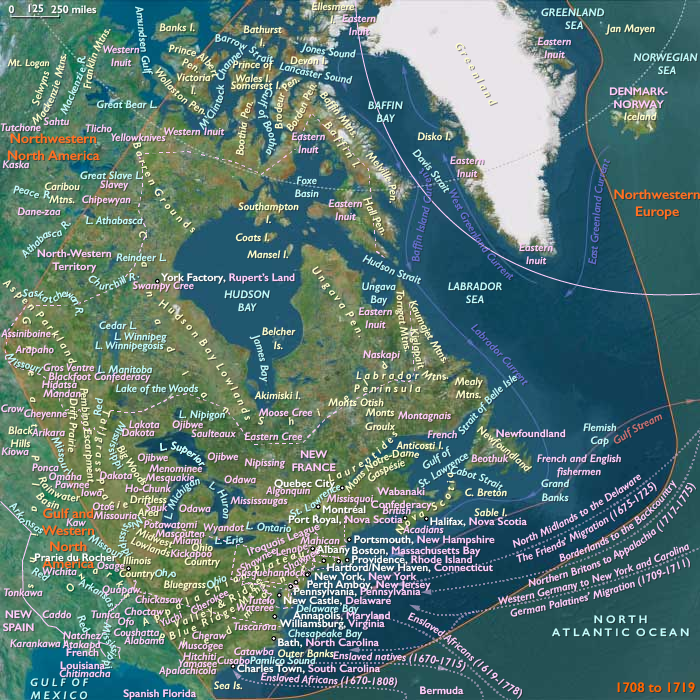
The winter of 1716-1717, even prior to…
March 1717 CE
The winter of 1716-1717, even prior to the Great Snow, has been the worst in memory.
The temperatures had not been unusually cold, but in December 1716, there had already been snow to the depth of 5 feet (1.5 m).
By the end of January, there were drifts 25 feet (7.6 m) high in a few places, overwhelming the people living in New England at this time.
The great snow, depending on the source, begins on February 27 or March 1.
A typical New England nor'easter passes through on February 27, with snow falling on some areas and other places receiving a mix of snow, sleet, and rain.
The first major snowstorm occurs on March 1, with another on the 4th, and a third, the worst among the three, on the 7th.
The snow lightens and stops at some points, but the sky remains cloudy, showing no signs of clearing.
Some of the oldest Native Americans say that even their ancestors never spoke of a storm of this magnitude.
Boston receives around forty inches (one hundred centimeters) of snow, while some places north of the city reach up to sixty inches (one hundred and fifty centimeters).
The snow in Hampton, Massachusetts, is so deep that people can only leave their houses from the second floor on the lee side of the house, implying actual snow depths of as much as eight feet (two point four meters) or more.
Many single-story homes are buried completely, without even the chimney showing.
On the larger residences, drifts reach the third-story window on the windward side.
Large expanses of snow are ten to fifteen feet (three to four point six meters) deep, with some significant drifts twenty feet (six point one meters) deep.
The post roads are impassible until at least March 15, with the mailmen describing snow drift six to fourteen feet (one point eight to four ponint three meters) from Boston to Portsmouth more than a week after the storm.
Travel is also impossible for a time from New York City to Boston.
The geographic scope of the storm is unknown, due to the scarce population and poor record-keeping of the day.
Most information is known only from private diaries.
The snow is known to be several feet deep around Philadelphia, New York City, New London, Connecticut, Boston and Portsmouth, New Hampshire.
Many livestock loss their lives, either starving or freezing to death under tremendous drifts of snow.
As many as ninety-five percent of the deer in the area die, either from starvation or predators, leading to many towns appointing "deer-reeves" to ensure their preservation.
Many orchards are damaged, since the snow covers even the tops of many trees, and animals will graze among the upper branches where they usually cannot.
Groups
Topics
Subjects
Regions
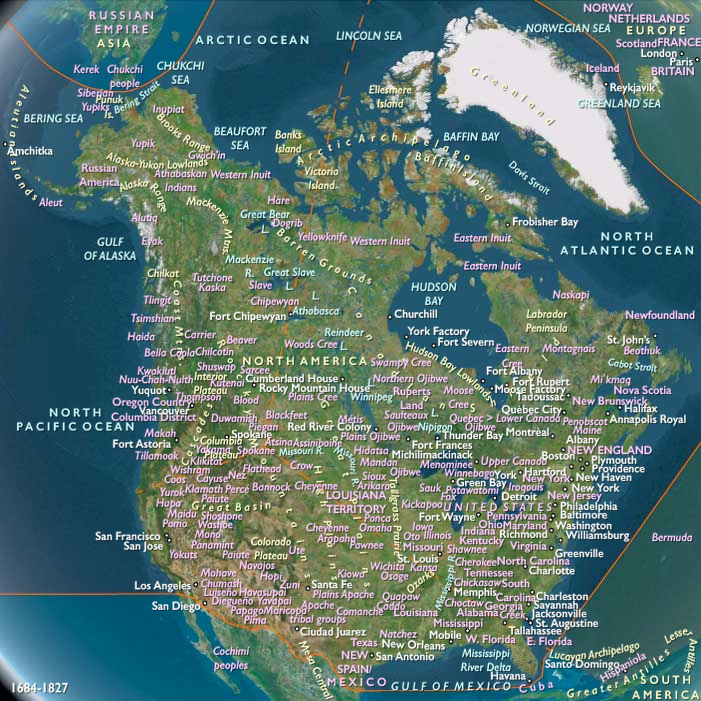
Northern North America
View →Subregions