
Event
Archaeological evidence places early Stone Age human…
Archaeological evidence places early Stone Age human habitation in the southern Gobi between one hundred thousand and two hundred thousand years ago.
By the first millennium BCE, bronze-working peoples live in Mongolia.
With the appearance of iron weapons by the third century BCE, the inhabitants of Mongolia have begun to form tribal alliances and to threaten China.
The origins of more modern inhabitants are found among the forest hunters and nomadic tribes of Inner Asia.
They inhabit a great arc of land extending generally from the Korean Peninsula in the east, across the northern tier of China to present Kazakhstan and to the Pamir Mountains and Lake Balkash in the west.
During most of recorded history, this has been an area of constant ferment from which emerge numerous migrations and invasions to the southeast (into China), to the southwest (into Transoxiana — modern Uzbekistan, Iran, and India), and to the west (across Scythia toward Europe).
By the eighth century BCE, the inhabitants of much of this region evidently were nomadic Indo-European speakers, either Scythians or their kin.
Also scattered throughout the area are many other tribes that are primarily Mongol in their ethnologic characteristics.
-
{# Image navigates to the detail page; the magnifying-glass chip is the only Fancybox lightbox trigger (kept a separate sibling — anchors can't nest). #}
 The Great Crossroads
World
-
{# Image navigates to the detail page; the magnifying-glass chip is the only Fancybox lightbox trigger (kept a separate sibling — anchors can't nest). #}
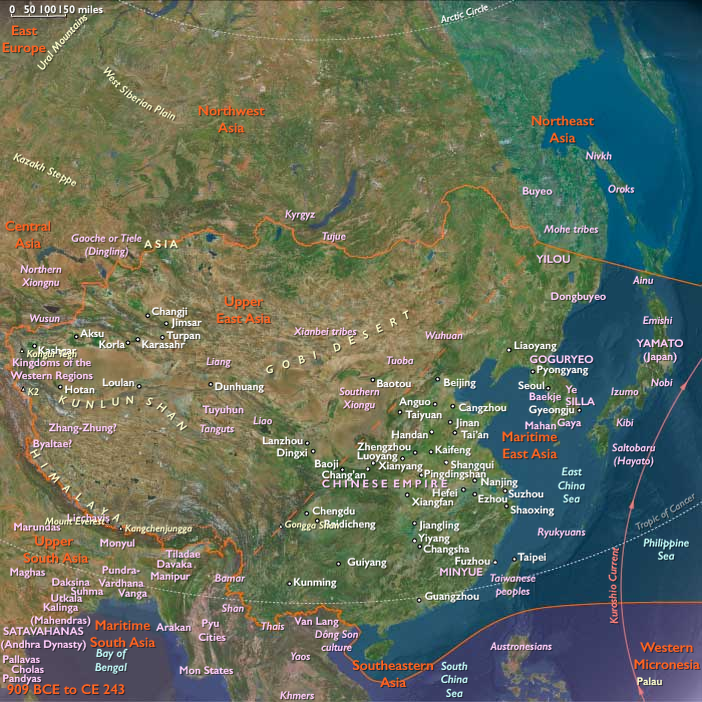 East Asia
Region
-
{# Image navigates to the detail page; the magnifying-glass chip is the only Fancybox lightbox trigger (kept a separate sibling — anchors can't nest). #}
 Upper East Asia
Subregion
