
The Yazoo land scandal had its origin…
1794 CE
The Yazoo land scandal had its origin in 1785, soon after the United States' victory in the American Revolutionary War.
Pent-up land hunger meant that settlers were eager for new territory.
Governor George Mathews had signed the Bourbon County Act, which organized Bourbon County, Georgia in the area of the Mississippi and Yazoo rivers, including the site of the present-day city of Natchez, Mississippi.
At the same time, a secret society formed, called the Combined Society, whose members' sole purpose was to make money by land speculation.
Wishing to acquire land at low prices for resale, they had used influence with politicians to accomplish that end.
Georgia had appointed civil and judicial officers for the new county, but under pressure from the U.S. government, Georgia had dissolved Bourbon County in 1788.
The U.S. government opposed Bourbon County because a portion of the land was also claimed by Spain, and claims to the area by the Choctaw and Chickasaw Native American tribes had not been extinguished.
The Combined Society had eventually faded away.
Three companies—The South Carolina Yazoo Company, The Tennessee Company, and The Virginia Yazoo Company (headed by Patrick Henry)—were formed in 1789 to buy land from the Georgia legislature.
Governor Telfair signed a deal to sell twenty million acres (eighty-one thousand square kilometers) of land to the Yazoo companies for two hundred and seven thousand dollars, or about one cent per acre, but the deal collapsed when the companies attempted to pay with worthless old currency.
In 1794, four new companies—the Georgia Company, the Georgia-Mississippi Company, the Upper Mississippi Company, and the new Tennessee Company—persuade the Georgia state assembly to sell more than forty million acres acres (one hundred and sixty thousand square kilometers) of land for five hundred thousand dollars.
Many Georgia officials and legislators are to be stockholders in these companies.
Groups
Topics
Subjects
Regions
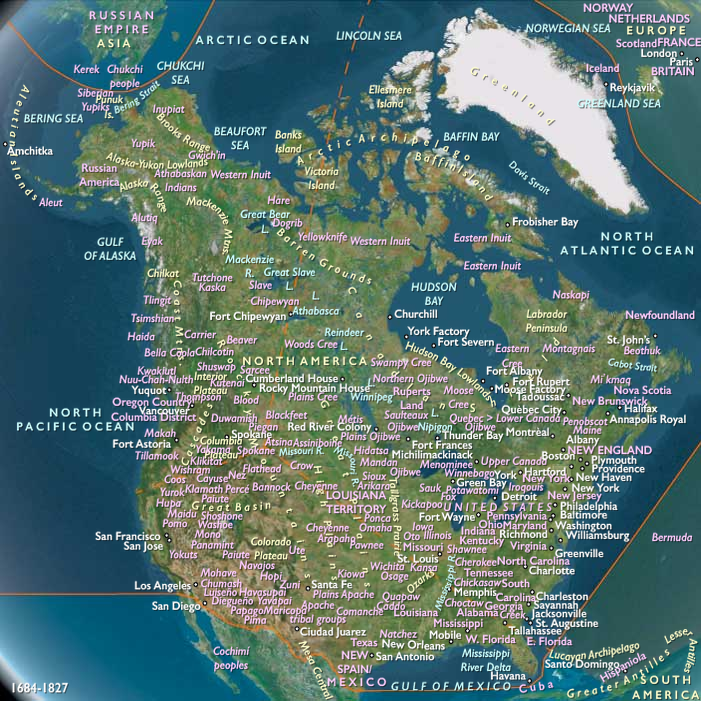
Northern North America
View →Subregions
