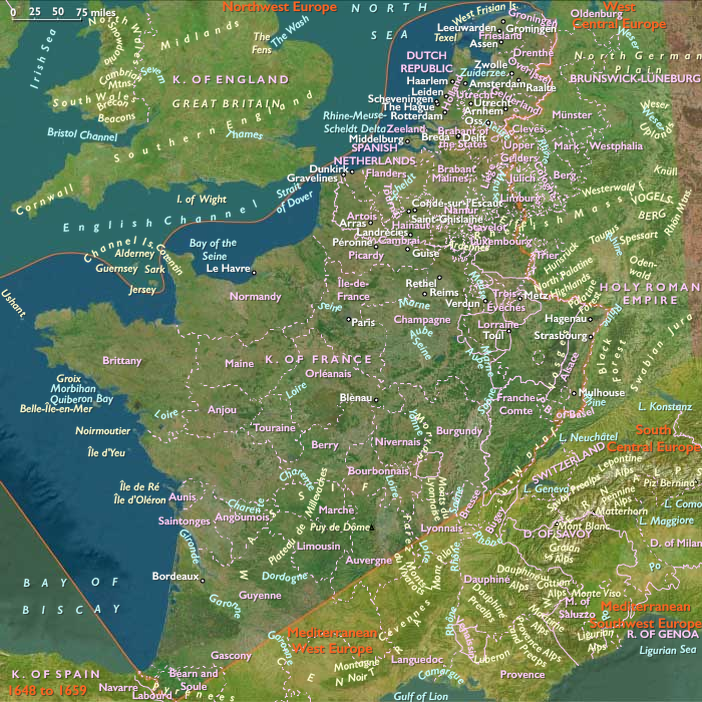
The young regent from Dordrecht, Johan de…
March 1654 CE
The young regent from Dordrecht, Johan de Witt, had taken over the office of Raadpensionaris in the province of Holland in 1653.
This office had usually been filled, after the execution of the capable Oldenbarnevelt, by men of questionable competency, who in any case were compliant to the will of the Stadtholder, like Jacob Cats.
Adriaan Pauw and Andries Bicker, then De Witt and his uncles Cornelis de Graeff and Andries de Graeff are highly capable men, however, who have taken an active leading role, not only in the States of Holland, but also as leader of the delegation of Holland in the States General.
Holland's potential as leader of the Union is therefore fully employed when De Witt gives direction to its policies.
In other words, though formally only the "salaried official" (which is what pensionaris means) of one of the provinces, De Witt fulfills in practice the leading role that previously had been fulfilled by the successive stadtholders of Holland.
The stadtholder is truly not missed.
The constitutional conflict about the supremacy of the sovereignty of the Generality over provincial sovereignty, which had seemed to be settled by the coup of William II, had become "unsettled" again after his death.
De Witt of course meets opposition from other provinces from time to time, and sometimes Holland is even outvoted in the States General.
This poses an unenviable dilemma for De Witt.
Although decisions are supposed to be unanimous in the States General, this would in practice be unworkable.
The principle of majority voting is therefore accepted by all provinces.
On the other hand, Holland cannot allow the other provinces to go against its wishes, as the major contributor to the Generality's budget.
De Witt is therefore only prepared to accept a majority decision if Holland is in the majority.
But how to justify this?
The solution is to push the old doctrine of the supremacy of provincial sovereignty (as long as it is Holland's sovereignty), which becomes the basic constitutional theory of the Republic during this Stadtholderless Era, at least of De Witt's States Party.
Subjects
Regions
West Europe
View →Subregions