The Zhou lineage began, according to Chinese…
909 BCE to 898 BCE
The Zhou lineage began, according to Chinese mythology, when a consort of the legendary Emperor Ku miraculously conceived Qi (lit. "the Abandoned One") after stepping into a divine footprint.
Qi was the culture hero credited with surviving three abandonments by his mother and with greatly improving Xia agriculture,to the point where he was granted lordship over Tai and the ancestral name Ji by his own Xia king and a later posthumous name (Houji, "Lord of Millet") by the Shang king Tang.
He even received sacrifice as a harvest god.
Qi's son Buzhu abandoned his position at court and either he or his son Ju abandoned agriculture entirely, living a nomadic life in the manner of their Rong and Di barbarian neighbors.
Ju's son Duke Liu, however, led his people to prosperity by restoring agriculture and settling them at a place called Bin, which his descendants ruled for generations.
Old Duke Danfu later led the clan from Bin to Zhou, an area in the Wei River valley of modern-day Qishan County.
The duke passed over his two elder sons Taibo and Zhongyong to favor Jili, a warrior who conquered several Rong tribes as a vassal of the Shang kings Wu Yi and Wen Ding before being treacherously killed.
Taibo and Zhongyong had supposedly already fled to the Yangtze delta, where they established the state of Wu among the tribes there.
Jili's son King Wen bribed his way out of imprisonment and moved the Zhou capital to Feng (within present-day Xi'an).
Around 1046 BCE, King Wen's son King Wu and his ally Jiang Ziya led an army of forty-five thousand men and three hundred chariots across the Yellow River and defeated King Zhou of Shang at the Battle of Muye, marking the beginning of the Zhou Dynasty.
The Zhou capital is Hào, near the present-day city of Xi'an in the Wei River valley.
Ji Yihu, who, as Gong Wang (the Communal King), had become the sixth king of the Zhou Dynasty in 922, dies between 909 and 900 and is succeeded by Ji Jian, who rules as Yi Wang (the Benign King).
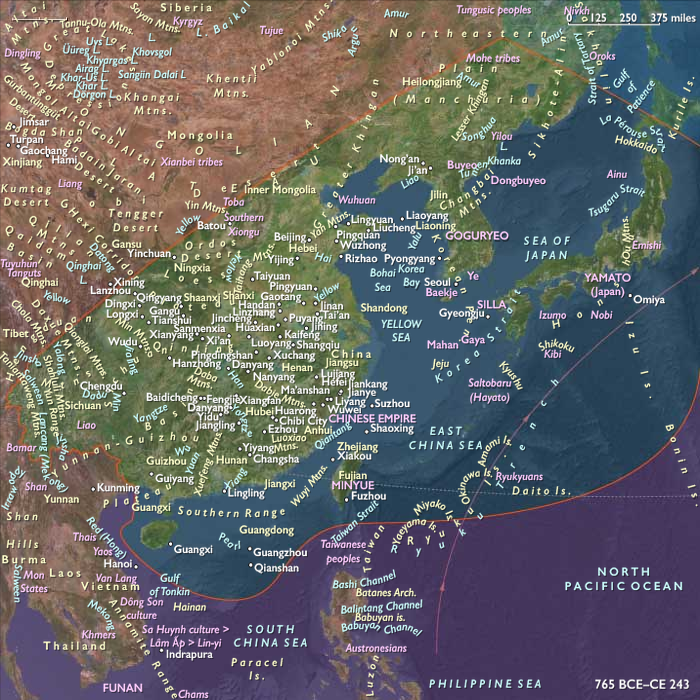
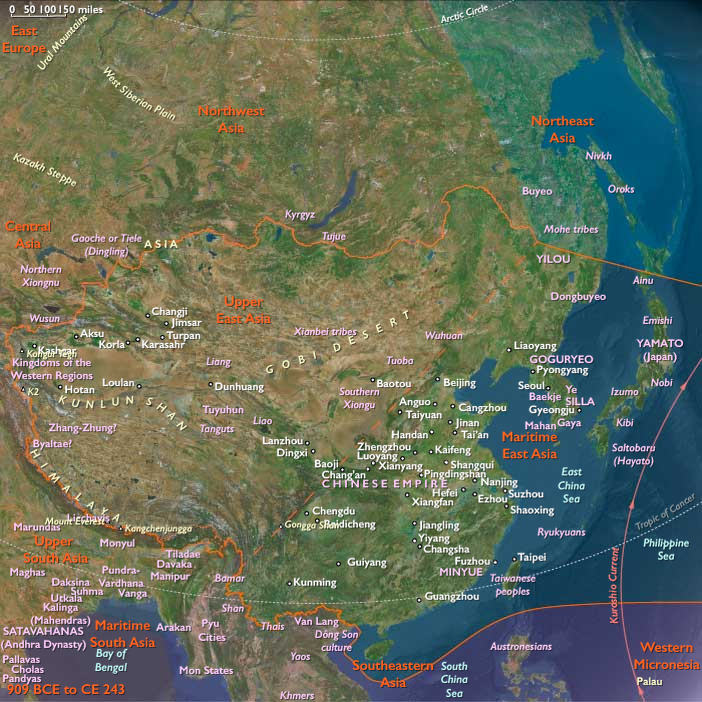
Sharing the language and culture of their Shang predecessors, the early Zhou rulers, through conquest and colonization, had established a large imperial territory wherein an amalgam of city-states as far as ...
Subjects
Regions
East Asia
View →Subregions