Theagenes of Megara, who builds a fountain …
Years: 633BCE - 622BCE
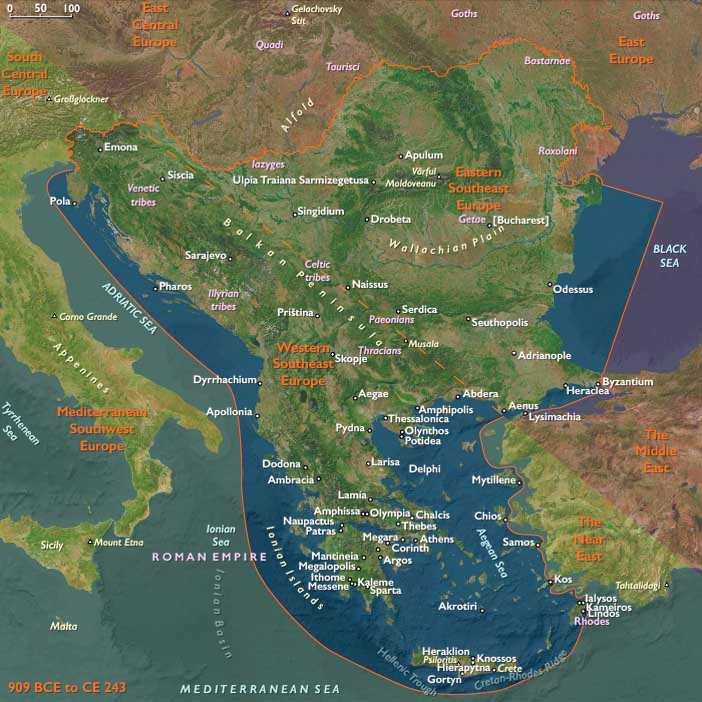
Theagenes of Megara, who builds a fountain house (that can still be seen off the “Road of the Spring-House” in modern Megara), “slaughters the flocks of the rich” (an action incomprehensible without more background information than is available) and tries in about 632 to help his son-in-law Cylon to power at Athens.
Locations
People
Groups
Topics
Commodoties
Subjects
Regions
Subregions
Related Events
Filter results
Showing 10 events out of 66163 total
The Middle East: 633–622 BCE
Succession Crisis and Assyrian Instability
Following Ashurbanipal's death, the Assyrian Empire quickly descends into chaos amid fierce succession disputes. Contenders for the throne include his sons Ashur-etil-ilani and Sinsharishkun, as well as prominent general Sin-shumu-lishir. The power struggle severely weakens Assyrian authority, leading to widespread internal strife and fragmentation of the central administration.
Rise of Nabopolassar and Babylonian Independence
Capitalizing on Assyria’s internal turmoil, the Chaldean leader Nabopolassar successfully revolts in 629 BCE, reasserting Babylonian independence from Assyrian domination. Nabopolassar captures Babylon, establishing himself as the new king and beginning a dynasty that will eventually challenge and overthrow Assyrian hegemony in the region.
Median Revival and Threat to Assyria
In the east, the Medes—under the leadership of the ambitious Cyaxares—capitalize on Assyria’s vulnerability. Cyaxares had earlier succeeded in freeing Media from Scythian control and now asserts his rule over the Persians in southwestern Iran. By the mid-620s BCE, the Medes actively prepare for war against the declining Assyrian Empire, establishing the foundations for a powerful alliance with Babylonia that will eventually lead to the empire’s downfall.
The contenders in the power struggle that follows Ashurbanipal’s death include Ashur-etil-ilani, his brother Sinsharishkun, general Sin-shumu-lishir, and the eventual new king of Babylonia, Nabopolassar.
Who fought against whom is not certain; however, the internal strife weakens Assyria to such a degree that a coalition of Medes, Persians, and Babylonians will be able to be destroy it in 609 BCE.
The Medes, Persians and other Iranic peoples of northern and western Iran have been subject to Assyria during the period of the Neo-Assyrian Empire (911-612 BCE).
This changes during the reign of Cyaxares, who had been born in the Median capital of Ecbatana.
After his father Phraortes was killed in 653 in a battle against the Assyrians, the king of Neo-Assyria, the Scythians had taken over Media.
At a young age, Cyaxares is seeking revenge.
He kills the Scythian leaders in about 625 and proclaims himself as King of Medes.
After throwing off the Scythians, he then conquers the Persians in southwestern Iran and prepares for war against Assyria.
The Assyrian civil war enables the Chaldeans, led by Nabopolassar, to revolt and proclaim Babylonia independent of Assyria, occupying Babylon in 629.
Near East (633–622 BCE): Religious Reformation and Regional Turmoil
Judah’s Religious Revival under Josiah
The decline and eventual death of the Assyrian king Ashurbanipal in 627 BCE weakens Assyrian dominance, allowing Judah significant autonomy for the first time in over a century. King Josiah of Judah, guided by a regency council of influential priests and landowners, embarks upon a vigorous campaign of national independence and religious renewal.
In 623–622 BCE, Josiah orders the High Priest Hilkiah to use accumulated tax revenue for the extensive renovation of the Jerusalem Temple. During these renovations, Hilkiah reportedly discovers a scroll containing the "Book of the Law," widely recognized by scholars as an early edition of Deuteronomy. This influential text, traditionally ascribed to Moses but likely compiled during Josiah's reign from earlier Israelite traditions, emphasizes monotheistic devotion to Yahweh, the rejection of foreign gods, and centralized worship.
Josiah’s reforms profoundly reshape Judah’s religious landscape. He systematically removes foreign altars, desecrates local sanctuaries, and centralizes sacrificial practices exclusively in Jerusalem. The Passover celebration, newly centralized in the Temple, achieves unprecedented prominence, as Josiah positions Jerusalem as the singular spiritual and political heart of the nation. His religious purge extends to the violent eradication of pagan practices, notably the destruction of the cult of Asherah, previously worshiped alongside Yahweh as his consort.
To cement this spiritual renewal, Josiah convenes a public assembly to formally ratify a covenant based on the newly discovered Torah, setting a definitive precedent for state enforcement of religious adherence and significantly advancing the canonization of sacred Hebrew scriptures.
Prophetic Advocacy by Zephaniah
The religious reforms gain vocal support from prophets such as Zephaniah, who around 630 BCE vigorously condemns foreign religious practices, idolatry, and those skeptical of divine judgment. His preaching aligns closely with Josiah's aggressive campaign against polytheism and social injustice, reinforcing the ideological foundations of the king's reform.
Lydia’s Struggles and the Decline of the Cimmerians
In Asia Minor, Ardys II of Lydia faces renewed conflicts. He successfully recaptures Miletus and conquers Priene, yet Sardis, Lydia’s capital, experiences a second devastating sack—this time by the Treres, a Thracian tribe allied with the Cimmerians. The Assyrians eventually defeat the Cimmerians in Cilicia between 637 and 626 BCE, bringing an end to their dominance in western Asia. Following their defeat, the Cimmerians fade from historical records, possibly settling in Cappadocia, suggested by its Armenian name "Gamir."
Scythian Invasions and Egyptian Response
Further regional instability arises in 626 BCE when Scythians under King Madyes exploit Assyria’s diminished military strength, freely ravaging Syria and Palestine. According to Herodotus, these Scythian incursions reach as far as Egypt, prompting Pharaoh Psamtik I to pay substantial tribute to avoid invasion. Despite this payment, the Scythians sack Ashkelon and its ancient temple, underscoring the vulnerability of regional powers in the face of nomadic threats.
Egypt’s Consolidation under Psamtik I
In Egypt, Pharaoh Psamtik I, founder of the Twenty-Sixth Dynasty, continues his methodical consolidation of authority. With local rulers initially secured through diplomacy, Psamtik systematically replaces them with loyal royal officials. Psamtik notably besieges Ashdod for twenty-nine years, as recorded by Herodotus, ultimately bringing this Philistine city—and indeed the entire Philistine region—firmly under Egyptian vassalage by the end of his reign.
Legacy of the Era
The era from 633 to 622 BCE is defined by critical shifts in religious and political landscapes across the Near East. Josiah’s religious reforms fundamentally alter the cultural and spiritual identity of Judah, laying essential foundations for monotheistic Judaism. Meanwhile, the decline of external powers, including the Cimmerians and Assyrians, coupled with the persistent threat of Scythian raids, fosters an environment of heightened political uncertainty and shifting alliances, reshaping the geopolitical fabric of the region for decades to come.
The prophet Zephaniah attacks imitations of foreign religious practices, idolatry, and those who doubt the threat of the Lord's wrath, around 630 BCE
After the death of King Ashurbanipal in 627 BCE, the Assyrian empire falls into chaos; it is no longer assert its authority in Jerusalem.
Under the auspices of the priestly regency council, Josiah, now nineteen, has already set in motion a vigorous movement of independence and restoration, a cardinal aspect of which is religious.
Egypt also is weak, and Judah thus obtains an unusual degree of independence from foreign powers.
Josiah’s reign is noted for the religious reforms he institutes from 626 BCE.
In the eighteenth year of his rule (623/622 BCE), Josiah orders the High Priest Hilkiah to use the tax money which had been collected over the years to renovate the temple.
A scroll of Moses' Torah is allegedly found In the course of renovating the Temple.
By scholarly consensus this is an edition of Deuteronomy—its name, meaning "repeated law," is based on the book's stylistic form: a series of speeches in which the law originally given on Mount Sinai is repeated by Moses to the next generation.
Ascribed by tradition to Moses, the Book of Deuteronomy could not have been written much earlier than the time of Josiah.
Deuteronomy consists of a double introduction, a legal section (dating to the reign of King Hezekiah) with concluding ritual elaboration, two old poems, and an account of Moses' death.
The books’ principal themes include the election of Israel by God, trust in God's power, rejection of foreign gods, and the importance of the Mosaic law.
Traditionally accepted as the genuine words of Moses delivered on the eve of the occupation of Canaan, a broad consensus of modern scholars see its origins in traditions from Israel (the northern kingdom) brought south to the Kingdom of Judah in the wake of the Assyrian destruction of Samaria in the late eighth century BCE.
Refugees fleeing to Judah had brought with them a number of new traditions (new to Judah, at least).
One of these was that the god Yahweh, already known and worshiped in Judah, was not merely the most important of the gods, but the only god who should be served.
Deuteronomy 12-26, the Deuteronomic Code, the oldest part of the book and the core around which the rest will develop, is a series of mitzvot (commands) to the Israelites regarding how they ought to conduct themselves in Canaan, the land promised by Yahweh, the God of Israel.
This outlook influences the Judahite landowning elite, who have become extremely powerful in court circles after they placed the eight year old Josiah on the throne following the murder of his father.
This book, containing provisions supposedly relating to covenantal traditions of pre-monarchic times, deeply impresses Josiah and gives a decisive turn to his reforms.
Anxious to abide by its injunctions, Josiah has the local YHWH altars polluted to render them unusable and collects their priests in Jerusalem.
All local sanctuaries are abolished, sacrifice being concentrated at Jerusalem.
The celebration of the Passover this year is concentrated in the Temple, as it had not been since the days of the judges who judged Israel (according to II Kings 23:22), or since the days of Samuel (according to II Chron. 35:18). (Both references reflect the unhistorical theory of the Josianic, or Deuteronomic, reformers that the Shiloh sanctuary had been the precursor of the Jerusalem Temple as the sole legitimate site of worship in Israel (as demanded by Deuteronomy, chapter 12).
Alongside the male cult of Yahweh, there has been, up to now, a women's cult of Asherah in the Jerusalem Temple, under qedeshim auspices consecrated for fertility practices, according to 2 Kings 23:7.
Asherah's devotees consider her the chief wife of Yahweh, even as she is the wife of El, head of the Canaanite pantheon, for in the Bible El is identified with Yahweh.
King Josiah’s administration, which in about 621 launches a program of national renewal, centered on the Temple in Jerusalem, eliminates her cult.
The official religion of the Hebrews from this time forward will leave no place for other gods, which means the elimination of every goddess.
Under the aegis of Hilkiah, this puritan reform, the most intense in Judah's history, purges the Temple of all foreign cultic objects of Baal, Ashterah (or Asherah), "and all the hosts of the heavens" and dedicates it wholly to the worship of Yahweh.
The living pagan priests are killed and the bones of priests exhumed from their graves and burned on their altars—which is viewed as an extreme act of desecration against these pagan deities by their adherents. (2 Kings 23:4, et seq.)
The authors of Kings and Chronicles add to these acts in Jerusalem Josiah's similar destruction of altars and images belonging to pagan deities in the cities of the tribes of Manasseh, Ephraim, "and Simeon, as far as Naphtali" (2 Kings 23:8f);(2 Chr. 34:6f).
He also has Hilkiah take the tax monies that had been collected over the years and use them to repair the neglect and damage the Temple had suffered during the reigns of Amon and Manasseh.
To seal the reform, the King convokes a representative assembly and has them enter into a covenant with God over the newfound Torah.
For the first time, the power of the state is enlisted on behalf of the ancient covenant and in obedience to a covenant document.
It is a major step toward the fixation of a sacred canon.

Ardys of Lydia again attacks Miletus and takes Priene.
Sardis during his reign is taken a second time, this time by the Treres, a Thracian tribe that operates in close connection with the Cimmerians.
Ardys, according to Assyrian sources, restores Lydia's diplomatic relations with Assyria.
The Cimmerian occupation of Lydia is brief, possibly due to an outbreak of plague.
The Assyrians in Cilicia between 637 and 626 finally beat the Cimmerian forces occupying Sardis.
The Cimmerian leader at this time is Tugdamme (Lygdamis), who is identified in Greek tradition as the victor over Sardis in 652 and is said to have attacked Ephesus.
The Cimmerians essentially disappear from western Asian historical accounts, and their fate is unknown.
They probably settle in Cappadocia, as its Armenian name, Gamir, suggests.
The term Gimirri will be used about a century later in the Behistun inscription of about 515 BCE as a Babylonian equivalent of Persian Saka (Scythians).
The Scythians under King Madyes, unchecked by the diminished Assyrian military, in 626 ravage Syria and Palestine according to Herodotus, seemingly being able to ride unopposed through the empires of the Near East as far as Egypt.
The Scythians pass through Ashkelon after Pharaoh Psamtik I pays a heavy tribute to prevent invasion.
Ashkelon's temple of Venus according to Herodotus is the oldest of its kind, imitated even in Cyprus, and he mentions that this temple was pillaged by marauding Scythians during the time of their sway over the Medes from 653 to 625 BCE.
The long-reigning Psamtik I, founder of the Twenty-Sixth Dynasty and pharaoh of Egypt from 663, besieges Ashdod for twenty-nine years according to the Greek historian Herodotus.
Together with the other Philistine cities, it becomes an Egyptian vassal during the second half of the sixth century.
Psamtik, having won over local rulers in the south of Egypt, gradually replaces them with royal officials.