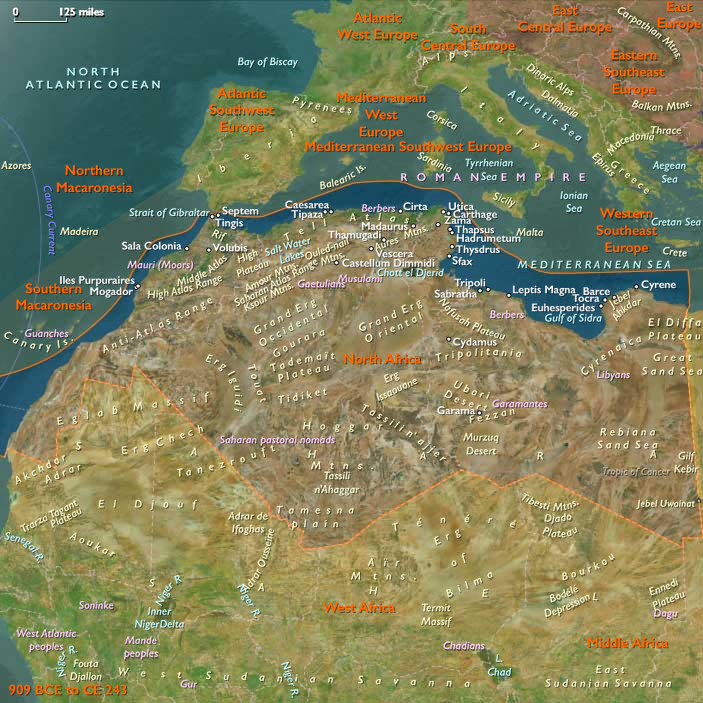
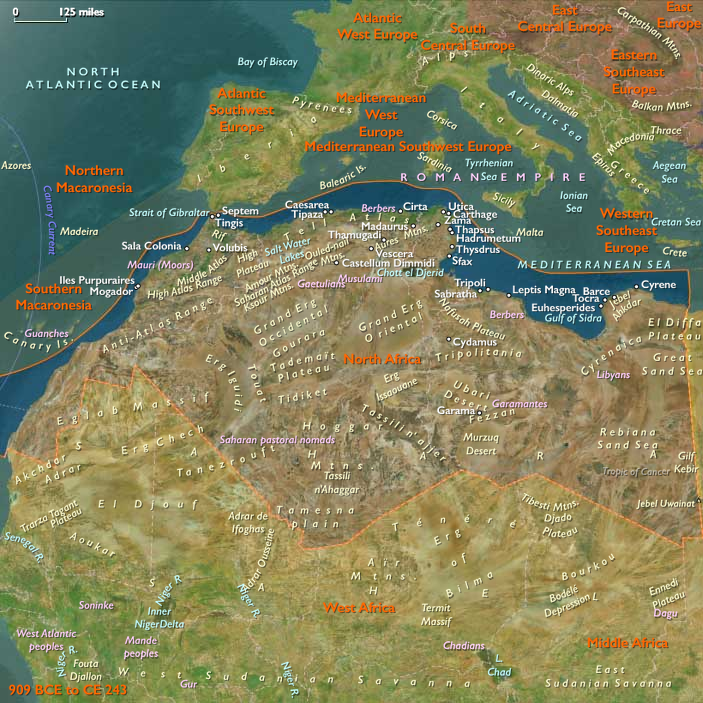
…their capital Garama—over six hundred kilometers south …
Years: 202 - 202
…their capital Garama—over six hundred kilometers south of Leptis Magna.
Locations
People
Groups
Topics
Commodoties
Subjects
Regions
Subregions
Related Events
Filter results
Showing 10 events out of 21 total
Valentinian, now sole emperor in the West, rules in favor of Ambrose and against Symmachus in 384 in the controversial issue of restoring the Altar of Victory to the Roman Senate House.
Theodosius's former general Arbogast, probably of Frankish descent, had risen in the Western Roman army to the rank of magister equitum, or master of the cavalry, and had been sent by the emperor Gratian, in 380, to assist Theodosius against the Goths in Thrace.
He has remained in the service of Theodosius and is now comes (Latin: “count”) and regent for Valentinian II, who is restored to his rule after the overthrow of Maximus, and rules from Vienna (modern Vienne) in Gaul.
In late 388, Arbogast recovers Gaul for Valentinian from Maximus's son, Flavius Victor, who had been proclaimed an Augustus from 384.
Victor's death leaves Valentinian, Theodosius and Arcadius as the sole Augusti in the Empire.
Arbogast has become all-powerful in Gaul by 391.
When Emperor Valentinian attempts to dismiss him, Arbogast tears up the order and declares that only Theodosius possesses the power to do so.
The seventeen-year-old Valentinian had been found dead in his palace at Vienne on May 15, 392, in circumstances suggestive of murder instigated by Arbogast, whom he had sought to dismiss from the regency of Gaul.
Three months afterward, Arbogast treacherously proclaims as emperor in the West the bureaucrat Eugenius, a sometime professor of rhetoric with close connections to the non-Christian aristocracy of the Senate.
The choice of Eugenius over proclaiming himself offers to Arbogast two strong advantages: Eugenius, a Roman, is more suitable than Arbogast, a Frank, as an emperor; furthermore, the Roman Senate is more likely to support Eugenius than Arbogast.
An admirer of the ancient Roman Republic, Arbogast despises the quarrels between Nicene and Arian Christians; he now sets about restoring the old cults.
Constantine's position grows even more untenable; his forces facing the rebel Gerontius are defeated at Vienne (411), where his son Constans is captured and executed.
Gundobad eventually breaks his promise of tribute as he regains his power and besieges Godegisel, locked up in the city of Vienne.
As famine devours Vienne, Godegisel expels the common people from the city for fear for himself.
An outraged expelled artisan, seeking vengeance on Godegisel, goes to Gundobad, and with his help he navigates the aqueduct and breaks into the city.
Gundobad murders Godegisel in 501 in an Arian church along with the bishop.
The events of the first decades of Gundobad's reign are not well known.
Our only source is Gregory of Tours, who wrote almost a century later.
According to Gregory, Gundobad set about ridding himself of his brothers.
First slain was Gundomar, though little is known of this encounter.
Next killed was Chilperic.
According to Gregory, Gundobad had his wife drowned after tying a stone round her neck and Chilperic's two daughters driven into exile.
The older daughter, Chroma became a nun.
The other, Clotilde, had been seen by envoys of Clovis I, King of the Franks, who told their master of her beauty and intelligence.
Clovis then asked Gundobad for Clotilde's hand in marriage.
Gundobad was said to be afraid to deny him.
However, a letter written by Avitus, bishop of Vienne, consoling Gundobad on the death of an unnamed daughter, gives details that suggest there was more to the story.
According to the explication of Danuta Shanzer and Ian Wood of Avitus' notoriously difficult Latin, the bishop writes, "In the past, with ineffable tender-heartedness, you mourned the deaths of your brothers."
Further, Avitus alludes to Gundobad's intent to marry his deceased daughter to a foreign ruler, whom they suggest was Clovis: "Indeed," they write, "Clovis is really the only likely candidate as a prospective son-in-law for Gundobad shortly after 501."
If their reading is correct, then it is likely that Clotilde was offered to Clovis as a replacement, as an act of diplomacy not subservience.

Bishop Avitus of Vienne has published treatises in confutation of the Nestorian, Eutychian, and Sabellian heresies; he has also written against the Pelagian errors of Faustus, abbot of Lerins, and converted many Jews who had settled in his diocese (Venant. Fortun. l. v. c. 5).
Provence had been legally a part of the Italian kingdom from 863.
Following the death of Louis the Stammerer and the division of his realm between his two sons, Carloman and Louis, some nobles advocate electing a sole king, but eventually both brothers are elected kings.
Although doubts are cast upon their legitimacy, the brothers had obtained recognition and in March 880 divide their father's realm at Amiens, Carloman receiving Burgundy and Aquitaine.
However, Duke Boso has renounced his allegiance to both brothers and had been elected King of Provence, or Lower Burgundy.
The brothers Carloman and Louis march against him in the summer of 880, taking Mâcon and the northern parts of Boso's realm.
They unite their forces with those of Charles the Fat and unsuccessfully besiege Vienne from August to November.
Richard, called the Justiciar, is a Bosonid, the son of Bivin of Gorze and Richildis.
His elder brother is Boso of Provence and his younger sister is Richildis, second wife of Charles the Bald.
After the death of the Emperor Louis II in 875, Richard and Boso had accompanied Charles to Italy for his imperial coronation.
In Pavia, while preparing for his return journey in February 876, Charles had nominated Boso "Duke and Viceroy of Italy and Duke of Provence."
On Charles' death in 877, Boso had returned to France and confided the realm of Italy and the duchy of Provence to Richard and Hugh the Abbot as missi dominici.
When Boso declared himself "King of Provence" in 879 following the death of Louis the Stammerer, Richard had defected from Boso and taken Boso's county of Autun, which Carloman II had confirmed to him in 880.
The two had joined battle on the Saône and Richard had captured Mâcon and garrisoned it in the name of Carloman and Louis III under the command of Bernard Plantapilosa, a relative of the hereditary Counts of Mâcon.
After taking Lyon, he had besieged his brother's capital of Vienne, where he had been joined by Louis, Carloman, and the emperor Charles the Fat.
Richard eventually drives Boso out in September 882 and captures his wife Ermengard and children Engelberga and Louis, sending them as prisoners to Autun.
Boso goes into hiding in Provence.