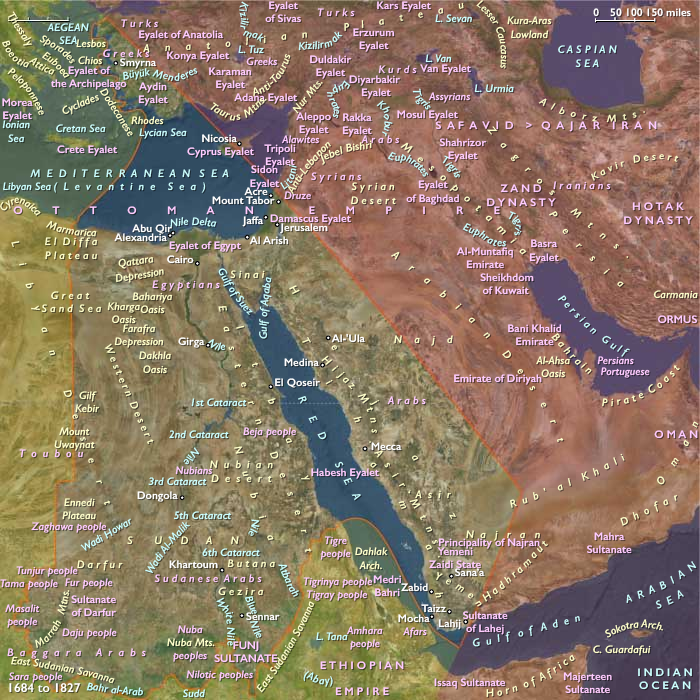
In addition to the upheavals caused by…
1684 CE to 1827 CE
Thus, Cairo is a devastated city and Egypt an impoverished country when the French arrive in 1798.
A French invasion force under the command of Napoleon disembarks near Alexandria on July 1, 1798.
The invasion force, which had sailed from Toulon on May 19, is accompanied by a commission of scholars and scientists whose function is to investigate every aspect of life in ancient and contemporary Egypt.
France wants control of Egypt for two major reasons—its commercial and agricultural potential and its strategic importance to the Anglo-French rivalry.
The principal share of European trade with Egypt during the eighteenth century has been handled by French merchants.
The French also look to Egypt as a source of grain and raw materials.
In strategic terms, French control of Egypt can be used to threaten British commercial interests in the region and to block Britain's overland route to India.
The French forces take Alexandria without difficulty, defeat the Mamluk army at Shubra Khit and Imbabah, and enter Cairo on July 25.
Murad Bey flees to Upper Egypt while Ibrahim Bey and the Ottoman viceroy go to Syria.
Mamluk rule in Egypt collapses.
Napoleon's position in Egypt is precarious nevertheless.
The French control only the Delta and Cairo; Upper Egypt is the preserve of the Mamluks and the Bedouin.
In addition, Britain and the Ottoman government join forces in an attempt to defeat Napoleon and drive him out of Egypt.
The British fleet under Lord Nelson annihilates the French ships on August 1, 1798, as they lie at anchor at Abu Qir, thus isolating Napoleon's forces in Egypt.
Sultan Selim III declares war on France on September 11.
The people of Cairo riot on October 21 against the French, whom they regard as occupying strangers, not as liberators.
The rebellion has a religious as well as a national character and centers around Al Azhar mosque.
Its leaders are the ulama, religiously trained scholars, whom Napoleon has tried to woo to the French side.
The populace during this period begins to regard the ulama not only as moral but also as political leaders.
To forestall an Ottoman invasion, Napoleon invades Syria, but, unable to take Acre in Palestine, his forces retreat on May 20, 1799.
Groups
Egyptians
View →
Arab people
View →
Circassians
View →
Jews
View →
Bedouin
View →
Coptic Orthodox Church of Alexandria
View →
Islam
View →
Egypt in the Middle Ages
View →
Muslims, Sunni
View →
Turkish people
View →
Ottoman Empire
View →
Egypt, Ottoman eyalet of
View →
Britain, Kingdom of Great
View →
French First Republic
View →
Topics
Subjects
Regions
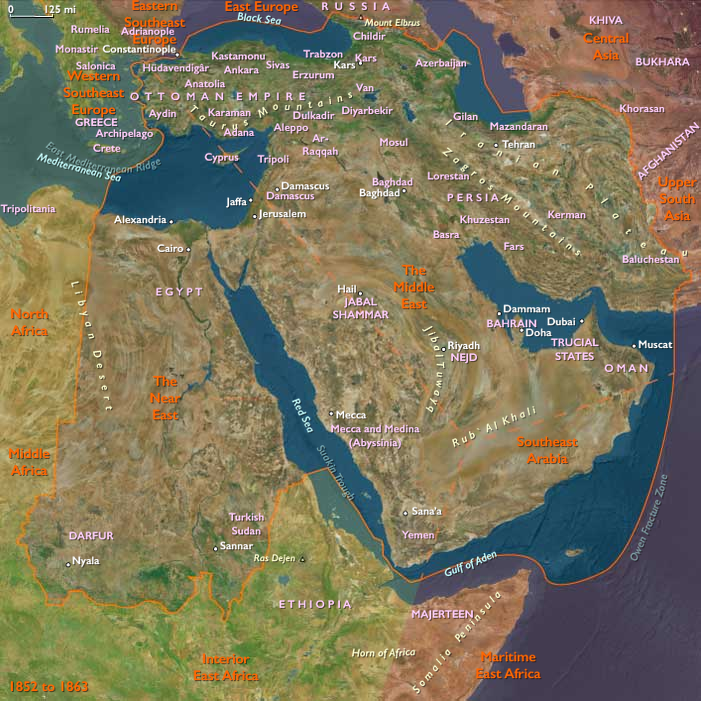
The Near and Middle East
View →Subregions