Tigranes of Armenia reoccupies Cappadocia in 78 …
Years: 77BCE - 77BCE
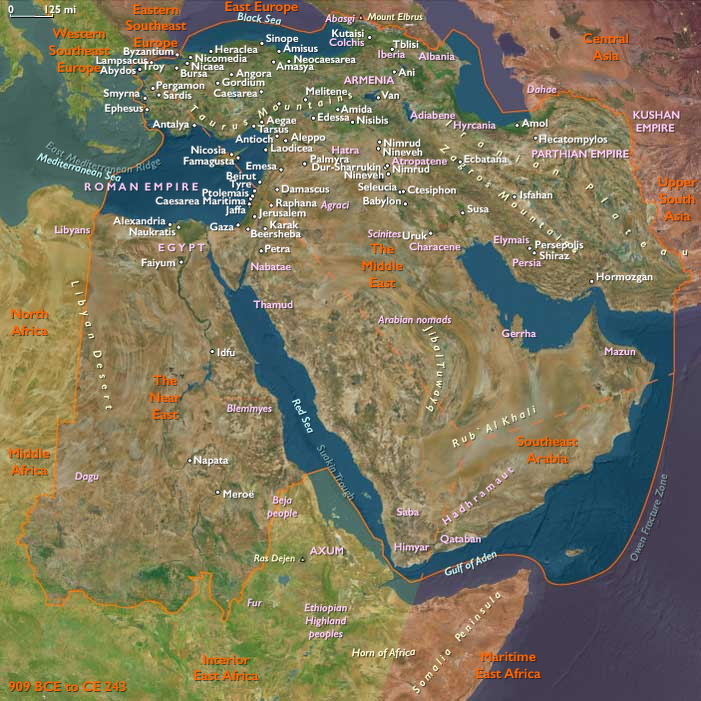
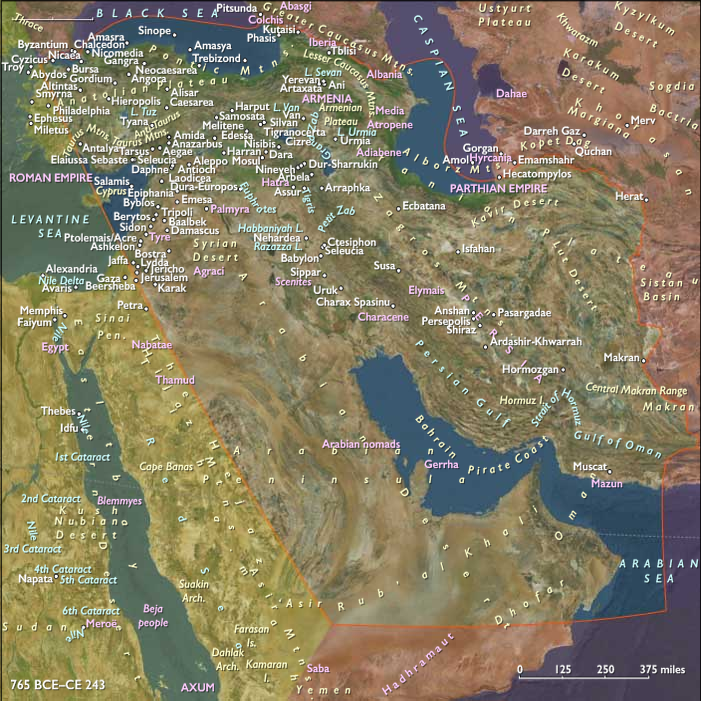
Tigranes of Armenia reoccupies Cappadocia in 78 BCE-77 BCE.
Locations
People
Groups
Topics
Subjects
Regions
Subregions
Related Events
Filter results
Showing 10 events out of 62715 total
Lepidus’ fellow rebel, Marcus Junius Brutus the Elder, the father of Caesar's famous murderer of the same name, and the founder of the colony in Capua, remains at Mutina, in Gaul.
Pompey marches to destroy him, but Brutus, for reasons unknown, surrenders before a battle has to be fought, putting himself and his troops in the power of Pompey, on the understanding that their lives should be spared.
Brutus is soon killed by one of Pompey's men, named Geminius.
Pompey, who had ordered Brutus’ death, forwards to Rome the news of his surrender and execution.
The senate blames Pompey for the perfidious act.
The terms of the oath Lepidus had sworn to be one of the two consuls for 78 did not prevent him from returning the next year with an army, so he had agreed to it.
Before he left, he had offered those Sulla had sent into exile a chance to return, a move which had alarmed the Senate, who correctly judged that he was attempting to gather his allies around him to start a civil war.
Lepidus is recalled from his province, but brings his army with him back to Rome, where he is defeated by Catulus in a pitched battle on the Campus Martius.
Forced into exile in Sardinia, he dies soon afterwards.
Sertorius is joined in 77 BCE—at the insistence of the forces that he had brought with him—by Marcus Perpenna Vento from Rome, with a following of Roman nobles and a sizable Roman army (fifty-three cohorts).
Perpenna belonged to the populares faction, led by Gaius Marius and Lucius Cornelius Cinna.
After Lucius Cornelius Sulla defeated the populares faction in Italy and became Dictator of Rome, Perpenna had fled with a substantial sum of money and an army to Hispania, where he is determined to wage war against Quintus Caecilius Metellus Pius on his own, despite the fact that Sertorius is already present in the province and is more or less ruling it.
Also this year, Pompey, who had intrigued for and won the assignment to join Metellus Pius against Quintus Sertorius' rebellion in Hispania, arrives to help finish off Sertorius.
Perpenna's soldiers are dissatisfied with his leadership, and when they learn that Pompey is crossing the Pyrenees, they demand that Perpenna take them to Sertorius, or they will abandon him to Pompey's mercies while they take themselves to Sertorius.
Perpenna yields to the demands of the legions, and hands them over to Sertorius.
This is not done with good will, and Perpenna, conscious of his noble bloodline and wealth, views the entire affair as a humiliation.

Alexander Jannaeus, on his deathbed, calls in 76 BCE for a reconciliation between the Sadducees, who he has always supported, and the rival Pharisees.
His son Hyrcanus II is appointed high priest; Alexander's widow, Salome Alexandra, reverses anti-Pharisaic policy and is guided by powerful religious advisers, members of the Pharisaic movement.
Egypt's independence during the last century of Ptolemaic rule has been exercised under Rome's protection and at Rome's discretion.
Rome for much of the period has been content to support a dynasty that has had no overseas possession except Cyprus after 96 BCE (the year in which Cyrene had been bequeathed to Rome by Ptolemy Apion) and no ambitions threatening Roman interests or security.
Ptolemy XII, whose quasi-legitimate and perhaps questionable royal status compels him to depend heavily upon Rome for support for his throne, is in 76 crowned in Alexandria according to Egyptian rites.
Sertorius, contemptuously calling Pompey Sulla's pupil, proves himself more than a match for his adversaries: he razes Lauron, a city allied to Rome, after a battle in which Pompey's forces are ambushed and defeated; he nearly captures Pompey at the battle of Sucro when Pompey decides to fight Sertorius without waiting for Metellus Pius; but is indecisively beaten at Saguntum.
However, Pompey writes to Rome for reinforcements, without which, he says, he and Metellus Pius will be driven out of Hispania.
C. Scribonius Curio, tribune of the plebs in 90 BCE, had later served under Lucius Cornelius Sulla in Greece as a legate in Asia during the campaign to restore the abandoned kingdoms of Mithridates.
He had laid siege to the tyrant Artistion, who had taken position on the Acropolis, during the attack on Athens.
Elected consul in 76 BCE with Gnaeus Octavius, he has come to Macedonia in 75 as Roman proconsul.
He successfully fights the Dardani, the Scordisci, and the Moesi, for which he wins a military triumph.
He is the first Roman general to penetrate to the Danube.
Mithridates II of Parthia, though beset by insurrections and border wars, had continued to control Iran and northern Mesopotamia until his death in 88, after which rival dynastic claimants began fighting for major territories.
The confusion ends in about 76/75 BCE, when the octogenarian king Sanatruces (perhaps a son of Mithridates I) is set on the Parthian throne by the central Asian tribe of the Sacaraucae Scythians, or Saka.
Pompey gains the upper hand in Hispania from 75 BCE on, and he and Metellus begin to capture city after city.
Though he is still able to win significant victories, Sertorius is losing the war, and his authority over his men has declined.
Cicero, like Julius Caesar, had grown up in a time of civil unrest and war.
Sulla’s victory in the first of a series of civil wars has led to a new constitutional framework that undermines libertas (liberty), the fundamental value of the Roman Republic.
His reforms have nonetheless strengthened the position of the equestrian class, contributing to that class’s growing political power.
Cicero is both an Italian eques and a novus homo, but he is, more importantly, a Roman constitutionalist.
His social class and loyalty to the Republic ensure that he will "command the support and confidence of the people as well as the Italian middle classes."
The fact that the optimates faction never truly accepts Cicero will undermine his efforts to reform the Republic while preserving the constitution.
He is able nevertheless to successfully ascend the Roman cursus honorum, holding each magistracy at or near the youngest possible age, becoming, at age thirty-one, quaestor in 75; he spends the year in Sicily.