
The Licchavi political system closely resembles that …
Years: 676 - 819
The Licchavi political system closely resembles that of northern India.
At the top is the "great king" (maharaja), who in theory exercises absolute power but in reality interfered little in the social lives of his subjects.
Their behavior is regulated in accordance with dharma through their own village and caste councils.
The king is aided by royal officers led by a prime minister, who also serves as a military commander.
As the preserver of righteous moral order, the king has no set limit for his domain, whose borders are determined only by the power of his army and statecraft—an ideology that supports almost unceasing warfare throughout South Asia.
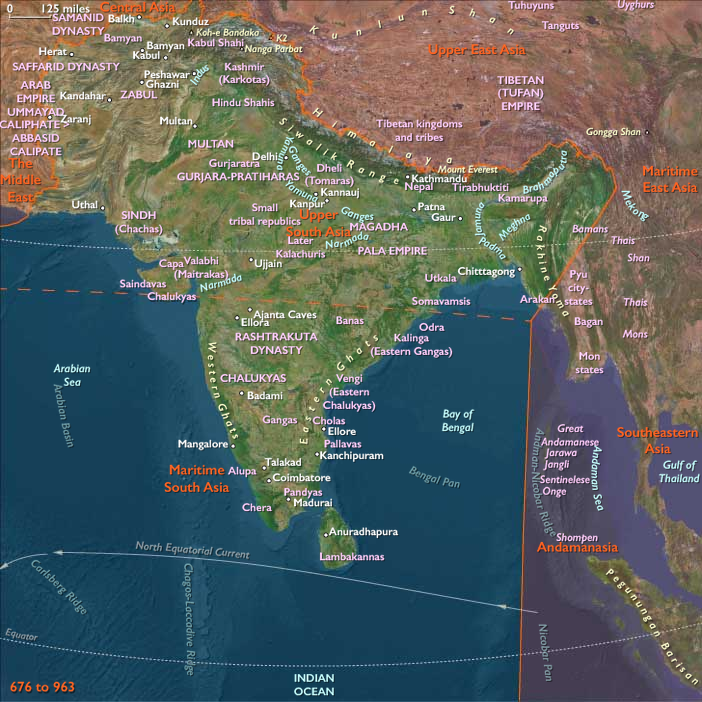
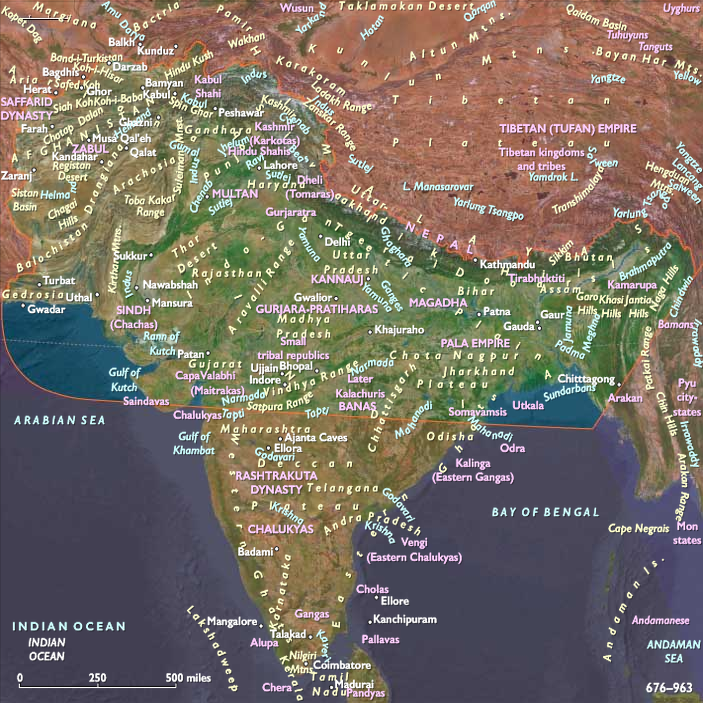
In Nepal's case, the geographic realities of the hills limits the Licchavi kingdom to the Kathmandu Valley and neighboring valleys and to the more symbolic submission of less hierarchical societies to the east and west.
Within the Licchavi system, there is ample room for powerful notables (samanta) to keep their own private armies, run their own landholdings, and influence the court.
There is thus a variety of forces struggling for power.
During the seventh century, a family known as the Abhira Guptas had accumulatedenough influence to take over the government.
The prime minister, Amsuvarman, had assumed the throne between approximately 605 and 641, after which the Licchavis regained power.
The later history of Nepal offers similar examples, but behind these struggles is growing a long tradition of kingship.
Locations
Groups
Topics
Subjects
Regions
Subregions
Related Events
Filter results
Showing 10 events out of 56205 total
We begin in the easternmost subregions and move westwardly around the globe, crossing the equator as many as six times to explore ever shorter time periods as we continue to circle the planet. The maps of the regions and subregions change to reflect the appropriate time period.
Narrow results by searching for a word or selecting from one or more of a dozen filters.
Punuk Culture (676–819 CE)
Large Villages, Whale Hunting, and the Maturation of the Thule Tradition
By the late 7th century CE, the Punuk culture emerged across the islands of the Bering Strait and the Chukchi Peninsula, representing a clear development out of earlier Old Bering Sea (OBS) and Okvik traditions. While these earlier phases were renowned for their artistry in ivory and compact, semi-subterranean settlements, the Punuk stage marked a decisive shift toward larger villages, intensified whale hunting, and new forms of social organization.
Archaeological evidence shows Punuk settlements clustering along the major Strait islands (St. Lawrence, Diomedes, Punuk group) and extending onto the Siberian and Alaskan coasts. Unlike the smaller OBS dwellings, Punuk houses were larger, square or rectangular subterranean structures, carefully engineered for insulation. Their walls and roofs were supported by massive whale jawbones, reinforced with driftwood, and covered with sod and skins. With only low entrances visible above ground, these houses retained warmth through long winters, reflecting architectural ingenuity in the unforgiving Arctic climate.
The artifact styles of the Punuk stage also distinguish it from earlier OBS forms. Harpoon heads and hunting implements became standardized in shape, reflecting a culture increasingly oriented toward whale hunting rather than smaller marine mammals. The artistry of ivory carving continued, but with a shift toward simpler, more functional motifs compared to the exuberant curvilinear designs of the OBS. This suggests that social emphasis was moving from symbolic display toward practical efficiency in large-scale hunts and cooperative subsistence.
Whale hunting became the hallmark of Punuk life. The remains of bowhead and gray whales in settlement middens attest to organized, communal hunts that required coordination, large boats, and substantial labor. This reliance on whales not only increased food security but also facilitated larger and denser settlements, as whale harvests could support bigger populations.
In cultural terms, the Punuk horizon signals the consolidation of the Thule trajectory in the Bering Strait. Communities were no longer small, mobile bands but village societies with durable architecture, cooperative whale hunts, and broader exchange networks stretching across the Strait. This stability allowed the Punuk tradition to flourish and paved the way for the full-fledged Thule migrations eastward into Arctic Canada and Greenland in the centuries to come.
Polynesia (676–819 CE): Chiefly Horizons, Sacred Genealogies, and the Oceanic Web
Geographic & Environmental Context
By the late 7th and early 9th centuries CE, Polynesia had fully matured as a cultural world—its islands scattered across a vast triangle stretching from Hawai‘i (North Polynesia) to Tonga and Samoa (West Polynesia) and to the far-flung eastern arc of Mangareva, Pitcairn, and Rapa Nui (East Polynesia).
The region comprised a spectrum of environments: high volcanic islands such as Tongatapu, Upolu, Tahiti, and Hawai‘i with fertile soils and perennial streams; mid-ocean atolls such as Tokelau, Tuvalu, and the Cooks dependent on rainwater and lagoon productivity; and the dry, isolated islands of the far southeast where ingenious field systems emerged. Despite their remoteness, these island worlds were joined by voyaging canoes, kinship alliances, and ritual exchanges that carried ideas, crops, and people across thousands of kilometers.
Climate & Environmental Shifts
The late Holocene climatic stability persisted across the Pacific. Trade winds blew reliably, seas were calm enough for open-ocean voyages, and ENSO variability remained modest. High islands enjoyed dependable rainfall that sustained breadfruit, banana, and taro agriculture, while atolls relied on coconuts, fish, and preserved breadfruit. Only in the eastern outliers did dryness and wind pose serious challenges—factors that spurred early Polynesian innovation in rock-mulch gardening and rain-fed irrigation.
Societies & Political Developments
West Polynesia: Hierarchies and Monumental Foundations
In Tonga, Samoa, and the Cook and Society Islands, population growth and inter-island competition gave rise to stratified chiefdoms. The Tu‘i Tonga dynasty began to consolidate authority, erecting massive earthen and stone mounds (langi) that anchored sacred kingship. Samoa maintained a federated chiefly system—matai councils of lineage heads balancing consensus and prestige. Across the region, authority blended divine ancestry with pragmatic leadership, expressed in ceremonies of kava drinking, tattooing, and oratory. Monumental platforms and marae sanctuaries symbolized unity between ancestors, land, and sea.
North Polynesia: Consolidation and Cultural Refinement
In Hawai‘i and the northern chain, societies became more territorial and structured, their valleys divided among chiefly lines (ali‘i). Irrigated taro terraces expanded in O‘ahu and Maui’s windward valleys; fishponds (loko i‘a) were engineered to capture tides and breed mullet. Ritualized chiefly exchanges—feasting, dancing, and tribute distribution—strengthened social cohesion. While navigation routes between Hawai‘i and the central Pacific likely thinned, local voyaging remained vigorous among the northern islands.
East Polynesia: Frontier Communities and Ancestral Memory
Far to the southeast, settlers in Mangareva, Pitcairn, and Rapa Nui lived in isolation, maintaining small but resilient societies. Chiefs presided over kin-based villages cultivating taro, yam, and sweet potato in terraces and rock gardens. Ahu shrines and standing stones emerged as ancestral foci—the embryonic stage of the moai tradition that would later define Rapa Nui. Canoes connected these islands intermittently, sustaining exchange in stone tools, shell ornaments, and genealogical lore. Here, voyaging became both a practical necessity and a sacred remembrance.
Economy & Exchange Networks
Across Polynesia, horticulture and arboriculture formed the economic base—taro, yam, breadfruit, banana, and coconut supplemented by pigs, chickens, and dogs introduced generations earlier.
-
West Polynesia exported shell valuables and basalt adzes through Tonga–Samoa–Fiji circuits.
-
North Polynesia relied on local specialization: irrigated taro inland, salt and fish from coasts.
-
East Polynesia used inter-island reciprocity to mitigate ecological limits.
Voyaging remained integral: double-hulled canoes carried goods, spouses, and genealogies; their movement stitched the region into a maritime commonwealth of mutual awareness, even as local identities deepened.
Technology & Material Culture
The lashed-lug canoe with mat sails epitomized Polynesian mastery of wood, fiber, and hydrodynamics. Stone adzes, coral files, and shell scrapers refined woodworking and house construction. Fine tapa cloth, dyed red, black, or yellow, became a medium of tribute and ceremony. Ornaments in whale ivory, shell, and bone displayed chiefly status. In the east, basalt and coral tools from Mangareva and Pitcairn circulated in small but steady exchange spheres.
Cultural & Symbolic Expressions
Polynesian cosmology centered on genealogy (whakapapa, gafa)—the sacred chain linking gods, chiefs, and commoners. Myths of Tangaloa, Tane, and Pele described creation through navigation and transformation.
Ritual life unfolded in marae and heiau—open-air temples marked by coral or basalt pavements where offerings and kava libations honored gods and ancestors. Song, dance, and tattooing codified memory, rank, and identity. Across the ocean, shared motifs—spiral designs, triangular tattoos, red sacred coloration—testify to a living network of cultural dialogue.
Environmental Adaptation & Resilience
-
Tonga and Samoa: irrigated taro and arboriculture balanced protein from lagoons.
-
Hawai‘i: fishpond systems, diversified valley agriculture, and ritual resource management sustained dense populations.
-
Rapa Nui: stone-mulch gardens and windbreaks stabilized soils.
-
Atolls: preserved breadfruit paste, coconut water, and dried fish underpinned food security.
Polynesians treated ecology as a sacred partnership—land (fenua, ʻāina) and sea (moana) were both kin and deity.
Movement & Interaction Corridors
West Polynesia remained the political and ritual center, radiating influence outward through marriage alliances, kava rites, and trade. Central Polynesian canoes ventured along the Tonga–Samoa–Cook–Tahiti axis, while smaller craft maintained contact across the Tuvalu–Tokelau–Pukapuka chain. The far east and north were increasingly autonomous, but oral traditions preserved the idea of a connected “sea of islands,” navigable through shared stars and genealogies.
Transition (After 819 CE)
By the early 9th century, Polynesia had reached a cultural equilibrium:
-
West Polynesia anchored a network of monumental chiefdoms under the rising Tu‘i Tonga.
-
North Polynesia fostered intricate irrigation, aquaculture, and lineage-based leadership.
-
East Polynesia, though remote, developed distinct ancestral monuments that anticipated later innovation.
This was an age of stability and synthesis—when Polynesian societies balanced expansion and rootedness, hierarchy and reciprocity, and the sacred ocean continued to bind their far-flung worlds into one cultural continuum.
North Polynesia (676–819 CE)
Early Polynesian Settlement and Development
Polynesian seafarers are renowned for their extraordinary ocean navigation and astronomical knowledge. At a time when Western vessels rarely ventured out of sight of land, Polynesians regularly undertook extensive voyages, covering vast distances across the Pacific Ocean.
The early settlement history of Hawaiʻi remains somewhat uncertain; however, substantial archaeological and paleoecological evidence supports human habitation of the Hawaiian archipelago by 800 CE, possibly dating back as early as 300–500 CE. Many researchers suggest that these initial Polynesian settlers originated from the Marquesas Islands.
Upon arrival, these early Polynesians brought with them essential clothing, plants, and livestock, quickly establishing settlements along coastal regions and within larger valleys. Their agricultural practices prominently featured crops like kalo (taro), maiʻa (banana), niu (coconut), and ulu (breadfruit). They also raised animals such as puaʻa (pigs), moa (chickens), and the ʻīlio (poi dog), although meats were consumed less frequently compared to vegetables, fruits, and seafood.
Staple condiments included paʻakai (salt), ground kukui nut, limu (seaweed), and ko (sugarcane), which served both culinary and medicinal purposes. Additionally, the settlers soon incorporated ʻuala (sweet potato) into their diet. This introduction of the sweet potato, native to South America, remains a mystery, leading some researchers to speculate on pre-Columbian transoceanic contacts between Polynesia and the Americas.
The early Polynesians constructed hale (homes) and sacred heiau (temples) as they settled into their new environment. Archaeologists currently suggest that the earliest communities were established at the southern end of the Hawaiian archipelago, particularly on the Big Island of Hawai'i, with settlements gradually extending northwards along coastal areas and easily accessible river valleys. As the population expanded, communities increasingly moved inland, adapting to diverse ecological niches and fostering complex societies that would flourish in the centuries to come.
West Polynesia (676–819 CE): Chiefly Consolidation, Monumental Beginnings, and Oceanic Networks
Geographic & Environmental Context
West Polynesia—comprising Tonga, Samoa, Tuvalu, Tokelau, the Cook Islands, Society Islands, and the Marquesas—formed the cultural and navigational heartland of Polynesia. High volcanic islands such as Tongatapu, Upolu, and Tahiti contrasted with coral atolls and reef islands that relied on lagoon and breadfruit ecologies. Reliable rainfall, fertile volcanic soils, and protected lagoons supported intensive arboriculture and horticulture.
Climate & Environmental Shifts
A mid-Holocene stability continued. Regular southeast trades and modest ENSO variability ensured dependable breadfruit and taro yields. Reef fisheries thrived, while volcanic slopes supported yam, banana, and taro gardens.
Subsistence & Settlement
Extended kin groups cultivated irrigated taro, maintained breadfruit groves, and herded pigs and chickens. Settlements clustered along coastal flats, with stone terraces, raised mounds, and canoe landings. Lagoon and offshore fishing remained central, employing outriggers, nets, and fish traps.
Technology & Material Culture
Polished adzes, basalt pounders, and shell ornaments show refinement in craft specialization. Canoe technology—double-hulled voyaging vessels with lashed-lug hulls and mat sails—reached peak sophistication, allowing routine inter-island travel. Fine tapa cloth and shell jewelry expressed rank distinctions.
Society & Political Structure
By the 700s, chiefly hierarchies (’eiki, ali‘i) coalesced around sacred genealogies linking leaders to gods and ancestors. Tonga emerged as the most stratified polity, with monumental mounds (langi) and raised tombs signaling the early Tu‘i Tonga dynasty’s rise. Samoa maintained a council-based chiefly system (matai), emphasizing ritual consensus rather than divine kingship. The Society and Cook Islands mirrored these dual traditions—strong hereditary titles balanced by lineage councils.
Movement & Interaction Corridors
Voyagers regularly crossed the Tonga–Samoa–Fiji triangle, distributing basalt tools, shell valuables, and marriage alliances. Long-distance expeditions to Tuvalu and Tokelau linked high islands to atolls through kin ties. Canoes moved food crops, pigs, and cultural motifs such as the Tongan kava rite and Samoan oratory conventions.
Cultural & Symbolic Expressions
Stone platform tombs, earthworks, and sacred enclosures (marae, malae) framed ritual life. Genealogical chants preserved chiefly descent; dances and oratory celebrated alliances and divine ancestry. The cosmos was envisioned as layered: the sea as a realm of spirits, the sky as ancestral heaven. Sacrificial rites, kava ceremonies, and tattooing reaffirmed sacred rank and community solidarity.
Environmental Adaptation & Resilience
Crop diversification (taro, yam, breadfruit, banana) and arboriculture buffered droughts. Coral-fishing management sustained lagoon ecosystems. The dual economy—coastal horticulture and offshore voyaging—ensured resilience across climatic shifts.
Transition
By 819 CE, West Polynesia had matured into a network of stratified chiefdoms—the Tongan state already centralizing power, Samoan and Society Island systems elaborating ceremonial leadership, and a shared Polynesian identity spreading outward through trade, kinship, and ritual exchange.
The Chinese Tang dynasty (618-907) institutes a series of administrative reforms culminating in 679 in the reorganization of Vietnamese territory as the Protectorate of Annam (or Pacified South), a name later used by the French to refer to central Vietnam.
The Tang dynastic period is a time of heavy Chinese influence, particularly in Giao Chau Province (in 203 the district of Giao Chi, had been elevated to provincial status and was renamed Giao Chau), which includes the densely populated Red River plain.
The children of ambitious, aristocratic families acquire a classical Confucian education, as increased emphasis is placed on the Chinese examination system for training local administrators.
As a result, literary terms dating from the Tang dynasty constitute the largest category of Chinese loan words in modern Vietnamese.
Despite the stress placed on Chinese literature and learning, Vietnamese, enriched with Chinese literary terms, remains the language of the people, while Chinese is used primarily as an administrative language by a small elite.
During the Tang era, Giao Chau Province also becomes the center of a popular style of Buddhism based on spirit cults, which will evolve as the dominant religion of Vietnam after the tenth century.
Buddhism, along with an expanding sea trade, links Vietnam more closely with South and Southeast Asia as Buddhist pilgrims travel to India, Sumatra, and Java aboard merchant vessels laden with silk, cotton, paper, ivory, pearls, and incense.
Two great Indonesian hegemonies dominate the period from about the mid-sixth to eleventh centuries.
The first is known as Srivijaya, a Buddhist trading kingship centered on the region of today's city of Palembang, on the Musi River in present-day Sumatera Selatan Province.
At its zenith in the ninth and tenth centuries, Srivijaya will extend its commercial sway from approximately the southern half of Sumatra and the Strait of Malacca to western Java and southern Kalimantan, and its influence as far away as locations on the Malay Peninsula, present-day southern Thailand, eastern Kalimantan, and southern Sulawesi.
It probably arose out of policies of war and alliance applied, perhaps rather suddenly, by one local entity to a number of trading partners and competitors.
The process is thought to have coincided with newly important direct sea trade with China in the sixth century, and by the second half of the seventh century Srivijaya has become a wealthy and culturally important Asian power.
The Chinese pilgrim Yijing (635-713), who briefly visits Srivijaya in 671 and 687, then lives there from 687 to 695, recommends it as a world-class center of Buddhist studies.
Inscriptions from the 680s, written in Pallava script and the indigenous Old Malay language (forerunner of contemporary Bahasa Indonesia), identify the realm and its ruler by name and demand the loyalty of allies by pronouncing elaborate threats and curses.
A northwesterly migration of Thais from their region of origin in northwestern Tonkin had brought to the Ta-li region (in what is present-day Yunnan, China) a successor state to the Ai Lao kingdom In the seventh century.
This new kingdom, Nanzhao, expands its power by controlling major trading routes, notably the southern Silk Road.
Culturally, this polyethnic, hierarchical, and militarized state is to have a great influence on later societies in Indochina, transmitting the Tantric Buddhism of Bengal to Laos, Thailand, the Shan state, and possibly Cambodia, as well as the political ideology of the maharaja (protector of Buddhism).
Nanzhao is organized administratively into ten prefectures called kien.
This term seems to be the origin of place-names keng (for example, Kengtung), chiang (for example, Chiang Mai), and xiang (for example, Xiangkhoang).
Moreover, the population and army of Nanzhao are organized in units of 100, 1,000, and 10,000, a form later found in Indochina.
Also, the title chao (prince) appears to have been of Nanzhao origin.
Another branch of this same migration begins at the headwaters of the Nam Ou and follows it downstream to Louangphrabang, continuing on through Xaignabouri to Chiang Mai.
Srivijaya's preeminence depends in part on exercising a degree of control over the burgeoning commerce moving through the Strait of Malacca.
This it accomplishes by mobilizing the policing capabilities of small communities of seafaring orang laut (Malay for sea people), providing facilities and protection in exchange for reasonable tax rates on maritime traders, and maintaining favorable relations with inland peoples who are the source of food and many of the trade goods on which commerce of the day is built, but Srivijaya also promotes itself as a commanding cultural center in which ideas from all over Buddhist Asia circulate and are redistributed as far as away Vietnam, Tibet, and Japan.
As a result of the expansion and contraction of mandala, places of importance are known by more than one name.
Muang Sua is the name of Louangphrabang following its conquest in 698 by a Thai prince, Khun Lo, who seizes his opportunity when Nanzhao is engaged elsewhere.
Khun Lo had been awarded the town by his father, Khun Borom, who is associated with the Lao legend of the creation of the world, which the Lao share with the Shan and other peoples of the region.
Khun Lo establishes a dynasty whose fifteen rulers will reign over an independent Muang Sua for the better part of a century.
Years: 676 - 819
Locations
Groups
Topics
Subjects
Regions
Subregions