
William Franklin, born in Philadelphia, Pennsylvania, at…
November 1766 CE
His mother's identity is unknown.
Confusion exists about William's birth and parentage because Benjamin is secretive about his son's origins.
In 1750, Ben had told his own mother that William was nineteen years old, but this may have been an attempt to make the youth appear legitimate.
William had been raised by Benjamin Franklin and Deborah Read, his common-law wife; William always called her his mother.
There is some speculation that Deborah Read was William's mother, and that because of his parents' common-law relationship, the circumstances of his birth were obscured so as not to be politically harmful to him or to their marital arrangement.
William had joined a company of Pennsylvania provincial troops in 1746 and fought in Albany in King George's War, obtaining the rank of captain in 1747.
As he grew older, he accompanied his father on several missions, including trips to England. Although often depicted as a young child when he assisted his father in the famed kite experiment of 1752, William was twenty-one years old at the time.
As a young man, William became engaged to Elizabeth Graeme, daughter of prominent Philadelphia physician Dr. Thomas Graeme and granddaughter of Pennsylvania's 14th Governor, Sir William Keith.
Neither family approved of the match, but when William went to London to study law about 1759, he left with the understanding that Elizabeth would wait for him.
While in London, Franklin sired an illegitimate son, William Temple Franklin, who was born on February 22, 1762.
His mother will never be identified, and he is placed in foster care.
Later that year, Franklin had married Elizabeth Downes on September 4, 1762 at St George's, Hanover Square in London.
She was born in the English colony of Barbados to the sugar planter John Downes and his wife Elizabeth (née Parsons).
She had met Franklin while visiting England with her father in 1760.
William Franklin had completed his law education in England, and was admitted to the bar.
William and Benjamin Franklin became partners and confidants, working together to pursue land grants in what was then called the Northwest (now Midwest).
Before they left England, the senior Franklin had lobbied hard to procure his son an appointment, especially working with the Prime Minister Lord Bute.
In 1763, William Franklin had been appointed as the Royal Governor of New Jersey, due to his father's influence with the British Prime Minister.
He replaces Josiah Hardy, a merchant and colonial administrator.
On November 10, 1766, he signs the charter for Queen's College, which will develop as Rutgers University in New Brunswick, New Jersey.
Groups
Subjects
Regions
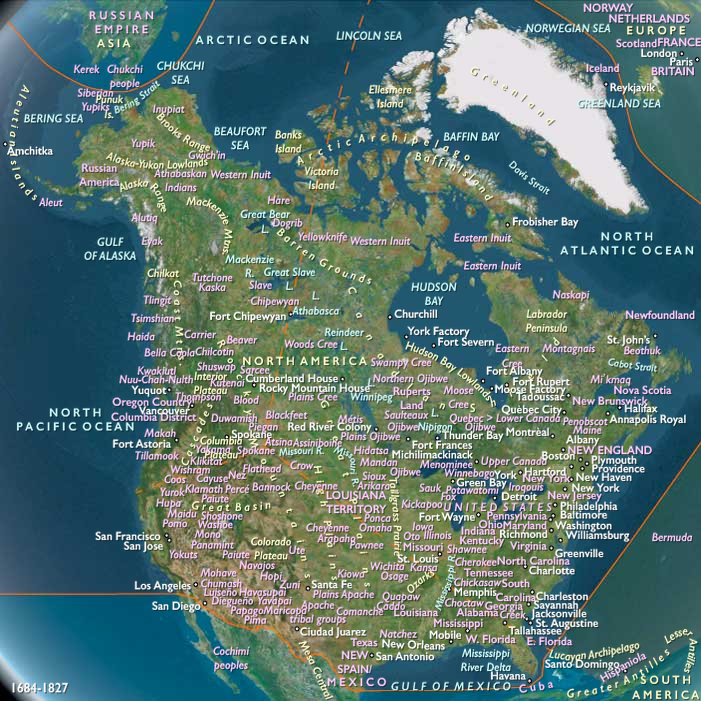
Northern North America
View →Subregions
