
Germany gradually extends its control of Togoland …
Years: 1888 - 1899
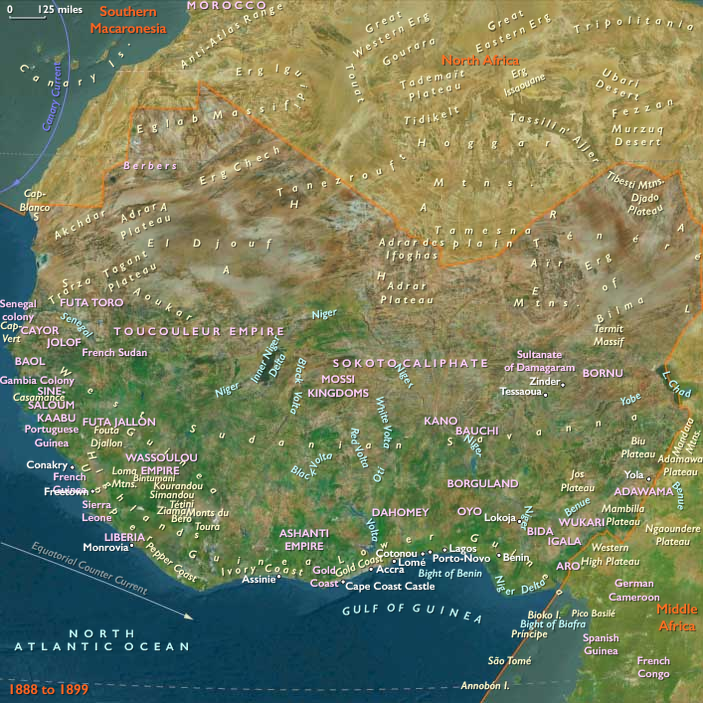
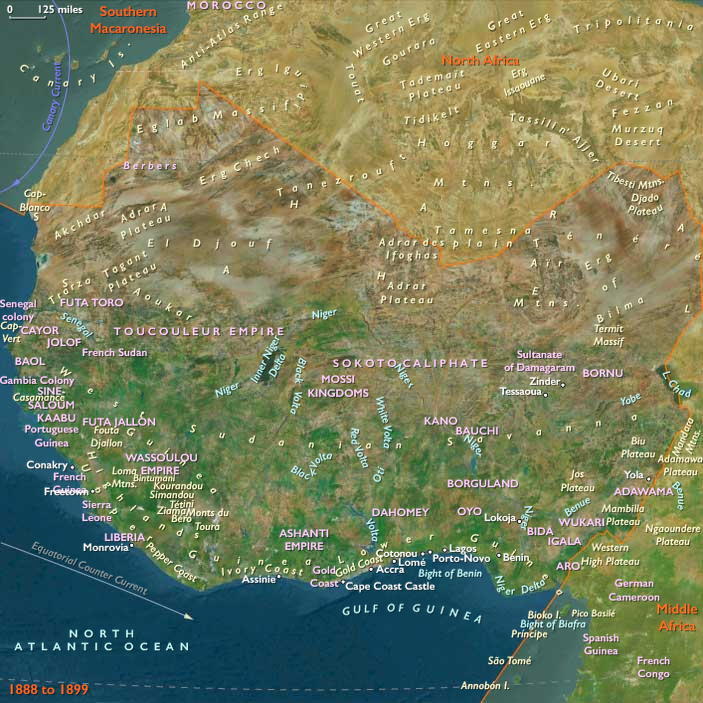
Germany gradually extends its control of Togoland inland.
The Polizeitruppe, organized in 1888 with twenty-five Hausa infantry, is used to enforce colonial authority over the hinterland of Togo.
Expanded to one hundree=d and forty-four members in 1894, it conducts operations against Kpandu, and "a number of towns in central Togo which had resisted the government were attacked and razed to the ground, the property of the inhabitants confiscated and the people fined sums ranging from 200 marks to 1,110 marks." (Amenumey, D. E. K. German Administration in Southern Togo. The Journal of African History 10, No. 4 (1969), pp. 623–639.)
Over the remainder of the decade, an additional thirty-five expeditions are authorized by the colonial government.
Colonial administrators and settlers bring scientific cultivation to the country's main export crops (cacao, coffee, cotton).
The total number of German officials in the colony is only twelve in 1890; by 1895 the capital Lomé has a population of thirty-one Germans and two thousand and eighty-four natives.
Germany and Great Britain trade territory in the Samoan Islands for the Northern Solomon Islands and control in Tonga in 1899, using the Togoland Neutral Zone (Yendi) and the Volta Triangle as bargaining chips.
The Polizeitruppe, organized in 1888 with twenty-five Hausa infantry, is used to enforce colonial authority over the hinterland of Togo.
Expanded to one hundree=d and forty-four members in 1894, it conducts operations against Kpandu, and "a number of towns in central Togo which had resisted the government were attacked and razed to the ground, the property of the inhabitants confiscated and the people fined sums ranging from 200 marks to 1,110 marks." (Amenumey, D. E. K. German Administration in Southern Togo. The Journal of African History 10, No. 4 (1969), pp. 623–639.)
Over the remainder of the decade, an additional thirty-five expeditions are authorized by the colonial government.
Colonial administrators and settlers bring scientific cultivation to the country's main export crops (cacao, coffee, cotton).
The total number of German officials in the colony is only twelve in 1890; by 1895 the capital Lomé has a population of thirty-one Germans and two thousand and eighty-four natives.
Germany and Great Britain trade territory in the Samoan Islands for the Northern Solomon Islands and control in Tonga in 1899, using the Togoland Neutral Zone (Yendi) and the Volta Triangle as bargaining chips.
Locations
Groups
- Tonga, Kingdom of
- Britain (United Kingdom of Great Britain and Ireland)
- German Empire (“Second Reich”)
- Togoland (Protectorate of Germany)
- Solomon Islands (German protectorate)
Topics
Commodoties
Subjects
Regions
Subregions
Related Events
Showing 10 events out of 10660 total
Years: 1888 - 1899
Locations
Groups
- Tonga, Kingdom of
- Britain (United Kingdom of Great Britain and Ireland)
- German Empire (“Second Reich”)
- Togoland (Protectorate of Germany)
- Solomon Islands (German protectorate)
Topics
Commodoties
Subjects
Regions
Subregions