Tokugawa Iemitsu, born around 1604, is the…
December 1629 CE
Tokugawa Iemitsu, born around 1604, is the eldest son of Tokugawa Hidetada and grandson of the last great unifier of Japan, the first Tokugawa Shogun Tokugawa Ieyasu.
He had been the first member of the Tokugawa family born after Tokugawa Ieyasu became shogun.
He had come of age in 1617 and dropped his childhood name in favor of Tokugawa Iemitsu; he also was installed officially as the heir to the Tokugawa shogunate.
The only person to contest this position was his younger brother Tokugawa Tadanaga.
A fierce rivalry began to develop between the brothers.
From an early age, Iemitsu had practiced the shudo tradition (which does not imply a specific homosexual identity, but rather, homosexual behavior).
However, in 1620, he had had a falling out with his lover, Sakabe Gozaemon, a childhood friend and retainer, aged twenty one, and murdered him as they shared a bathtub.(Louis Crompton, Homosexuality p.439)
Iemitsu was nineteen in 1623 when Hidetada had abdicated the post of shogun in his favor.
Hidetada continues to rule as Ōgosho (retired Shogun), but Iemitsu has nevertheless assumed a role as formal head of the bakufu bureaucracy.
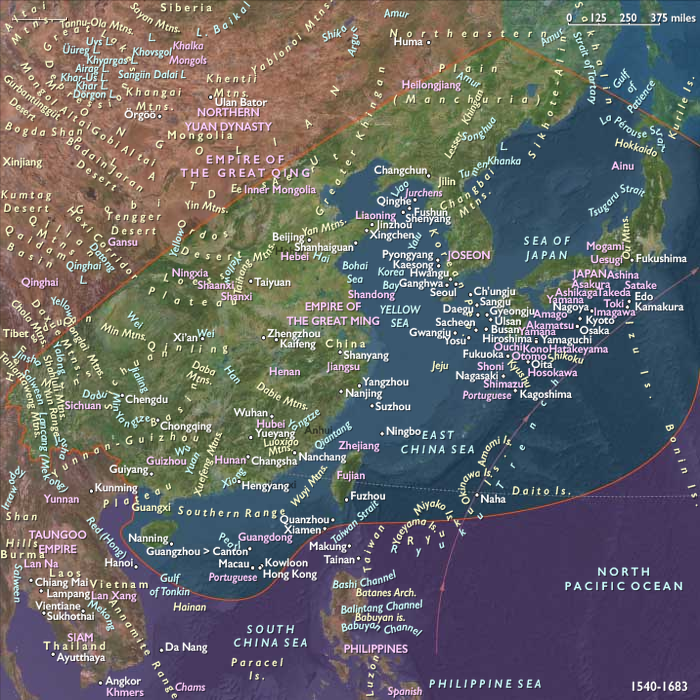
IShogun Iemitsu and retired Shogun Hidetada had in 1626 visited Emperor Go-Mizunoo, Empress Masako (Hidetada's daughter and Iemitsu's sister), and Imperial Princess Meisho in Kyoto.
Shogun Iemitsu had made lavish grants of gold and money to the court nobles and the court itself, yet relations with Go-Mizunoo had deteriorated after the Purple Clothes Incident, during which the Emperor was accused of having bestowed honorific purple garments to more than ten priests despite an edict which had banned them for two years (probably in order to break the bond between the Emperor and religious circles).
The shogunate had intervened, making the bestowing of the garments invalid.
When the wet nurse of Iemitsu and Masako breaks a taboo by visiting the imperial court as a commoner in December 1629, Go-Mizunoo, embarrassed, abdicates on the same day that the priests go into exile, and Meisho becomes empress.
The shogun is now the uncle of the sitting monarch.
Locations
Subjects
Regions
East Asia
View →Subregions