
Northern Australia (1828–1971 CE): Frontier Violence, Pastoral …
Years: 1828 - 1971
Northern Australia (1828–1971 CE): Frontier Violence, Pastoral Economies, and Strategic Outposts
Geography & Environmental Context
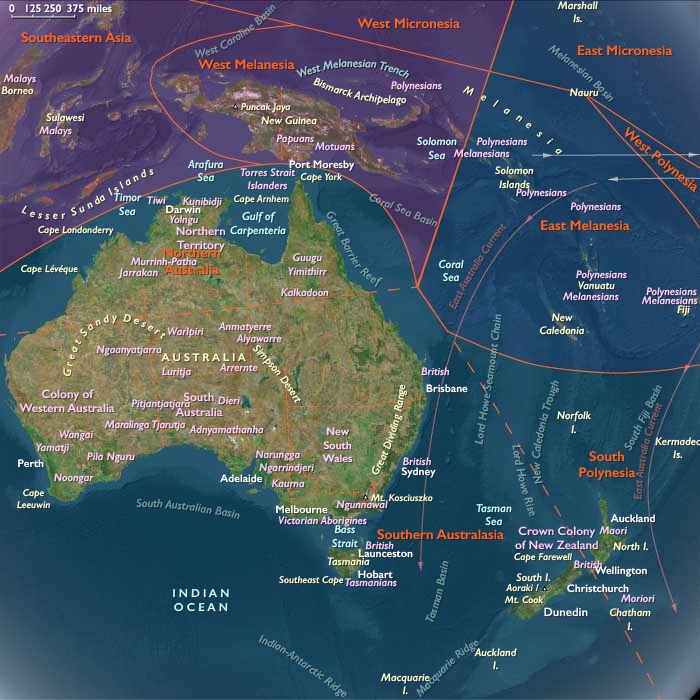
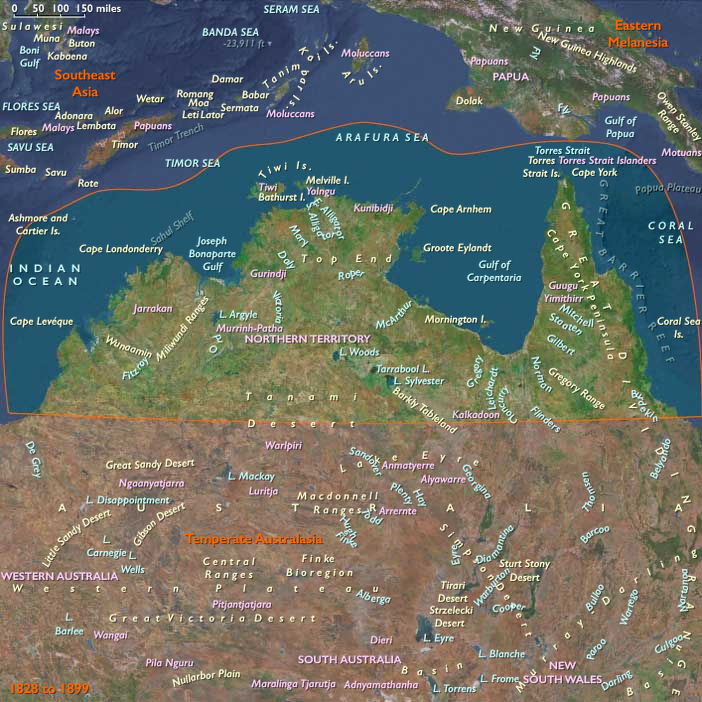
Northern Australia comprises the Northern Territory’s Top End, Queensland north of the Tropic of Capricorn, and the Kimberley and Pilbara regions of Western Australia. Anchors include the Darwin–Katherine river systems, the Gulf of Carpentaria, the Cape York Peninsula, the Kimberley Plateau, and the Great Barrier Reef. Its environment is shaped by the monsoonal cycle: torrential rains and flooding in the wet season, drought and bushfires in the dry, and cyclones along Queensland’s coasts.
Climate & Environmental Shifts
The 19th century brought severe droughts alternating with flood years. Cattle plagues (pleuropneumonia, tick fever) decimated herds until eradication campaigns in the 20th century. Cyclones repeatedly leveled towns along the Queensland coast. In the 20th century, dams and irrigation schemes (Burdekin, Ord River) sought to stabilize agriculture, while mining altered landscapes in the Pilbara and Cape York.
Subsistence & Settlement
-
Indigenous lifeways: Aboriginal groups maintained seasonal mobility—hunting, fishing, gathering tubers and fruits, and using fire to manage landscapes. Kinship and Dreaming traditions anchored land relationships.
-
Pastoral frontier: From the 1830s, sheep and cattle stations spread across the savannas. Indigenous people were displaced or forced into stock work, often for rations rather than wages.
-
Plantations & missions: Sugar plantations developed in Queensland, initially relying on indentured South Sea Islander labor (“Kanakas”), later replaced by wage workers. Christian missions concentrated Aboriginal communities, curtailing autonomy.
-
Urban centers: Darwin grew as an administrative and later military hub; Townsville, Cairns, and Rockhampton prospered as sugar and cattle ports; Broome flourished on the pearling industry. By the 1960s, Mount Isa and Weipa exemplified mining towns.
Technology & Material Culture
-
19th century: Cattle runs depended on windmills, bores, and horse mustering; cane harvests were cut by hand.
-
20th century: Trucks, mechanized cane cutters, and aircraft (Flying Doctor Service, 1928) transformed remote life. Refrigeration enabled beef and dairy exports. WWII introduced radar, airfields, and military engineering.
-
Everyday life: Bark shelters and stone fish traps in Indigenous communities; tin-roofed homesteads and cane-cutters’ barracks on the frontier; postwar spread of radios, kerosene fridges, and later televisions into towns.
Movement & Interaction Corridors
-
Maritime trade: Exports of cattle, sugar, pearls, and later minerals moved through Darwin, Townsville, Cairns, and Broome.
-
Labor flows: Aboriginal workers, indentured Pacific Islanders, Chinese in pearling and mining, and postwar European migrants shaped multicultural labor regimes.
-
Military corridors: During WWII, Darwin was bombed in 1942; the Top End became a staging ground for Allied forces. After 1945, Cold War defense ties deepened, with bases and surveillance posts established.
-
Overland expansion: Telegraph lines (1870s), rail links, and later highways connected the frontier to southern cities.
Cultural & Symbolic Expressions
-
Indigenous traditions: Rock art, corroborees, and Dreaming narratives endured, often hidden from missionary oversight.
-
Frontier folklore: Stories of drovers, crocodile hunters, and pearlers became staples of northern identity.
-
Religions: Missions enforced Christianity, but syncretic traditions persisted. Postwar towns mixed Anglican, Catholic, and migrant faiths.
-
Multiculturalism: Sugar towns incorporated Italian, Maltese, and Greek migrants; Darwin became one of Australia’s most ethnically diverse cities by mid-century.
Environmental Adaptation & Resilience
-
Indigenous strategies: Fire-stick farming, seasonal mobility, and aquatic resource management buffered climate extremes.
-
Pastoral adaptations: Windmills tapped aquifers, and boreholes expanded grazing ranges. Tick eradication and selective breeding improved cattle resilience.
-
Sugar industry: Mechanization and irrigation stabilized yields but at ecological cost.
-
Cyclone response: Communities rebuilt repeatedly with stronger housing and disaster protocols.
Political & Military Shocks
-
Colonial violence: Frontier wars and massacres (notably Coniston, 1928) devastated Aboriginal communities.
-
Federation (1901): Integrated Queensland and the Northern Territory into the Commonwealth.
-
WWII: Darwin’s bombing and the defense of northern approaches tied the region permanently to national security.
-
Postwar development: Schemes like the Ord River Project (1950s–60s) symbolized visions of “making the north productive.” Mining booms in Pilbara iron ore, Mount Isa copper, and Cape York bauxite reshaped economies.
-
Civil rights: Indigenous workers challenged discriminatory labor regimes; the 1966 Wave Hill Walk-Off by Gurindji stockmen marked a landmark in the Aboriginal land-rights movement. The 1967 referendum extended full citizenship recognition to Aboriginal Australians.
Transition
Between 1828 and 1971, Northern Australia was transformed from an Indigenous heartland and contested frontier into a pastoral, plantation, and mining zone central to national defense. Indigenous dispossession was violent and enduring, yet Aboriginal resilience persisted in cultural traditions and political activism. The WWII bombing of Darwin and postwar Cold War installations highlighted the north’s strategic value. By 1971, Northern Australia was a land of cattle stations, sugar fields, multicultural towns, and Aboriginal land-rights campaigns—an unfinished frontier of both opportunity and injustice, poised for further development and reform.
Groups
- Australians, Indigenous
- Bininj
- Yolngu
- Tiwi people
- Yanyuwa
- Garrwa people
- Wardaman peopl
- Jawoyn
- Torres Strait Islanders
Topics
Commodoties
Subjects
Regions
Subregions
Years: 1828 - 1971
Groups
- Australians, Indigenous
- Bininj
- Yolngu
- Tiwi people
- Yanyuwa
- Garrwa people
- Wardaman peopl
- Jawoyn
- Torres Strait Islanders
Topics
Commodoties
Subjects
Regions
Subregions