Event
Barbados converts to sugar within a generation…
Barbados converts to sugar within a generation (1640s) An English colony of smallholders growing tobacco and cotton, largely with indentured European labor, becomes within roughly two decades an island of large sugar estates worked by enslaved Africans. Dutch merchants displaced from Brazil supply the technique, the credit, and the initial access to slave markets. Land consolidates as the mill's capital requirement prices smallholders out; the free population falls as those smallholders leave for other islands and the mainland; the enslaved population rises past it.
The interest of the case is its speed and its completeness. Nothing was discovered here — the model was three transplants old — but Barbados is where it lands on a colony that already had a functioning settler economy and replaces it. What the sugar frontier does to a place with people already on it, as opposed to an empty island, is answered on Barbados first and repeated across the Antilles afterward.
-
{# Image navigates to the detail page; the magnifying-glass chip is the only Fancybox lightbox trigger (kept a separate sibling — anchors can't nest). #}
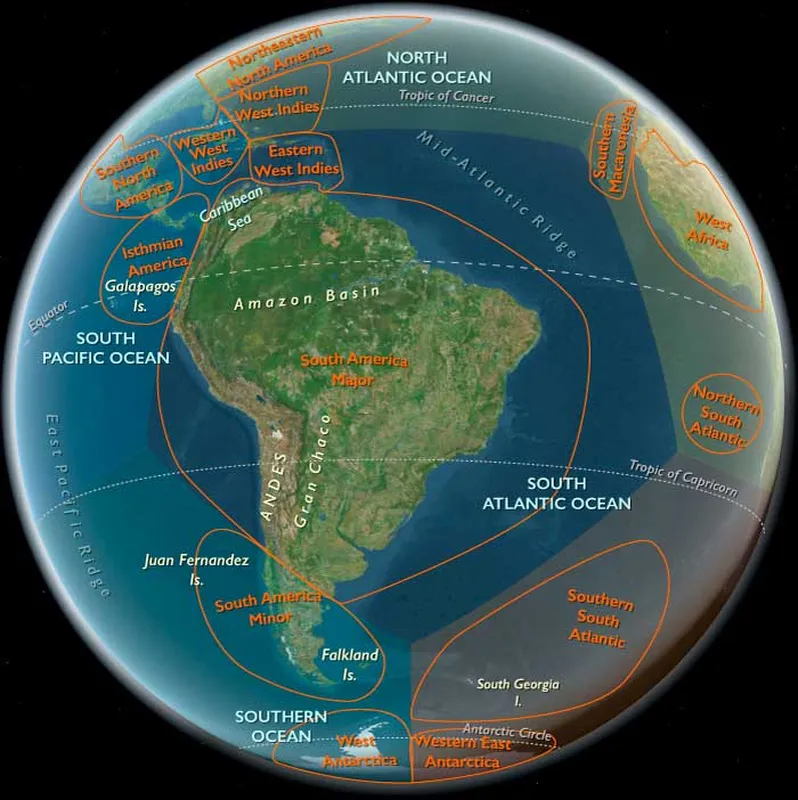 South America and The Eastern Isles
World
-
{# Image navigates to the detail page; the magnifying-glass chip is the only Fancybox lightbox trigger (kept a separate sibling — anchors can't nest). #}
 West Indies
Region
-
{# Image navigates to the detail page; the magnifying-glass chip is the only Fancybox lightbox trigger (kept a separate sibling — anchors can't nest). #}
 Eastern West Indies
Subregion