Turku, situated at the mouth of the …
Years: 1290 - 1290
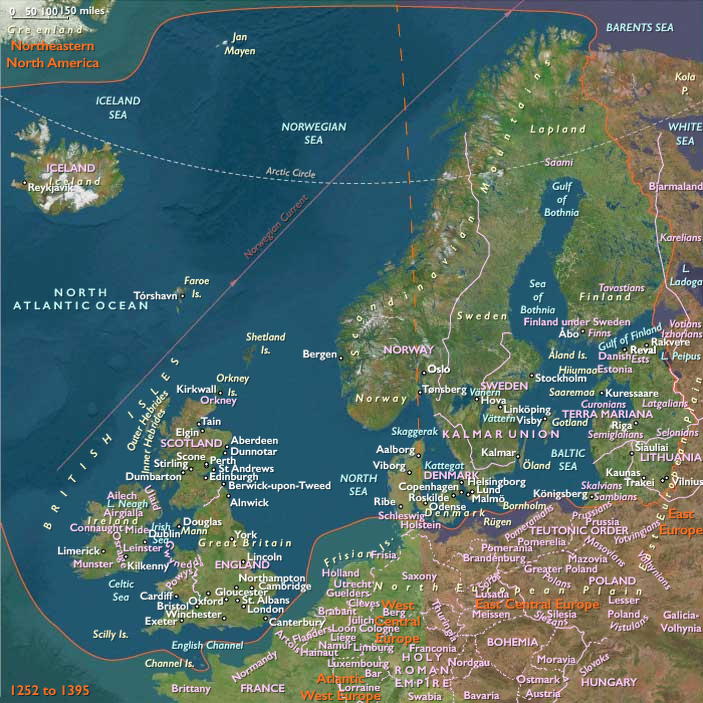
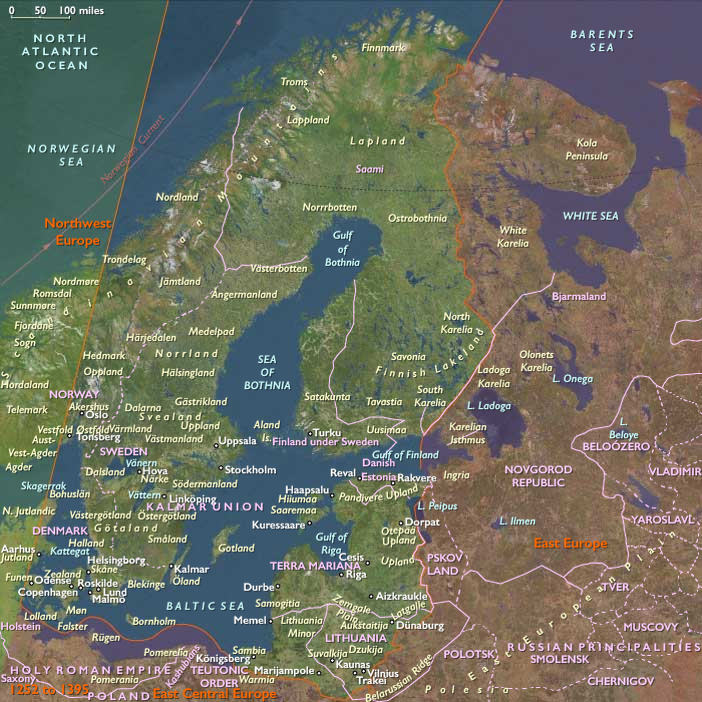
Turku, situated at the mouth of the Aurajoki River on the Gulf of Bothnia, about one hundred miles (one hundred and sixty kilometers) northwest of Helsinki, had begun as a trading center just north of its present location and moved south during the thirteenth century; it begins to grow around its castles and cathedral, on which construction begins in 1290.
The oldest city in Finland, it will quickly became the most important city in Finland, a status it will retain for hundreds of years.
Locations
Groups
Subjects
Regions
Subregions
Related Events
Filter results
Showing 10 events out of 45324 total
An earthquake with its epicenter in present Ningcheng County, Inner Mongolia, takes an estimated one hundred thousand lives.
The earthquake destroys four hundred and eighty storehouses and countless houses in Ningcheng.
Changping, Hejian, Renqiu, Xiongxian, Baoding, Baixiang, and ...
…Yixia are also affected.
It severely damages the Fengguo Temple in Yixian.
The first construction on the Akershus Fortress, built to protect Christanstad, started around the late 1290s, by King Haakon V, replacing Tønsberg as one of the two most important Norwegian castles of the period (the other being Båhus).
It is constructed in response to an earlier attack on the city by the Norwegian nobleman, Earl Alv Erlingsson of Sarpsborg.
Magnus III is succeeded upon his death by his ten-year-old son Birger as king of Sweden.
Although Sweden is an elective monarchy at this time, Birger had already been appointed heir to the throne in 1284.
King Andrew II of Hungary had granted the Burzenland region to the Teutonic Knights in 1211, with the purpose of ensuring security of the southeastern borders of his kingdom against the Cumans, whose ethnic origins are uncertain.
A nomadic tribe of tengrist Kipchaks, the Cumans are reported to have blond hair, fair skin and blue eyes (which sets them apart from other groups and will later puzzle historians), although their anthropological characteristics suggests that their geographical origin might be in Inner-Asia, South-Siberia, or as Istvan Vassary states, east of the large bend of the Yellow River in China.
The Teutonic Knights had campaigned against the Cumans, on behalf of King Andrew, during the years of 1221-1225.
However, the Teutonic Knights failed to defeat the Cumans and began to establish a country independent of the King of Hungary.
In 1238, after Mongol attacks on Cumania, King Béla IV of Hungary offered refuge to the remainder of the Cuman people under their leader Khan Kuthen (Hungarians spelled his name Kötöny/Köten).
Kuthen in turn vowed to convert his forty thousand families to Christianity.
King Béla had hoped to use the new subjects as auxiliary troops against the Mongols, who were already threatening Hungary.
A tense situation erupted when Mongol troops invaded Hungary.
The Hungarians, frustrated by their own helplessness, took revenge on the Cumans, whom they accused of being Mongol spies.
After a bloody fight, the Hungarians killed Kuthen and his bodyguards.
Another source states that during the Mongol invasion of Hungary, after Koten, his family and other Cuman nobles were arrested, Koten realized that he would be handed over to the Mongols so he killed himself and his wives.
This enraged the proud Cumans, who left for the Balkans, going on a rampage of destruction "equal to that which Europe had not experienced since the incursions of the Mongols."
With the departure of its only ally and most efficient military force, Hungary was now further weakened to attack.
After the invasion, King Béla IV, now penniless and humiliated after the confiscation of his treasury and loss of three of his border areas, had begged the powerful Cumans to return to Hungary and help rebuild the country.
In return for their military service, the Hungarian king invited the Cumans to settle in areas of the Great Plain between the Danube and the Theiss Rivers; this region had become almost uninhabited after the Mongol raids of 1241-1242.
The nomads have subsequently settled throughout the Great Hungarian Plain, creating two regions incorporating the name Cumania (Kunság in Hungarian), Greater Cumania (Nagykunság) and …

…Little Cumania (Kiskunság).
As the Cumans came into the kingdom the Hungarian nobility suspected that the king intended to use the Cumans to strengthen his royal power at their expense.
During the following centuries the Cumans in Hungary will be granted rights and privileges, the extent of which depends on the prevailing political situation.
Some of these rights will survive until the end of the nineteenth century, although be then the Cumans had long since assimilated with Hungarians.
The Cumans are different in every way to the local population of Hungary—their appearance, attire, and hairstyle set them apart.
Elizabeth the Cuman, the daughter of a Cuman chieftain Seyhan, had in 1270 become queen of Hungary, ruling during the minority of her son (future king Ladislaus IV of Hungary) in the years of 1272-1277.
A struggle took place between her and the noble opposition, which led to her imprisonment by the rebels; but supporters freed her in 1274.
During her reign, gifts of precious clothes, land, and other objects were given to the Cumans with the intent to ensure their continued support, and in particular during the civil war between King Béla IV of Hungary and Stephen V of Hungary, when both sides tried to gain Cuman support.
Bela during this conflict in 1264 sent Cuman troops commanded by the chieftain Menk to fight his son Stephen.
Elizabeth married King Stephen V of Hungary; they were parents of six children.
Their son, Ladislaus IV of Hungary, became the king of Hungary while her other son, Andrew of Hungary, became Duke of Slavonia.
Stephen V of Hungary had by 1262 taken the title of 'Dominus Cumanorum' and become the Cumans' highest judge.
After Stephen's enthronement, the Cumans came directly under the power of the king of Hungary and the title of 'Dominus Cumanorum' (judge of the Cumans) had passed to the count palatine, who was the highest official after the king.
The Cumans have their own representatives and are exempt from the jurisdiction of county officials.
Bohemia’s nineteen-year-old King Wenceslas II Premyslid, having overcome the dissident faction headed by Zavis, his mother’s lover and now husband, executes him in 1290 and begins ruling independently.
A new Western-style feudal socioeconomic system has emerged in Hungary but it has yet to take root.
During the last third of the thirteenth century, Hungarian assimilation into Europe is threatened by the ongoing conflicts between various baronial factions.
Moreover, Hungary is still the destination of migrating pagan tribes and the focus of barbarian attacks, and it continues to exhibit the features of a country on the borders of Christian feudal Europe.
The already shaky prestige of the royal house of Hungary had declined further under Ladislas IV the Cuman, who is assassinated in 1290 with no legitimate heir; claims to the throne are made through the female line of the Árpáds.
A male heir is found in Italy: a grandson of Andrew II of Hungary (reigned 1205-35), being the only son of that monarch’s youngest and posthumous son (possibly illegitimate) who was born of the old king's third marriage with Beatriz D'Este.
Although his claim to the throne is impugned, he succeeds Ladislas IV as Andrew III and is married hastily with a Polish princess, Fenenna of Kujavia.
Pope Nicholas IV, in league with Hungary’s ecclesiastical party, had set another prince, Andrew's cousin's grandson Charles Martel d'Anjou, as candidate for the throne; the eighteen-year-old Charles is the eldest son of King Charles II of Naples and Maria of Hungary, the daughter of King Stephen V of Hungary.
His partisans attempt, without success, to oust Andrew.
Wladyslaw Lokietek, or Wladyslaw the Elbow-high, born around 1260 as the third son of Kazimierz I Kujawski, Duke of Leczyca, Sieradz and Kuyavia, had in 1287 inherited Kuyavia upon the death of his father, while the remaining two duchies had gone to his brothers, Leszek Czarny (the Black) and Kazimierz II of Łęczyca.
However, following the deaths of both brothers, the entire inheritance had passed to Wladyslaw, who then set about the task of reuniting the five quarreling provinces of the Kingdom of Poland.
His next step is to win Lesser Poland—the 'senior palatinate', comprising the areas around Krakow, Leczyca, and Sieradz—for which he has had to contest the local prince, Przemysl II.
Following Przemysl's death in 1290, Wladyslaw proclaims himself his successor and establishes himself in Lesser Poland, as well as in Pomerania.
The name Wallachia, generally not used by Romanians themselves (but present in some contexts as Valahia or Vlahia), is derived from the word "walha" used by Germanic peoples to describe Celts, and later romanized Celts and all Romance-speaking people.
In northwest Europe this gave rise to Wales, Cornwall, Wallonia, among others, while in Southeast Europe it evolved into the ethnonym Valach, used to designate Germanic speakers' Romance-speaking neighbors, and subsequently taken over by Slavic-speakers to refer to Romanians.
The traditional Hungarian name for Wallachia is "Havasalföld", or literally "Snowy Lowlands" (the older form is "Havaselve", which means "Land beyond the snowy mountains", its translation to Latin - Transalpina - is used in the official royal documents of Kingdom of Hungary).
Vlach/Romanian settlers from Hungarian-ruled Transylvania have emigrated from the mountains into the plain north of the Danube.
Hungary organizes this new land of the Vlachs—Wallachia—into a province, appointing a ban (or voivode, as they are called locally) to govern.
According to Romanian tradition, Radu Negru-Voda, a leading Vlach nobleman, leaves Fagaras in southern Transylvania with a group of nobles in 1290 and …