Charles Babbage, a mathematician and Cambridge graduate,…
1824 CE
Charles Babbage, a mathematician and Cambridge graduate, had been elected a fellow of the Royal Society in 1816 at the age of twenty-four.
At this time, numerical tables are calculated by humans who are called 'computers', meaning "one who computes", much as a conductor is "one who conducts".
At Cambridge, Babbage had seen the high error-rate of this human-driven process and had started his life's work of trying to calculate the tables mechanically.
He had begun in 1822 with what he calls the difference engine, made to compute values of polynomial functions.
Unlike similar efforts of the time, Babbage's difference engine is created to calculate a series of values automatically.
By using the method of finite differences, it is possible to avoid the need for multiplication and division.
At the beginning of the 1820s, Babbage works on a prototype of his first difference engine, some parts of which still survive in the Museum of the History of Science in Oxford.
This prototype evolves into the "first difference engine." (It remains unfinished; the finished portion is located at the Science Museum in London.)
This first difference engine would have been composed of around twenty-five thousand parts, weigh fifteen tons (thirteen thousand six hundred kilograms), and would have been eight feel (two point four meters) tall.
Although Babbage receives ample funding for the project, it is never completed.
He later designs an improved version,"Difference Engine No. 2" (which will not be constructed until 1989–91, using his plans and nineteenth century manufacturing tolerances).
It performed its first calculation at the London Science Museum returning results to thirty-one digits, far more than the average modern pocket calculator.
Babbage wins the Gold Medal of the Royal Astronomical Society in 1824 "for his invention of an engine for calculating mathematical and astronomical tables".
People
Subjects
Regions
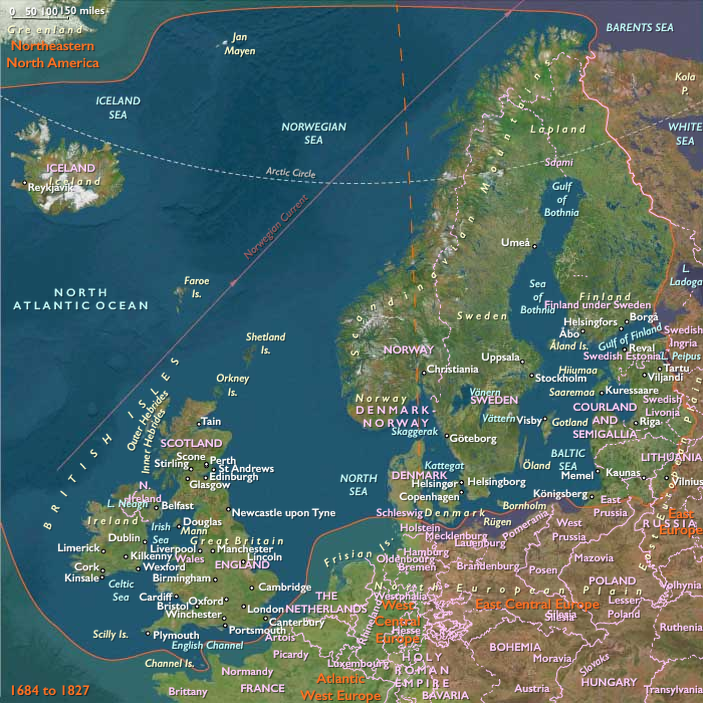
North Europe
View →Subregions