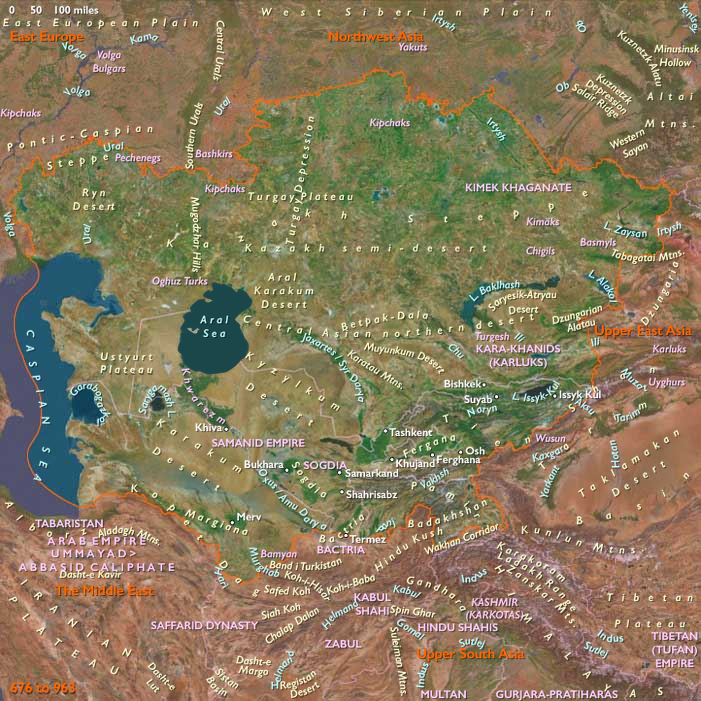
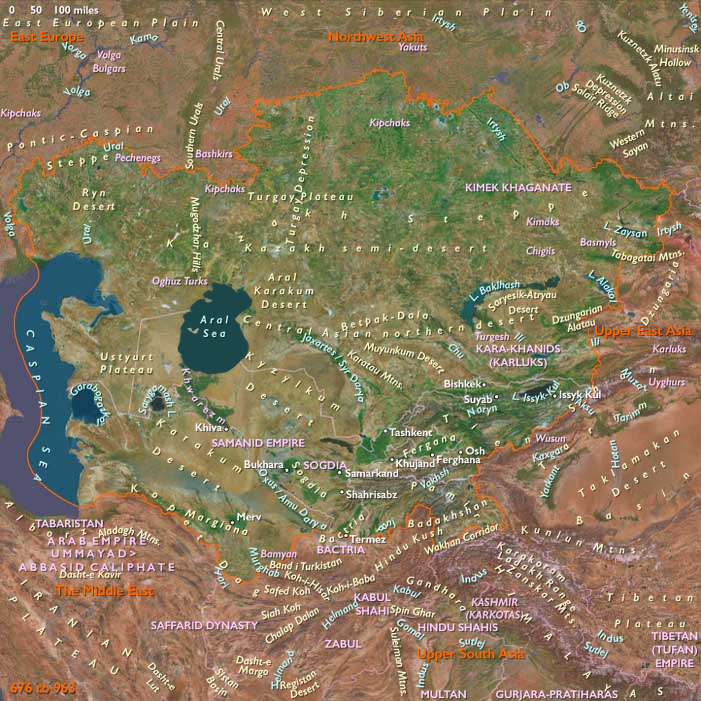
Islamic Arabs begin the conquest of the …
Years: 676 - 819
Conversion to Islam occurs by means of incentives, gradual acceptance, and force of arms.
Islam spreads most rapidly in cities and along the main river valleys.
It is the prevalent religion in the entire region by the ninth century.
Related Events
Filter results
Showing 10 events out of 11 total
Eastern Southeast Europe (1864–1875 CE): Cultural Revival, National Movements, and Pre-Independence Turmoil
Settlement and Migration Patterns
Hungarian and Serbian Territorial Realignments
Austria-Hungary returned Vojvodina, home to a significant Serbian population, to Hungarian control following the establishment of the Dual Monarchy in 1867. This administrative shift stirred ethnic tensions and political instability, as Hungarian authority once again attempted to assert dominance over non-Magyar populations.
Economic and Social Developments
Infrastructure and Economic Growth in the Danubian Principalities
In Romania, significant strides were made toward economic unification and modernization. The dismantling of customs barriers between Wallachia and Moldavia in the late 1840s set the stage for deeper integration. Economic progress continued under Prince Alexandru Ioan Cuza, who implemented essential infrastructure projects and agrarian reforms, though these measures were only partially successful due to entrenched boyar interests.
Cultural and Artistic Developments
Bulgarian National Revival
The Bulgarian cultural renaissance accelerated dramatically during this period. Dobri Chintulov and other literary figures produced influential works in modern Bulgarian, fueling national consciousness. Education expanded rapidly with the establishment of schools teaching in Bulgarian, notably in Gabrovo under Neofit Rilski, and the opening of schools for girls in cities like Pleven. The growth of Bulgarian-language publications and the formation of cultural institutions such as the chitalishte greatly contributed to the rise of a distinct national identity.
Serbian Literary and Cultural Awakening
Serbian national identity was similarly invigorated by scholars such as Vuk Karadžić and Dositej Obradović, who revitalized the Serbian language, folklore, and literature. Their work significantly strengthened Serbian cultural nationalism and intellectual life, creating a foundation for future national aspirations.
Intellectual and Religious Developments
Bulgarian Ecclesiastical Autonomy
The struggle for ecclesiastical independence reached a climax in 1870 when the Ottoman Sultan officially declared the Bulgarian Orthodox Church a separate exarchate, ending centuries of Greek Patriarchate dominance. This ecclesiastical autonomy became a critical milestone in Bulgaria's national consolidation, symbolizing the political and cultural separation from Greek and Ottoman influences.
Emergence of the Young Ottoman Movement
The Young Ottoman movement gained prominence among Western-oriented Ottoman intellectuals who sought reform through adopting European political models. Their advocacy for constitutional government and national integration significantly influenced Ottoman reform efforts and the broader political discourse within the empire.
Political Dynamics and Regional Rivalries
Revolts and Revolutionary Activities in Bulgaria
Bulgarian revolutionary activities intensified, spearheaded by figures such as Georgi Rakovski, Vasil Levski, and Liuben Karavelov. Their efforts culminated in the formation of the Bulgarian Revolutionary Central Committee (BRCC), which coordinated revolts against Ottoman rule, notably the September Uprising of 1875. Although these revolts were initially unsuccessful, they drew international attention to Bulgaria's plight and set the stage for greater involvement by external powers.
Romanian Political Developments
Political turbulence marked Prince Alexandru Ioan Cuza’s final years due to his increasingly unpopular reforms and perceived corruption, culminating in his forced abdication in 1866. His successor, the German-born Prince Carol I, instituted a constitutional monarchy, modernized the administration, and significantly advanced infrastructure projects, including railway construction.
International Rivalries and the Eastern Question
The weakening Ottoman Empire continued to be a central concern in European diplomacy, with Britain and France intervening to counterbalance Russian influence. This geopolitical maneuvering intensified as nationalist movements within Ottoman territories grew stronger, setting the stage for the significant territorial and political rearrangements soon to come.
Key Historical Events and Developments
-
Establishment of the Dual Monarchy (Austria-Hungary) in 1867, returning Vojvodina to Hungarian control.
-
Official recognition of the Bulgarian Orthodox Church as a separate entity in 1870.
-
Revolutionary efforts in Bulgaria, particularly the BRCC and the September Uprising of 1875.
-
Forced abdication of Prince Alexandru Ioan Cuza (1866) and subsequent ascension of Prince Carol I.
Long-Term Consequences and Historical Significance
This era laid critical foundations for Eastern Southeast Europe's subsequent political and national transformations. Cultural and religious movements bolstered national identities, while revolutionary activities against Ottoman rule highlighted the region’s growing instability, directly influencing the dramatic territorial and political shifts that occurred in the following decades.

The Bulgarian Secret Central Committee, founded by émigré Bulgarians in Bucharest in 1866, continues Rakovski's mission under the leadership of Vasil Levski and Liuben Karavelov
These ideologues refine Rakovski's idea of armed revolutionary groups, creating a cadre of intellectuals who will prepare the people to rise for independence.
Beginning in 1868, Levski founds the first revolutionary committees in Bulgaria.
Captured by the Turks, he becomes a national hero when he is hanged in 1873.
In 1870 Karavelov founds the Bulgarian Revolutionary Central Committee (BRCC) in Bucharest.
The death of Levski temporarily shatters the group, but the committee resumes its activities when Georgi Benkovski joins its leadership in 1875.
By this time, the political atmosphere of the Balkans is charged with revolution, and the Ottoman Empire looks increasingly vulnerable.
Britain, Russia, and Austria-Hungary were growing concerned about the implications of those trends for the European balance of power.
In 1875 Bosnia and Herzegovina revolt successfully against the Turks, and the next year Serbia and Montenegro will attack the Ottoman Empire.
The BRCC builds an intricate revolutionary organization in the early 1870s, recruiting thousands of ardent patriots for the liberation struggle.
Finally, in 1875 the committee believes that external distractions have weakened the Ottoman Empire enough to activate this struggle.
Local revolutionary committees in Bulgaria attempt to coordinate the timing and strategy of a general revolt.
Armed groups are to enter Bulgaria from abroad to support local uprisings, and diversionary attacks on Ottoman military installations ware planned.
Despite these efforts at coordination, the BRCC strategy fails.
Although planned as a general revolt, the September Uprising of 1875 occurs piecemeal in isolated locations, and several local revolutionary leaders fail to mobilize any forces.
The Turks easily suppress the uprising, but the harshness of their response attracts the attention of Western Europe; from this time, the fate of Bulgaria becomes an international issue.
Cuza’s foes unite to force his abdication.
On February 23, 1866, army officers loyal to the country’s leading boyars awaken Cuza and his mistress, force the prince to abdicate, and escort him from the capital.
The next morning, street placards in Bucharest announce the prince's departure and rule by a regency pending the election of a foreign prince.
With the tacit support of Napoleon III, Ion Bratianu, the leader of Romania's Liberals, nominates as the new prince the French emperor’s twenty-seven-year-old cousin, Prince Karl of southern Germany's Hohenzollern-Sigmaringen family.
Over objections from the other European powers, the Romanians elect by plebiscite the prince, who, disguised as a salesman, travels through Austria by second-class rail and steamboat to accept the throne.
Karl’s reign in Romania, as Prince Carol I, coincides with new achievements in nation building: a constitution, based in large part on Western models, is promulgated on July 1, 1866; it establishes a bicameral legislature, gives the prince power to veto legislation, proclaims equality before the law, and contains guarantees of freedom of religion, speech, and assembly.
Most of the constitution's civil-rights provisions, however, are not enforced, and it extends voting rights only to the landed aristocracy and clergy.
The document also limits naturalization to Christians, a measure aimed at denying civil rights to Jews living in or migrating to the principality.
The Romanian Orthodox Church becomes the official state religion.
Carol, a Roman Catholic, pledges to raise his successor in the Romanian Orthodox Church.
The Romanian Parliament votes in September 1866 for the construction of a nine hundred and fifteen kilometer railway, from Varciorova in the south to Roman in the north, via the important population centers of Pitesti, Bucharest, Buzua, Braila, Galati and Tecuci, and contracted to the German Strousberg consortium for the price of two hundred and seventy thousand golden francs per kilometer.
Émigré Bulgarians Lyuben Karavelov and Vasil Levski create a Bulgarian Secret Central Committee in Bucharest in 1866 to prepare for a national uprising.
These ideologues refine Georgi Sava Rakovski's idea of armed revolutionary groups, creating a cadre of intellectuals who will prepare the people to rise for independence.
The Bulgarian Secret Central Committee dispatches “apostles” into Bulgaria to spread the message among the people.
The Turks and the Russians begin to mediate in 1866, seeking a compromise that will ensure the security of each in the face of increasing regional unrest.
Rakovski, well educated and experienced in the 1841 uprising and the drive for ecclesiastical independence, envisions a federal republic including all Balkan nations except Greece.
His fighters are to stir a full-scale national uprising after crossing into Bulgaria from assembly points in Romania and Serbia.
However, the Serbs, who had supported the Bulgarians while they were useful in opposing the Turks, disband the Bulgarian legions in Serbia when they no longer serve this purpose.
Lyuben Karavelov founds the Bulgarian Revolutionary Central Committee (BRCC) in Bucharest in 1870.
Rakovski had died in 1867 without achieving Bulgarian independence, but he had united the émigré intelligentsia, and the presence of his army influences Turkish recognition of the Bulgarian church in 1870.
Because the cultivation of Bulgarian national consciousness is initially a cultural rather than a political movement, it is consequently directed more against the “cultural yoke” of the Greeks than the “political yoke” of the Ottoman Empire.
After the Turkish conquest of the Balkans, the Greek patriarch had become the representative of the Rum millet, or the “Roman nation,” which comprised all the subject Christian nationalities.
The desire to restore an independent Bulgarian church is a principal goal of the national “awakeners,” whose efforts are rewarded in 1870 when the Sublime Porte issues a decree establishing an autocephalous Bulgarian church, headed by an exarch, with jurisdiction over the fifteen dioceses of Bulgaria and Macedonia.
Although the Greek patriarch refuses to recognize this church and excommunicates its adherents, it will become a leading force in Bulgarian life, representing Bulgarian interests at the Sublime Porte and sponsoring the further expansion of Bulgarian churches and schools.
Following the failure of the September Uprising, Georgi Benkovski reorganizes the BRCC and makes plans for a new revolt.
The April Uprising of 1876 is more widespread, but it also suffers from poor coordination.
Poor security allows the Turks to locate and destroy many local groups before unified action is possible.
Massacres at Batak and other towns further outrage international opinion by showing the insincerity of recent Turkish reform proposals.
The deaths of an estimated thirty thousand Bulgarians in these massacres spur the Bulgarian national movement.
An international conference in Constantinople produces proposals to curb the Muslim fanaticism responsible for the Bulgarian massacres and give local self-government to the Christians on European territory in the empire.
Two autonomous Bulgarian regions were proposed, one centered at Sofia and the other at Turnovo.
When the sultan rejects the reforms, Russia declares war unilaterally in early 1877.
This is Russia's golden opportunity to gain control of Western trade routes to its southwest and finally destroy the empire that has blocked this ambition for centuries.
Britain, shocked by the Turkish massacres, does not oppose Russian advances.
Years: 676 - 819
Groups
- Tajik people
- Iranian peoples
- Arab people
- Sogdia
- Buddhism
- Islam
- Chinese Empire, Tang Dynasty
- Umayyad Caliphate (Damascus)
- Umayyad Caliphate (Harran)
- Abbasid Caliphate (Kufa)
- Abbasid Caliphate (Baghdad)