
Rebellious silk workers (French: canuts) seize Lyon,…
November 1831 CE
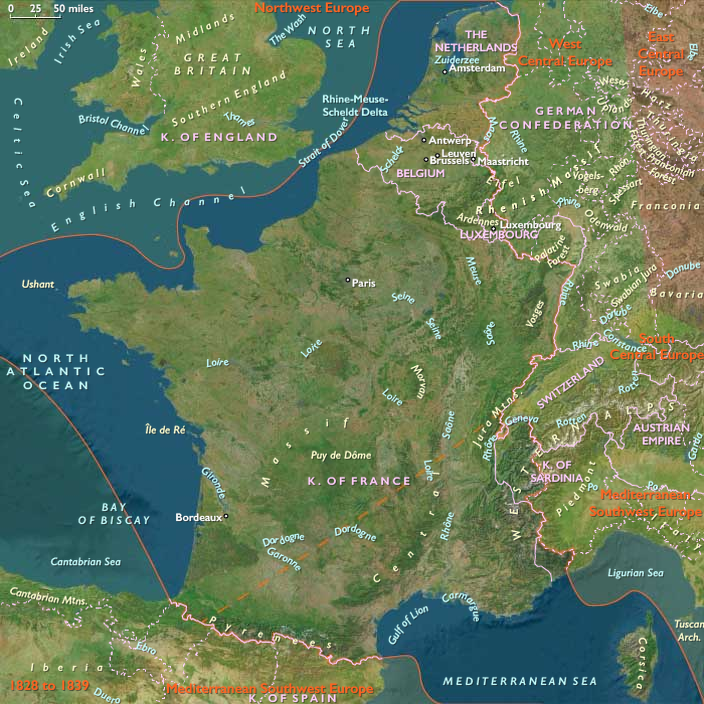
Rebellious silk workers (French: canuts) seize Lyon, France, on November 22 after a bloody battle with the military, causing six hundred casualties.
The grim condition of the economy in 1831 has drastically reduced the demand for silk goods.
Salaries are continually being reduced, much less than their maximum during the economically prosperous years of the First French Empire.
On October 18, the canuts had asked the prefect of the department of the Rhône, Louis Bouvier-Dumolart, to help them negotiate with the manufacturers.
The canuts wanted a fixed price to be established, which would stop the further decrease of the price of silk goods.
The prefect had organized a group of owners and workers, which was able to establish a fixed rate on October 26.
A labor court, the Conseil de prud'hommes, had been given the role of ensuring the rate was applied.
The intervention of the prefect was, however, poorly received by some manufacturers who considered his actions to be demagogic, and the concessions afforded by their representatives to be a sign of weakness.
One hundred and four of them have refused to apply the rate, claiming it is against the principles of the French Revolution.
Laws such as the Le Chapelier Law and the Allarde decree of 1791 had established the principle of economic non-intervention by the state, in addition to explicitly banning guilds (a predecessor to trade unions), and denying the right to strike.
The manufacturers claim the fixed rate is contrary to freedom of enterprise.
On November 10, they had rejected the salary claims of the canuts, which they considered to be exorbitant.
This attitude infuriates much of the working class.
On November 21, 1831, several hundred weavers had toured the then independent commune of Croix-Rousse.
They forced the few weavers still at work to close their workshops, harassing the National Guard.
Soon after they erected barricades and marched to Lyon.
On November 22 in Lyon, the workers capture the fortified police barracks at Bon-Pasteur, pillaging the arsenal and stealing weapons in the process.
Several units of the military guard and the national guard are attacked.
The infantry attempts to stop them, but is forced to retreat under a hail of tiles and bullets.
The national guard, most of which has been recruited from among the canuts, changes sides, joining the insurgents.
After a bloody battle that causes about six hundred casualties (one hundred dead, two hundred and sixty-three injured on the military side, sixty-nine dead, one hundred and forty injured on the civilian side), the insurgents capture the town.
Locations
Topics
Commodities
Regions
West Europe
View →Subregions
