
Another earthquake strikes Antioch in 528, two …
Years: 528 - 528
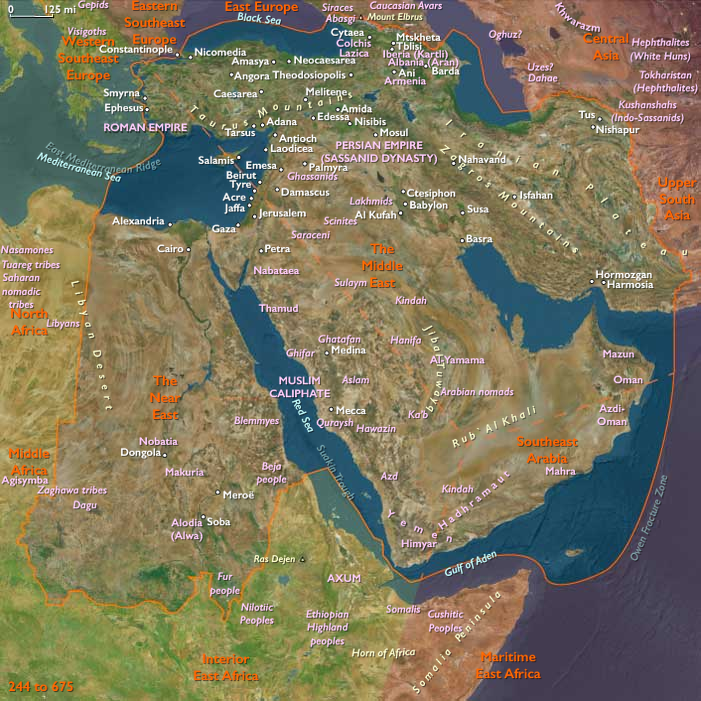
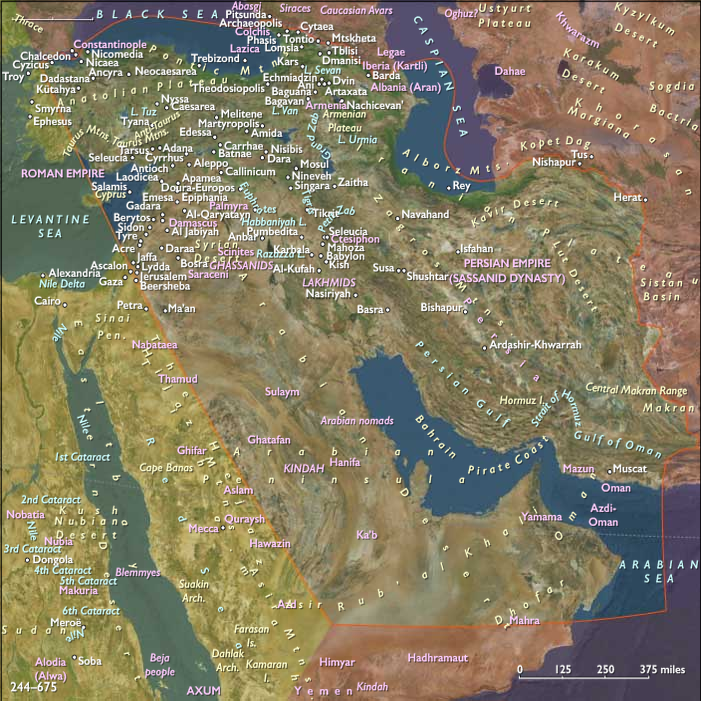
Another earthquake strikes Antioch in 528, two years after the disastrous earthquake of 526, killing thousands, and causing a fire that destroys the Great Church built by Constantine I.
Locations
Groups
- East, Diocese of the
- East, or Oriens, Praetorian prefecture of
- Syria Prima (Roman province)
- Christianity, Chalcedonian
- Roman Empire, Eastern: Justinian dynasty
Subjects
Regions
Subregions
Related Events
Filter results
Showing 10 events out of 58116 total
The spread of Buddhism dramatically influences Chinese architecture.
By the sixth century, Buddhism has spread with tremendous momentum throughout China: Chinese culture is adjusting and adapting its traditions to include Buddhism worship.
The Chinese transform the rounded earthen mound of the South Asian stupa into the towering pagoda to house the sacred buried relics of Buddha at its core.
The Songyue Pagoda, constructed in 523 during the Northern Wei Dynasty at the Songyue Monastery on Mount Song, in Henan province, is one of the few intact sixth-century pagodas in China and is also the earliest known Chinese brick pagoda.
Most structures from that period were made of wood and have not survived.
Unique in form, being twelve-sided, the tower is 40 m (131 ft) high and built of yellowish brick held together with clay mortar.
The pagoda has had a changing shape over time from its Indian Buddhist origins to its form in China.
The unique many-sided shape of the Songyue Pagoda suggests that it represents an early attempt to merge the Chinese architecture of straight edges with the circular style of Buddhism from the Indian subcontinent.
The perimeter of the pagoda decreases as it rises, as this is seen in Indian and Central Asian Buddhist cave temple pillars and the later round pagodas in China.
Emperor Xiaoming, by now a teenager, is said to spend much of his time drinking.
He is also said to favor his concubine Consort Pan greatly, to the exclusion of his wife Empress Hu (his cousin) and the other concubines.
In 528, Consort Pan bears him a daughter.
However, Empress Dowager Hu falsely declares that Consort Pan's child is a son, and orders a general pardon.
By this time, Emperor Xiaoming, aged eighteen, is tired of the hold that his mother has on his administration, and he further despises Zheng Yan and Xu Ge.
He therefore sends secret messengers to the general Erzhu Rong, who controls the region around Bing Province (modern central Shanxi), ordering him to advance on Luoyang to force Empress Dowager Hu to remove Zheng and Xu.
After Erzhu advances to Shangdang (in modern Changzhi, Shanxi), Emperor Xiaoming suddenly changes his mind and sends messengers to stop him, but the news leaks.
Zheng and Xu therefore advises Empress Dowager Hu to have Emperor Xiaoming poisoned.
She does so, and after initially announcing that Emperor Xiaoming's "son" by Consort Pan will succeed him, admits that the "son" is actually a daughter, and instead selects Yuan Zhao, the two-year-old son of Yuan Baohui the Prince of Lintao, to succeed Emperor Xiaoming.
Erzhu Rong refuses to recognize this arrangement, and soon arrives at and captures Luoyang, throwing Empress Dowager Hu and Yuan Zhao into the Yellow River to drown.
Baekje’s King Seong maintains diplomatic ties with Liang Dynasty China as well as Wa (Japan).
A sponsor of Buddhist temples, he welcomes priests bringing Buddhist texts directly from India.
In 528, Baekje officially adopts Buddhism as its state religion.
An Imperial general named Justin, mentioned in 528 as "stratelates of Moesia", probably holds the title of dux Moesiae Secundae and the rank of magister militum.
He joins forces with Baduarius, dux of Scythia Minor, in battle against a force of foreign invaders of Scythia and Moesia, who John Malalas identifies as "Huns", while Theophanes the Confessor identifies them as Bulgars.
Justin is killed in this battle and is succeeded in his post by Constantiolus.
The invaders next enter Thrace.
The Eastern Roman church’s liturgy had become firmly established with the coronation of Justinian.
A hymn writer himself, the new emperor perceives the need for trained singers to conduct the musical affairs of the church, especially because the varied Office hymns necessitate more time in the service than do the masses of the Western church.
Soon, the Eastern liturgy includes elaborate services rich in hymns.
The principal forms of hymns in Eastern Roman music, are the “troparion” established in the fourth century, a monostrophic prayer with responses interpolated between psalm verses; and the “kontakion,” a poetic form with numerous stanzas, whose initial letters form an acrostic.
Priscian, Latin grammarian, writes the Institutiones Grammaticae ("Grammatical Foundations").
In Constantinople, he codifies this manuscript in eighteen volumes that will be widely used through the Middle Ages, providing the raw material for the field of speculative grammar.
The details of Priscian's life are largely unknown.
Priscian was of Greek descent, and was born and raised in Caesarea (modern Cherchell, Algeria) the capital of the Roman province of Mauretania Caesariensis.
According to Cassiodorus, he taught Latin at Constantinople.
Priscian's minor works include a panegyric to Anastasius (491—518), written about 512, which helps establish his time period.
In addition, the manuscripts of his Institutiones grammaticae contain a subscription to the effect that the work was copied (526, 527) by Flavius Theodorus, a clerk in the imperial secretariat.
The Persians press on from Iberia to capture forts in eastern Lazica in 528.
Attempting to remedy the deficiencies revealed by these Persian successes, Justinian reorganizes the eastern armies by dividing the command of the magister militum of the East in two and appointing a separate magister militum of Armenia over the northern portion.
Procopius of Caesarea, Palestine-born and trained in law, serves Justinian’s general Belisarius as legal advisor from 527, accompanying him on his campaigns.
The most important Roman initiative on the southern front in 528 is Belisarius's expeditions to Thannuris, where he tries unsuccessfully to protect Roman workers, undertaking the construction of a fort right on the frontier.
The Sassanid crown prince, Khosrau, an orthodox Zoroastrian, collaborates with the chief mobed to contrive the condemnation of the Mazdakites.
In 528, Kavadh has them assemble as if for a meeting and then massacres them.
By this time, the Nestorian doctrine (claiming that divine and human persons remained separate in the incarnate Christ) has become dominant among the Christians in Iran and is definitely established as the accepted form of Christianity in the Sassanian Empire.
Al-Mundhir attacks Syria in 528 and returns with much booty, but…
…the Lakhmids’ position in their wars with the Ghassanids changes drastically in 528 when al-Mundhir III’s forces suffers a serious defeat to Ghassanid forces under the command of al-Harith ibn Jabalah.
Malwa had become part of the Gupta Empire during the reign of Chandragupta II (375–413), also known as Vikramaditya, who had conquered the region, driving out the Western Kshatrapas.
The Gupta period is widely regarded as a golden age in the history of Malwa, when Ujjain serves as the empire's western capital.
Kalidasa, Aryabhata and Varahamihira are all based in Ujjain, which has emerged as a major center of learning, especially in astronomy and mathematics.
Around 500, Malwa had reemerged from the dissolving Gupta Empire as a separate kingdom.
Years: 528 - 528
Locations
Groups
- East, Diocese of the
- East, or Oriens, Praetorian prefecture of
- Syria Prima (Roman province)
- Christianity, Chalcedonian
- Roman Empire, Eastern: Justinian dynasty
