
...undertakes the first European exploration of present …
Years: 1541 - 1541
...undertakes the first European exploration of present Kansas.
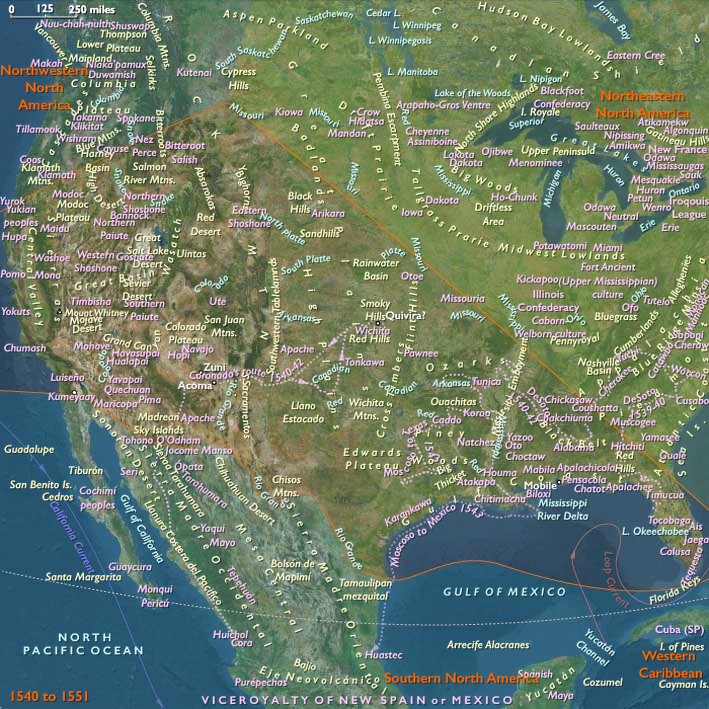
Coronado pushes on to the seminomadic village of Quivira, near the town of Lyons, Kansas, but finds little wealth here.
The people later known as the Wichita, who live southeast of the great bend of the Arkansas River in south central Kansas, are of Caddoan linguistic stock, and call themselves Kitikitish. (A century later, the French will call them “Pani Pique” ("Tattooed Pawnee") because they practice tattooing.
A semisedentary agricultural people, the Wichita raise maize, pumpkins, and tobacco, and live in villages composed of conical thatch-covered lodges.
Coronado is disappointed in his search for gold as the Quivirans appear to have been prosperous farmers and good hunters but have no gold or silver.
There are about twenty-five villages of up to two hundred houses each in Quivira.
Coronado says: "They were large people of very good build", and he was impressed with the land, which was "fat and black."
Though Coronado is impressed with Wichita society, he often treats the Wichita poorly in his expedition.
Even after Wichita migration, some settlements are thought to have remained in northern Quivira in 1680.
Coronado also noted: "They eat meat raw/jerky like the Querechos [the Apache] and Teyas. They are enemies of one another...These people of Quivira have the advantage over the others in their houses and in growing of maize".
The Quivirans apparently call their land Tancoa (which bears a resemblance to the later sub-tribe called Tawakoni) and a neighboring province on the Smoky Hill River is called Tabas (which bears a resemblance to the sub-tribe of Taovayas).
Settlements will exist here until the Wichita are driven away in the eighteenth century.
Locations
People
Groups
Topics
Commodoties
Subjects
Regions
Subregions
Years: 1541 - 1541
Locations
People
Groups
Topics
Commodoties
Subjects
Regions
Subregions