Urbain Grandier, serving as priest in the…
August 1633 CE
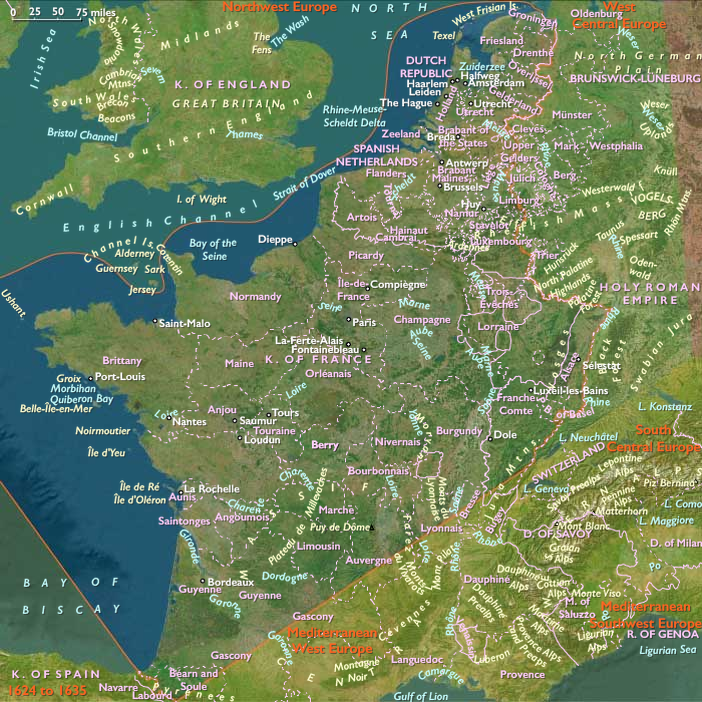
Urbain Grandier, serving as priest in the church of Sainte Croix in Loudun, in the Roman Catholic Diocese of Poitiers, had ignored his vow of priestly celibacy: he is known to have had sexual relationships with a number of women and to have acquired a reputation as a philanderer.
A group of nuns from the local Ursuline convent in 1632 had accused him of having bewitched them, sending the demon Asmodai, among others, to commit evil and impudent acts with them.
Grandier had been arrested, interrogated and tried by an ecclesiastical tribunal, which had acquitted him.
Grandier, however, has gained the enmity of the powerful Cardinal Richelieu after a public verbal attack against him, and has also written and published scathing criticisms of Richelieu.
Richelieu orders a new trial, conducted by his special envoy Jean de Laubardemont, a relative of the Mother Superior of the convent of Loudun.
Grandier is rearrested at Angers and the possibility of appealing to the Parlement of Paris is denied to him.
Interrogated for a second time, the nuns (including the Mother Superior) do not renew their accusations, but this does not affect the predetermined outcome of the trial.
The judges (the clerics Laubardemont, Lactance, Surin and Tranquille), after torturing the priest, introduce documents purportedly signed by Grandier and several demons as evidence that he had made a diabolical pact.
One of the pacts is written in Latin and appears to be signed by Grandier; another looks almost illegible (but is in fact written in Latin abbreviations, and backwards, nonetheless—and has been published and translated in a number of books about witchcraft), has many strange symbols, and is "signed" by several demons with their seals, as well as by Satan himself (a signature clearly reads Satanas).
It is unknown if Grandier wrote or signed the acts under duress, or if they were entirely forged.
Nearly a year later, Grandier is found guilty and sentenced to death.
The judges who condemn Grandier order that he be put to the "extraordinary question", a form of torture which is usually, but not immediately, fatal, and is therefore only administered to victims who are to be executed immediately afterwards.
Despite torture, Grandier never confesses to witchcraft.
He is on August 18, 1634, burned alive at the stake in Loudun.
Locations
Topics
Regions
West Europe
View →Subregions