
Valdemar and his predecessor King Canute VI…
July 1227 CE
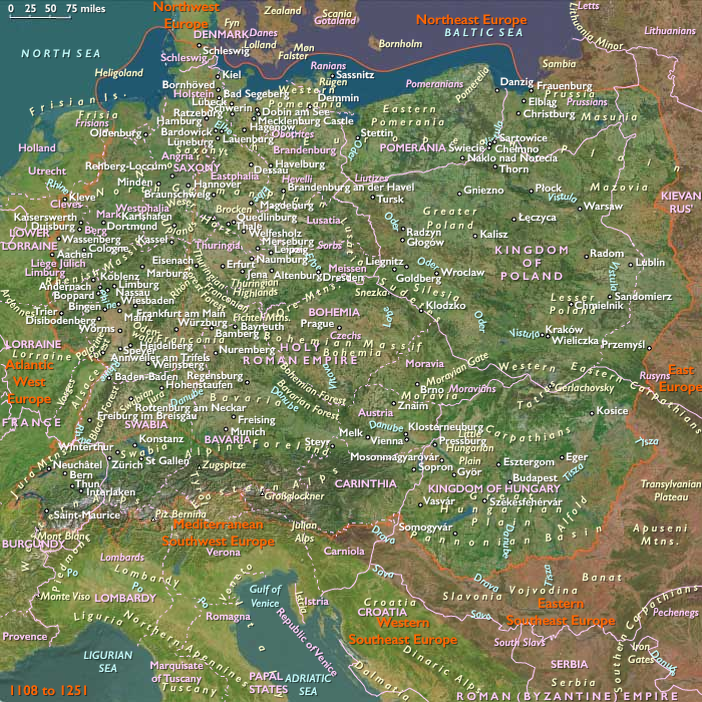
Valdemar and his predecessor King Canute VI of Denmark had previously conquered Holstein, Mecklenburg, Hamburg, Lübeck (1202), Ratzeburg and the coast of Pomerania including the island of Rügen.
The Germans have turned against Valdemar by 1227, when they meet his Danes at the Battle of Bornhöved.
The contest, maintained with great firmness on both sides, continues for an unusual length of time, and the carnage is so great that its combatants are said to have fought knee deep in blood.
King Valdemar has one of his eyes shot out, and has several horses killed under him, but his troops and their allies fight with such bravery that the victory would have been theirs had not the contingent of Dithmarschen, a Saxon ethnic group, deserted their colors, passing over to the enemy at the most critical moment of the action.
The Danes are obliged to give way, and in the ensuing confusion, Otto I, Duke of Brunswick-Lüneburg and the Bishop of Ribe are taken prisoner.
Otto is sent to Rostock, the capital of a lordship held by Mecklenburg, where he is shut up in a fortress.
But Valdemar, who escapes from the field, busies himself in repairing this disaster by forming a fresh army, with which he keeps his enemy in check.
As a result of the battle, the Danish border with the Holy Roman Empire is moved north again from river Elbe to the Eider River, the southern border of the Duchy of Schleswig; this border will remain in effect until 1806.
The victorious Adolf IV of Schauenburg regains the County of Holstein and his fellow victor Albert I, Duke of Saxony, reasserts himself as liege lord of the Counts of Schauenburg and Holstein against the Welf claim.
Dithmarschen shakes off Danish supremacy and returns to a very loose overlordship by the Prince-Archbishopric of Bremen, paving the way for its de facto autonomy as a peasant republic until 1559.
The Principality of Rügen is the only possession in the Holy Roman Empire left to Valdemar after the battle.
Groups
Commodities
Subjects
Regions
Central Europe
View →Subregions
