Various competitive dukes control the region of…
December 1503 CE
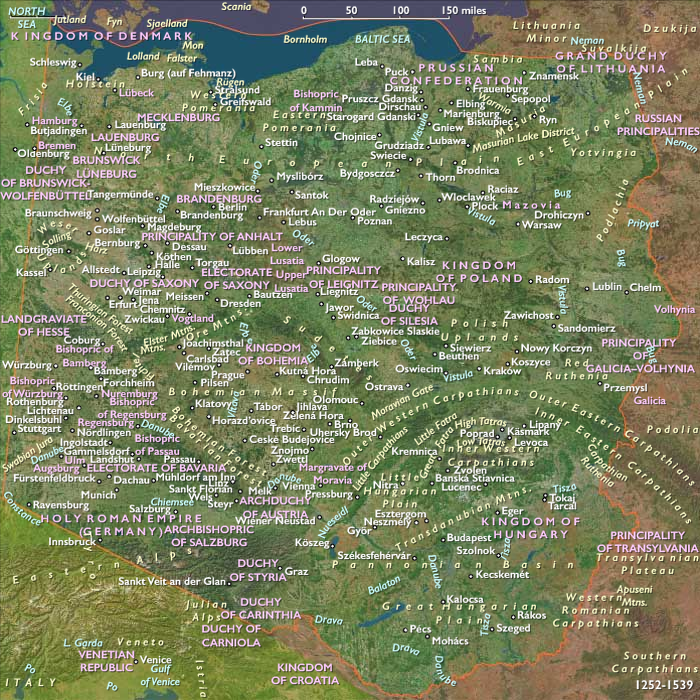
Various competitive dukes control the region of Bavaria.
The Baron of Bavaria-Landshut, George Wittelsbach, called "the Rich," together with his cousin Albert IV of Bavaria-Munich, had tried to extend his influence in Further Austria, but had abandoned these plans in 1489 to settle the difference with Frederick III, Holy Roman Emperor.
George has now become a strong ally of Emperor Maximilian I and has supported his campaigns in Swabia, Switzerland, Geldern and Hungary.
His wedding with the princess Hedwig Jagiellon, a daughter of King Casimir IV of Poland, in 1475 had bee celebrated in the Landshut Wedding with one of the most splendid festivals of the Middle Ages.
The couple have had five children, three sons and two daughters.
However, none of their sons have survived, and per the restrictions of the Salic law practiced in medieval Germany, their daughters cannot inherit the duchy, despite George’s attempt to bequeath the duchy to his daughter Elizabeth and her husband Ruprecht of the Palatinate, third son of Philip, Elector Palatine.
Thus, when George dies in December 1503 without a male heir, his territory should, by tradition, pass to another Wittelsbach branch, that controlled by Duke Albert IV of Bavaria-Munich, but the branches are quarreling and George has bequeathed his holdings to his daughter and son-in-law.
The Munich branch seeks and receives a favorable legal ruling, but the dissatisfied elector assembles an army.
Holy Roman Emperor Maximilian dispatches imperial troops, joined by the forces of supportive nobles, to uphold the ruling.
Locations
People
Groups
Commodities
Subjects
Regions
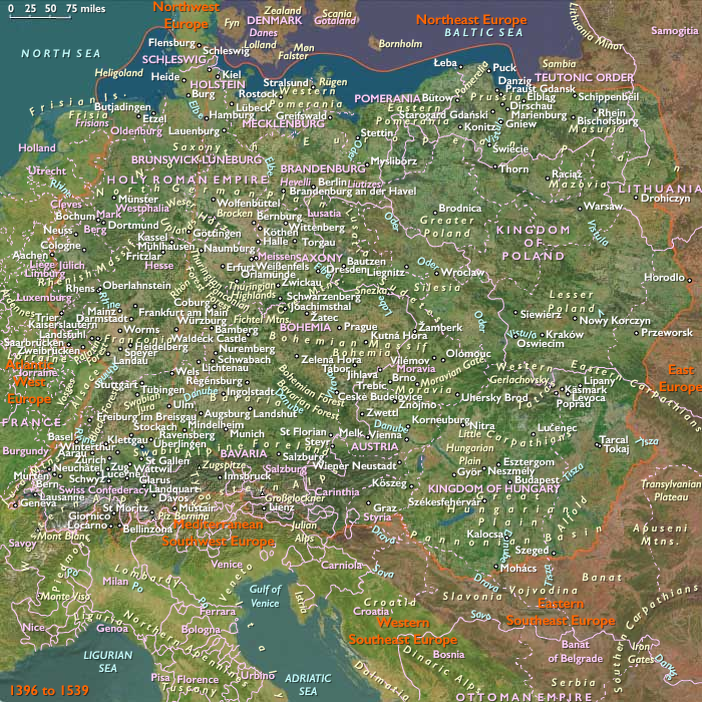
Central Europe
View →Subregions