
The Origins and Medieval History of Póvoa…
1308 CE
The Origins and Medieval History of Póvoa de Varzim
The history of Póvoa de Varzim, today northern Portugal’s main fishing port, dates back to the Viking and medieval eras, with a long-standing tradition of maritime activity, agriculture, and noble land disputes.
Viking Fishermen and the Founding of Villa Euracini (9th–10th Century)
- Ninth-century Viking fishermen from Brittany established a peaceful colony in Villa Euracini, located on a sandy coastal plain south of Cape Santo André, between the Minho and Douro Rivers.
- During the 10th century, Viking raiders also attacked northwestern Iberia, but Euracini endured, developing into a fishing and trading community.
- The town was first recorded in Portuguese history on March 26, 953, during the rule of Countess Mumadona Dias in the first County of Portugal.
Evolution of the Name: From Euracini to Varazim
- Over the Middle Ages, Euracini gradually evolved into Uracini, Vracini, Veracini, Verazini, Verazim, and eventually Varazim.
Medieval Development and the Role of the Knights Hospitaller
- The natural wealth of Varazim’s coast attracted nobles and aristocrats, leading to a division of the land.
- The northern part of Varazim was granted to the Knights Hospitaller and became known as Varazim dos Cavaleiros (Knights’ Varazim).
- The southern part, under royal control, relied heavily on fishing and agriculture, which led to disputes over fishing revenues.
The Founding of Póvoa de Varzim (1308)
- In 1308, King Denis issued a Foral (Royal Charter), granting the royal lands to fifty-four families of Varazim.
- These families were required to establish a medieval town, known as a Póvoa (a communal fishing and agricultural settlement).
- This charter formally marked the foundation of Póvoa de Varzim, setting the stage for its growth into a major fishing port.
Póvoa de Varzim Today
- Now a prominent fishing city, Póvoa de Varzim remains one of Portugal’s most important coastal communities.
- Its Viking and medieval maritime heritage is still evident in its fishing traditions, port economy, and historical sites.
The story of Póvoa de Varzim reflects centuries of cultural blending, economic evolution, and strategic importance, from its Viking settlers to its recognition by King Denis, shaping it into northern Portugal’s leading fishing hub.
Locations
People
Commodities
Regions
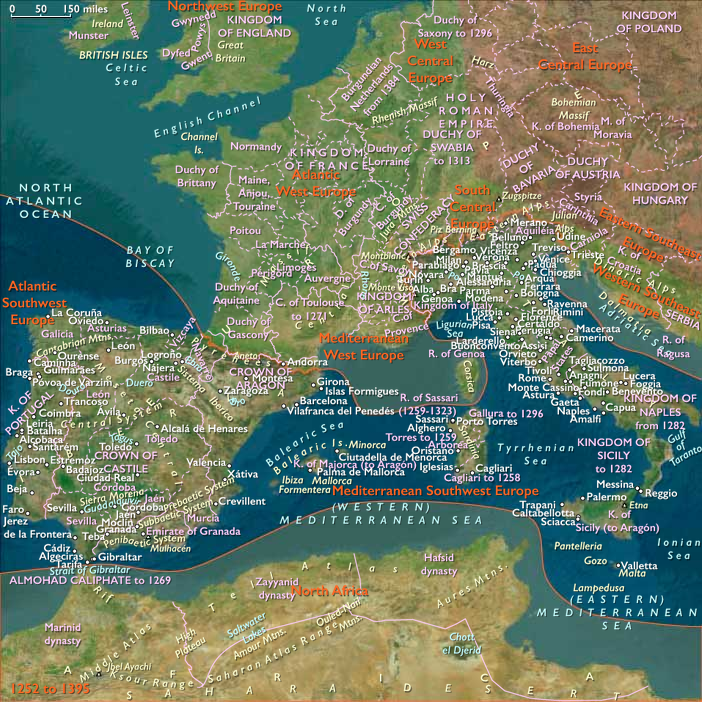
Southwest Europe
View →Subregions

Atlantic Southwest Europe
View →Related Events
No active filters.
Showing 10 events out of 44930 total
John of Montecorvino, a Franciscan, is the founder of the earliest Roman Catholic missions in India and China, becoming archbishop of Beijing and patriarch of the Orient.
Traveling by sea from Nestorian Meliapur in Bengal, he had reached China in 1294, appearing in the capital "Cambaliech" (now Beijing), only to find that Kúblaí Khan had just died, and Temür (1294-1307) had succeeded to the Mongol throne.
Though the latter apparently had not embraced Christianity, he had thrown no obstacles in the way of the zealous missionary, who soon won the confidence of the ruler in spite of the opposition of the Nestorians already settled there.
John had built a church at Khanbaliq in 1299 and in 1305 a second opposite the imperial palace, together with workshops and dwellings for two hundred persons.
He gradually bought from heathen parents about one hundred and fifty boys, from seven to eleven years of age, instructed them in Latin and Greek, wrote psalms and hymns for them and then trained them to serve Mass and sing in the choir.
At the same time he has familiarized himself with the native language, preached in it, and translated into Chinese the New Testament and the Psalms.
Among the six thousand converts of John of Montecorvino is a Nestorian Ongut prince named George, allegedly of the race of Prester John, a vassal of the great khan, mentioned by Marco Polo.
John had written letters of January 8, 1305, and February 13, 1306, describing the progress of the Roman mission in the Far East, in spite of Nestorian opposition; alluding to the Roman Catholic community he had founded in India, and to an appeal he had received to preach in "Ethiopia" and dealing with overland and sea routes to "Cathay," from the Black Sea and the Persian Gulf respectively.
After he had worked alone for eleven years, the German Franciscan Arnold of Cologne was sent to him (1304 or 1303) as his first colleague.
In 1307 Pope Clement V, highly pleased with the missionary's success, had sent seven Franciscan bishops who were commissioned to consecrate John of Montecorvino archbishop of Peking and summus archiepiscopus, 'chief archbishop' of all those countries; they are themselves to be his suffragan bishops.
Only three of these envoys arrive safely: Gerardus, Peregrinus and Andrew of Perugia.
They consecrate John in 1308 and succeed each other in the episcopal see of Zaiton, established by Montecorvino.
The first work on the royal fortress on Oslo’s small Akershus Peninsula had started around the late 1290s under King Håkon V, replacing Tønsberg as one of the two most important Norwegian castles of the period (the other being Båhus).
It had been constructed in response to an earlier attack on Oslo by the Norwegian nobleman Earl Alv Erlingsson of Sarpsborg.
The fortress is first used in battle in 1308, when it is besieged by the Swedish duke Erik of Södermanland, who later in the same year wins the Swedish throne.
The immediate proximity of the sea is a key feature, for naval power is a vital military force as the majority of Norwegian commerce in this period is by sea.
The fortress is strategically important for the capital, and therefore, Norway as well.
Whoever rules Akershus fortress rules Norway.
Pomerania, the region on both sides of the Oder River, bounded by the Baltic Sea in the north and the Vistula River in the south, had been split during the twelfth century between Poland and the Holy Roman Empire; the eastern part has become known as Pomerelia.
The expansionist Brandenburg state having conquered the region, Lokietek, in mounting a recovery effort, agrees to ask for help the Teutonic Knights.
The Knights oblige, repulsing the Brandenburgers and seizing the city of Danzig in November 1308.
Some historians claim that, based on the subsequent stagnation and reversal in the development of Danzig, all the inhabitants of the city, Polish and German, were slaughtered.
This massacre is, however, disputed by other historians.
The Teutonic Knights having moved their operations to the Baltic area, the Order’s grand master establishes his residence at Marienburg (Malbork) castle near Danzig.
Poznan (Posen), founded in the ninth century, has served as the residence of the first Polish kings from the tenth century until 1308, when Wladyslaw Lokietek makes Krakow his capital.
Lokietek is to fight a lifelong uphill battle with powerful adversaries and leave the Kingdom in a precarious situation, with limited area under its control and many unresolved issues, but he will be the savior of Poland's existence as a state.
Theodore Svetoslav is to remain at peace with his neighbors until the end of his life.
His reassertion of central control over outlying provinces such as Vidin is probably peaceful.
Bulgaria’s sparsely documented recovery of the banate of Severin from the Kingdom of Hungary must have been achieved during the dynastic struggles in that country.
The leaderless Catalans, more inclined to pillage Greek cities than to fight the Turks, have taken to pillaging and murdering throughout imperial territories, especially in Thrace and Macedonia.
For some years, they have used the Gallipoli Peninsula as a base from which to ravage Thrace, inviting thousands of Turks to come over and help them.
The Company is a powerful asset in the political arena and Frederick III of Sicily tries to gain control over it, assigning the Infante Ferdinand of Majorca to Gallipoli to become its Captain.
However one of the leaders of the Company, Bernat de Rocafort, opposes this move, and faces Berenguer de Entença, Ferran Ximenis d'Arenós, and others who had accepted the Infante.
The struggle ends with the departure of the Infante and Ferran and with Rocafort becoming leader of the Company.
(The administrator, Ramon Muntaner also departs; he will later chronicle the Company’s exploits.)
Rocafort offers the Company's services to Charles of Valois, to strengthen his claim to the Empire.
The Catalans finally move west in about 1308.
The last Mongol invasion of India takes place in 1307-1308 under Iqbalmand, who had just about managed to cross the Indus when Ala-ud-Din Khilji’s armies overtake them and put them all to the sword.
The Mongols will not attack India again after 1308.
There are a number of reasons for this: principal among these is that during their earlier descent from the mountains into the Indus plains, the Mongols had become aware of their handicap in an environment of higher temperatures and humidity, coupled with their lack of dexterity in riding horses at the speeds they are comfortable at in higher and drier areas.
The hilltop fort of Siwana, built by famous Rajput ruler Raja Bhoj’s son Veernarayan, who at one stage had controlled much of Barmer and had close ties with the Solanki dynasty of Gujarat, falls in August 1308, after a heroic defense led by Sutal Deo, to forces of Alauddin Khilji, who is finalizing his campaign to bend the Rajput princes to submission.