Viking Irish raiders ally with Gruffydd ap …
Years: 1049 - 1049
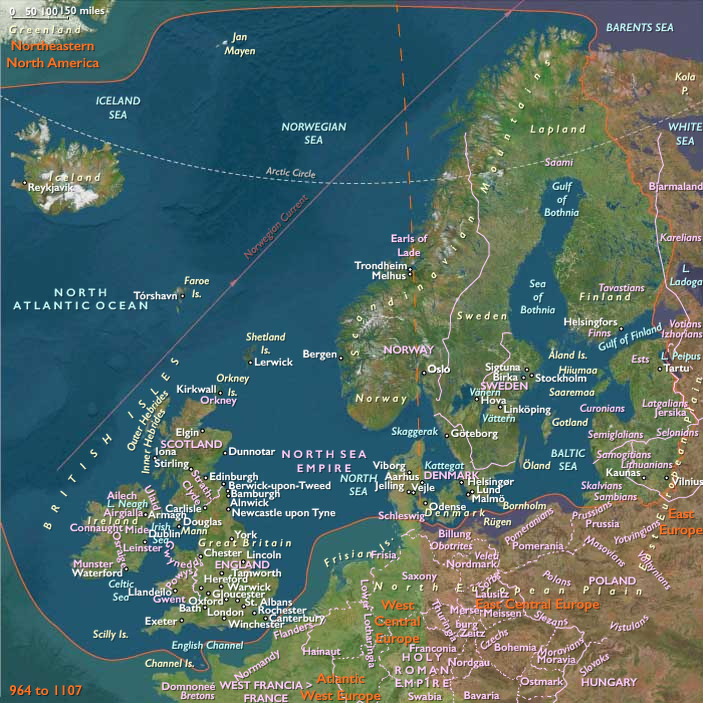
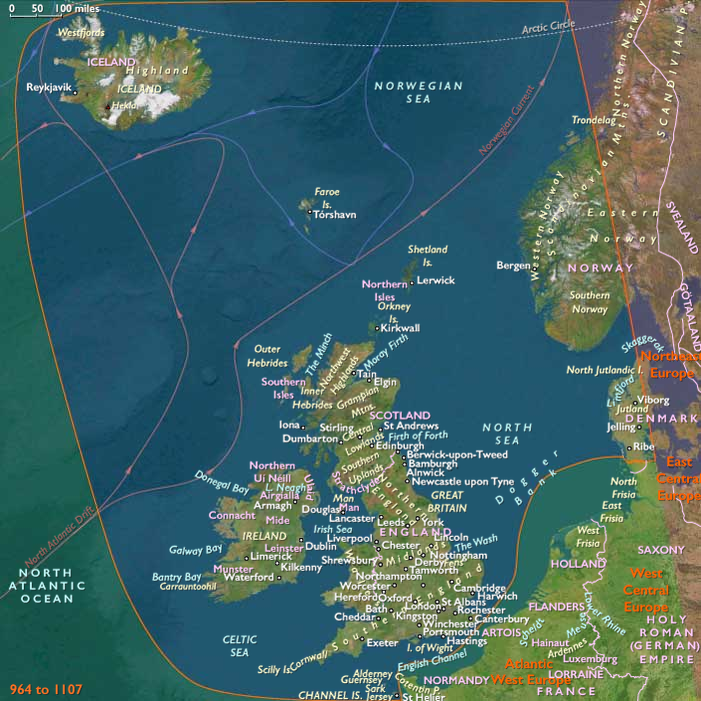
Viking Irish raiders ally with Gruffydd ap Rhydderch of Gwent in raiding along the River Usk.
Ealdred, Bishop of Worcester, is unsuccessful in driving them off and is again routed by the Welsh.
This failure underscores Ealdred's need for a strong earl in the area to protect against raids.
Normally, the bishop of Hereford would have led the defense in the absence of an Earl of Hereford, but in 1049 the incumbent, Æthelstan, is blind, so Ealdred has taken on the role of defender.
Locations
People
Groups
- Anglo-Saxons
- Gwent, Welsh Kingdom of
- Christianity, Chalcedonian
- Welsh people
- Vikings
- England, (Anglo-Saxon) Kingdom of
Subjects
Regions
Subregions
Related Events
Filter results
Showing 10 events out of 51211 total
The Northern Song dynasty's capital city of Kaifeng reaches its peak importance in the eleventh century when it is a commercial and industrial center at the intersection of four major canals.
During this time, the city is surrounded by three rings of city walls and probably has a population of between six hundred thousand and seven hundred thousand.
The famous architect Yu Hao had built a magnificent wooden pagoda as part of Youguo Temple between 965–99 that was considered by many of his contemporaries to be a marvel of art.
Unfortunately, the widely admired structure had burned down in 1044 after a lightning strike.
Under the order of Emperor Renzong, a new pagoda is built in its place by 1049, constructed of nonflammable brick and stone.
it is dubbed the 'Iron Pagoda' due its iron-gray color when viewed from afar (its bricks are in fact glazed red, brown, blue, and green).
This octagonal-base structure stands at a current height of 56.88 meters (186.56 feet), with a total of thirteen stories.
It is a solid-core brick tower with an inner spiral stone staircase and outside openings to allow light and air flow.
The architectural style features densely positioned, articulated dougong in the eaves (miyan) and multiple stories (louge).
(Dougaong, literally "cap [and] block", is a unique structural element of interlocking wooden brackets, one of the most important elements in traditional Chinese architecture.)
The exterior features more than fifty different varieties of glazed brick and sixteen hundred intricate and richly detailed carvings, including those of standing and sitting Buddha, standing monks, singers and flying dancers, flowers, lions, dragons and other legendary beasts as well as many fine engravings.
Under the eaves are one hundred and four bells that ring in the wind.
The foundation rests in the silt of the Yellow River.
Inside the Iron Pagoda are frescos of the classical Chinese tales, such the Journey to the West.
The Youguosi Pagoda, or Iron Pagoda as it is called today, measures 54.7 meters (179 ft) in height.
It has survived the vicissitudes of war and floods to become the oldest landmark in Kaifeng.
(Another Song Dynasty pagoda, Bo Ta, dating from 974, has been partially destroyed.)

Xu Daoning had begun his working life selling medicine prescriptions in Kaifeng.
While selling prescriptions, he also began painting nature scenes in the style of Li Cheng.
After gaining popularity he had taken up painting murals for Chinese nobles.
His most notable work is Fishermen's Evening Song, from about 1049.
The imperial forces finally force the Seljuqs to withdraw in late 1049.
Malta had become involved in the Muslim–Byzantine Wars, and the conquest of Malta is closely linked with that of Sicily that began in 827 after admiral Euphemius' betrayal of his fellow Greeks, requesting that the Aghlabid dynasty invade the island.
The Muslim chronicler and geographer al-Himyari recounts that in 870, following a violent struggle against the occupying imperial forces, the Muslim invaders, first led by Halaf al-Hadim, and later by Sawada ibn Muhammad, looted and pillaged the island, destroying the most important buildings, and leaving it practically uninhabited until it is recolonized by the Muslims from Sicily in 1048–1049.
It is uncertain whether this new settlement took place as a consequence of demographic expansion in Sicily, as a result of a higher standard of living in Sicily (in which case the recolonization may have taken place a few decades earlier), or as a result of civil war that had broken out among Muslim rulers of Sicily in 1038.
The Muslims introduce new irrigation, some fruits and cotton and the Siculo-Arabic language is adopted on the island from Sicily: it will eventually evolve into the Maltese language.
The Christians in the island are allowed freedom of religion; they have to pay jizya, a tax for non-Muslims, but are exempt from the tax that Muslims have to pay (Zakaat).
Bruno of Egisheim-Dagsburg, a native of Eguisheim, Upper Alsace, was born into family was of noble rank, and his father, Count Hugh, was a cousin of Emperor Conrad II (1024–1039).
He had been educated at Toul, where he had successively become canon and, in 1026, bishop.
In the latter capacity, he had rendered important political services to his relative Conrad II, and afterwards to Emperor Henry III.
He has become widely known as an earnest and reforming ecclesiastic by the zeal he showed in spreading the rule of the order of Cluny.
On the death of Pope Damasus II in 1048, Bruno had been selected as his successor by an assembly at Worms in December.
Both the Emperor and the Roman delegates had concurred.
However, Bruno apparently favored a canonical election and stipulated as a condition of his acceptance that he should first proceed to Rome and be freely elected by the voice of the clergy and people of Rome.
Setting out shortly after Christmas, he meets with abbot Hugh of Cluny at Besançon, where he is joined by the young tuscan Benedictine monk Ildebrando, or Hildebrand, the future Pope Gregory VII.
Arriving in pilgrim garb at Rome in the following February, he is received with much cordiality, and at his consecration assumed the name Leo IX.
With Leo IX’s appointment to the papacy, the movement of church reform, which had been gathering momentum in Burgundy and Lorraine, finally comes to Rome.
Leo has brought several reform-minded churchman to Rome, including Ildebrando, who, together with the diplomat and reformer Humbert of Silva Candida, and the Benedictine reformer Peter Damian, assist the new pope in his extensive reform program.
Leo IX favored traditional morality in his reformation of the Catholic Church.
One of his first public acts is to hold the well-known Easter synod of 1049, at which celibacy of the clergy (down to the rank of subdeacon) is required anew.
Also, the Easter synod is where the Pope at least succeeds in making clear his own convictions against every kind of simony.
Benedict IX refuses to appear on charges of simony in 1049 and is excommunicated.
The Zirid period of Tunisia is considered a high point in its history, with agriculture, industry, trade and learning, both religious and secular, all flourishing.
Management of the area by later Zirid rulers has been neglectful as the agricultural economy has declined, prompting an increase in banditry among the rural population.
The political turmoil notwithstanding, the general economic well-being had initially made possible an extensive building program.
However, the kingdom had found itself in economic crisis in the 1040s, reflected in currency devaluation, epidemic and famine.
This may have been related to the high level of tribute which the Zirids are compelled to pay annually to the Fatimids (one million gold dinars a year).
When al-Muizz, under the influence of Sunni jurists in Kairouan, recognizes the Abbasids in Baghdad as rightful Caliphs in 1049 (a move that is popular with the urban Arabs of Kairouan), the break with the Fatimids is complete.
In response, the Fatimids deport the Arab tribes of Banu Hilal and Banu Sulaym to Ifriqiya to ravage Zirid territory.
The Campaigns of 1049: A Year of Triumph for Emperor Henry III
The year 1049 marked a turning point in Emperor Henry III’s reign, as he secured a series of military and political victories that strengthened imperial authority. One of his most significant triumphs was the defeat and death of Dirk IV of Holland, one of his most persistent adversaries in the Low Countries.
The Death of Dirk IV of Holland
- Dirk IV of Holland had been a major rebel against imperial rule, frequently raiding imperial territories and attacking pro-imperial bishops such as the Bishop of Utrecht.
- After Henry III’s earlier defeat at Flushing in 1047, Dirk had continued to challenge imperial authority, leading another round of rebellions.
- In 1049, Henry’s forces confronted Dirk, decisively defeating him in battle.
- Dirk IV was killed during the engagement, marking the end of his resistance and restoring imperial dominance over Holland.
Other Successes in 1049
- With Dirk IV eliminated, Henry III secured greater control over the Low Countries, reducing the threat of further insurrections from rebellious lords.
- The emperor continued his policy of appointing loyal bishops to key territories, further consolidating imperial governance in the region.
- These victories weakened the anti-imperial coalition, leaving Baldwin of Flanders and Godfrey the Bearded as the only major remaining threats to imperial rule in Lotharingia.
Significance and Impact
- Dirk IV’s death removed a key figure in the anti-imperial resistance, allowing Henry to refocus his attention on consolidating power elsewhere.
- The year 1049 cemented Henry’s military supremacy, proving his ability to crush rebellious vassals and enforce imperial rule.
- These victories paved the way for continued imperial authority in the Low Countries, reducing the number of major threats to Henry’s reign.
The death of Dirk IV was a decisive imperial victory, marking 1049 as a year of triumph for Henry III, as he continued to expand and reinforce the power of the Holy Roman Empire.
Imperial and Anglo-Danish Campaign Against Baldwin V of Flanders (1049)
In 1049, Emperor Henry III launched a naval offensive against Baldwin V of Flanders, one of his most persistent adversaries in the Low Countries. This imperial harassment by sea was strategically coordinated with King Edward the Confessor of England and King Sweyn II of Denmark, both of whom had personal grievances against Baldwin, as he had harbored their enemies.
The Strategic Alliance Against Baldwin V
- Henry III sought to weaken Baldwin V, who had been a key supporter of the Lotharingian rebels, particularly Godfrey the Bearded.
- Baldwin had previously given refuge to several exiles, including enemies of King Edward the Confessor of England and Sweyn II of Denmark.
- In retaliation, Sweyn and Edward joined Henry III, lending naval support to an imperial fleet that harassed Flemish ports and coastal settlements.
Naval and Military Actions
- The imperial fleet, supported by Anglo-Danish ships, conducted raids along the Flemish coast, disrupting Baldwin’s economic and military networks.
- Key trading ports were blockaded or attacked, cutting Baldwin off from maritime resources and trade routes.
- This multi-pronged assault forced Baldwin to defend both land and sea, stretching his military resources thin.
Consequences and Impact
- The naval attacks destabilized Baldwin’s hold on coastal Flanders, undermining his ability to support further rebellions against imperial rule.
- By aligning with England and Denmark, Henry III isolated Baldwin diplomatically, reducing his potential allies in the region.
- The campaign forced Baldwin to shift to a defensive posture, limiting his ability to engage in further hostilities against the empire.
Legacy
- This coordinated imperial, English, and Danish offensive marked a rare instance of international military cooperation against a rebellious vassal.
- The campaign demonstrated Henry III’s strategic reach, as he successfully leveraged naval power to suppress an inland rebellion.
- Although Baldwin V remained a formidable figure, his role as an anti-imperial leader was significantly weakened, setting the stage for further imperial consolidation in the Low Countries.
By harassing Baldwin V at sea, Henry III demonstrated his ability to project power beyond the empire’s borders, reinforcing his dominance in Lotharingia and further disrupting the rebel coalition that had long opposed him.
The End of War in the Low Countries and Lotharingia: A Fragile Peace (1050)
By 1050, after years of rebellion, military campaigns, and shifting alliances, war in the Low Countries and the Lorraines finally came to an end. Emperor Henry III had successfully subdued his rebellious vassals, including Godfrey the Bearded, Baldwin V of Flanders, and Dirk IV of Holland (who had been killed in battle in 1049). The result was a hard-won but fragile peace, which allowed imperial authority to stabilize in the region.
Key Factors Leading to Peace
-
The Death of Dirk IV of Holland (1049)
- Dirk IV had been a major instigator of rebellion, raiding imperial lands and attacking the Bishopric of Utrecht.
- His defeat and death in 1049 removed a key anti-imperial leader, reducing the number of active rebel factions.
-
Naval Attacks on Baldwin V of Flanders
- Henry III, along with Sweyn II of Denmark and King Edward the Confessor of England, had launched a series of naval raids against Baldwin.
- These attacks weakened Flanders’ ability to continue supporting rebellion, forcing Baldwin into a defensive position.
-
Godfrey the Bearded’s Submission
- Godfrey the Bearded, after years of leading the Lotharingian rebellion, had finally been reconciled with Henry III and restored to imperial favor.
- This move removed the main leader of resistance in Lotharingia, signaling the end of large-scale conflict.
-
Diplomatic and Ecclesiastical Appointments
- Henry III had strategically appointed loyal bishops in Metz, Verdun, and Utrecht, ensuring that imperial authority was reinforced through Church leadership.
- The division of Lorraine into Upper and Lower duchies under separate rulers loyal to the emperorreduced regional instability.
The Aftermath: A Stabilized But Watchful Empire
- Imperial authority was now firmly established, but Henry III remained watchful over the Low Countries and Lotharingia, as tensions could easily resurface.
- Baldwin V of Flanders remained a powerful figure, though now more cautious in his defiance of the emperor.
- Normandy and France were beginning to rise in influence, and Henry III would soon shift his diplomatic and military focus to broader European affairs.
Conclusion: A Period of Fragile Stability
The cessation of war in the Low Countries and Lorraine marked a significant triumph for Henry III, whose military and diplomatic efforts had finally quelled resistance. However, the peace was not absolute, as power struggles among the nobility and territorial ambitions of neighboring rulers continued to simmer beneath the surface.
For now, however, the empire enjoyed a much-needed respite, allowing Henry III to turn his attention to other matters of imperial governance and European diplomacy.
Adalbert of Bremen manages a peace with Bernard of Saxony and negotiates a treaty with the missionary monarch Sweyn II of Denmark.
Years: 1049 - 1049
Locations
People
Groups
- Anglo-Saxons
- Gwent, Welsh Kingdom of
- Christianity, Chalcedonian
- Welsh people
- Vikings
- England, (Anglo-Saxon) Kingdom of