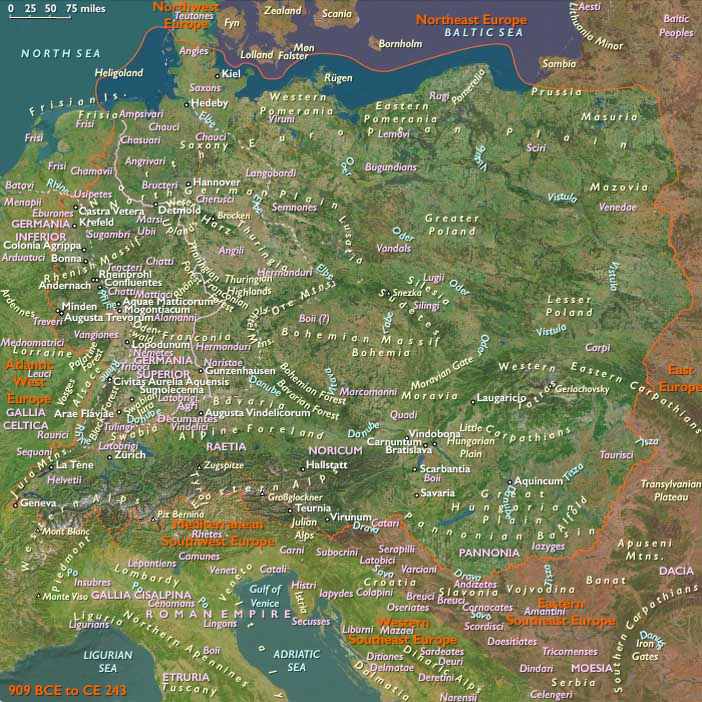
…Vindobona (modern Vienna), in Pannonia Superior, which…
103 CE
…Vindobona (modern Vienna), in Pannonia Superior, which will be the legion's camp until the fifth century.

Groups
Commodities
Subjects
Regions
Central Europe
View →Subregions
East Central Europe
View →Related Events
No active filters.
Showing 10 events out of 61310 total
Legio X Equestris had been one of the four legions used by Julius Caesar in 58 BCE, for his invasion of Gaul.
They had remained faithful to Caesar in the civil war against Pompey, being present in the battles of Pharsalus (49 BCE) and Munda (45 BCE).
In 45 BCE, Caesar had disbanded the legion, giving the veterans farmlands near Narbonne.
The legion had been reconstituted in 42 BCE and fought for Augustus (then Octavian), Lepidus and Mark Antony in the Battle of Philippi against the murderers of Caesar.
After this, they had followed Mark Antony in his campaign against Parthia and were defeated with him at Actium.
Augustus then took control of the legion and settled the veterans in Patras.
The legion rebelled and lost its cognomen Equestris as punishment.
Reinforcements had been added from other legions, and the Tenth was rebaptized Gemina.
The newly formed X Gemina had been relocated to Hispania Tarraconensis, where Augustus was preparing a campaign against the Cantabrians.
They stayed in Hispania for many years and their veterans were among the first inhabitants of modern Zaragoza.
In 70, after the Batavian rebellion had been suppressed by Vespasian, X Gemina was sent to Batavia in Germania Inferior to police the lands and prevent new revolts.
From 71 to 103, the legion has been stationed at the base built by II Adiutrix at Oppidum Batavorum, the present day Dutch city of Nijmegen.
As part of the army of Germania Inferior, X Gemina had fought against the rebellion of the governor of Germania Superior, L. Antonius Saturninus, against Emperor Domitian.
For this reason, the Tenth — as well as the other legions of the army, I Minervia, VI Victrix, and XXII Primigenia — had received the title Pia Fidelis Domitiana, "faithful and loyal to Domitian", with the reference to the Emperor dropped at his death.
In 103, it is moved to Aquincum and later to …
Palmyra, a wealthy and elegant city located along the caravan routes linking Persia with the Mediterranean ports of Roman Syria and Phoenicia, had come under Roman control during the reign of Roman Emperor Tiberius (14–37).
Made part of the Roman province of Syria dt has steadily grown in importance as a trade route linking Persia, India, China, and the Roman empire.
During the ensuing period of great prosperity, the Arab citizens of Palmyra have adopted customs and modes of dress from both the Iranian Parthian world to the east and the Graeco-Roman west.
Rome's original harbor was Ostia.
Claudius had constructed the first harbor on the Portus site, four kilometers (two-and-a-half miles) north of Ostia, enclosing an area of sixty-nine hectares (one hundred and seventy acres), with two long curving moles projecting into the sea, and an artificial island, bearing a lighthouse, in the center of the space between them.
The foundation of this lighthouse was provided by filling a massive ship, used to transport an obelisk from Egypt to adorn the spina of Vatican Circus, built under Caligula.
The harbor thus opened directly to the sea on the northwest and communicated with the Tiber by a channel on the southeast.
The object was to obtain protection from the prevalent southwest wind, to which the river mouth was exposed.
Though Claudius, in the inscription which he caused to be erected in CE 46, boasted that he had freed the city of Rome from the danger of inundation, his work was only partially successful, for in 62 Tacitus speaks of a number of grain ships sinking within the harbor during a violent storm.
Nero had given the harbor the name of "Portus Augusti".
It was probably Claudius who had constructed the new direct road from Rome to Portus, the Via Portuensis which is 24 km (15 miles) long.
The Via Portuensis runs over the hills as far as the modern Ponte Galeria, and then straight across the plain.
An older road, the Via Campana, runs along the foot of the hills, following the right bank of the Tiber, and passing the grove of the Arval Brothers at the sixth mile, to the Campus salinarum romanarum, the salt marsh on the right bank from which indeed it derives its name.
In 103, Trajan constructs another harbor farther inland—a hexagonal basin enclosing an area of 39 hectares (97 acres), and communicating by canals with the harbor of Claudius, with the Tiber direct, and with the sea, the last now forming the navigable arm of the Tiber (reopened for traffic by Gregory XIII and again by Paul V).
It bears the name Fossa trajana, though its origin is undoubtedly due to Claudius.
The basin itself is still preserved, and is now a reedy lagoon.
It was surrounded by extensive warehouses, remains of which may still be seen: the fineness of the brickwork of which they are built is remarkable.
The Romans make use of fired bricks, which now become the primary building material in the Roman Empire, and the Roman legions, which operate mobile kilns, introduce bricks to many parts of the empire.
Roman bricks are often stamped with the mark of the legion that supervised its production.
The use of bricks in Southern and Western Germany, for example, can be traced back to traditions already described by the Roman architect Vitruvius.
Menelaus of Alexandria, a Greek or Egyptian mathematician and astrologer who flourishes around 100, gives considerable attention to spherical trigonometry, demonstrating the significance of the arcs of great circles in dealing with such problems as spherical triangles.
He is the first to recognize geodesics on a curved surface as natural analogs of straight lines.
Although very little is known about Menelaus's life, it is supposed that he lived in Rome, where he probably moved after having spent his youth in Alexandria.
He was called Menelaus of Alexandria by both Pappus of Alexandria and Proclus, and a conversation of his with Lucius, held in Rome, is recorded by Plutarch.
Confucians weave dance, music, and poetry into their ceremonies.
The form and calligraphy of poetry is the basic for Chinese court music and dance.
Roman engineers, honoring Trajan in 104, build a bridge of six symmetrical semicircular masonry arches along the approach to the Spanish city later called Alcántara, carrying the Roman road from Norba to Conimbriga.
The bridge stands today.
Spanish-born and -educated Latin poet Marcus Valerius Martialis (later anglicized as Martial) dies in Rome circa 104, leaving as his legacy the amusing “Epigrams,” a fourteen-book collection of over fifteen hundred short, witty poems, many of them satirical commentaries on contemporary Roman life—particularly the seamy side—and the scandalous activities of his acquaintances.
Romanticizing his provincial upbringing, he has written a total of 1,561 poems, 1,235 of which are in elegiac couplets.
He is considered the creator of the modern epigram.
Paper is considered to be one of the Four Great Inventions of Ancient China, as the first standard papermaking process was developed in China during the early second century.
Inscription thus becomes relegated to a lesser role.
While the Han Dynasty Chinese court eunuch Cai Lun is widely regarded to have first invented the modern method of papermaking (inspired from wasps and bees) from wood pulp in 105, the discovery of specimens bearing written Chinese characters in 2006 at northeastern China's Gansu province suggest that paper had been in use by the ancient Chinese military more than one hundred years before Cai in 8 BCE.
Archaeologically however, true paper without writing has been excavated in China dating to the reign of Emperor Wu of Han from the second century BCE, used for purposes of wrapping or padding protection for delicate bronze mirrors.
It was also used for safety, such as the padding of poisonous 'medicine' as mentioned in the official history of the period.
Although paper used for writing will become widespread by the third century, paper will continue to be used for wrapping and other purposes.
The emperor, on his departure from Dacia in 102, had ordered the construction of a permanent stone bridge across the Danube near the present Romanian city of Turnu Severin.
The celebrated bridge, constructed between 103 and 105 by the architect Apollodorus of Damascus, is the largest in the Empire.
The Danube is about twelve hundred meters (four thousand feet) broad at this spot; the bridge is composed of twenty arches supported by stone pillars (only two of which are still visible at low water).
In the year of the bridge’s completion, Decebalus breaks the treaty, annihilating a Roman garrison stationed in Dacia and invading Moesia to attack a neighboring people allied to Rome.
There appears to have been a serious setback at the hands of the tribes of the Picts of Alba around 105 CE: several Roman forts are destroyed by fire, with human remains and damaged armor at Trimontium (at modern Newstead, in southeast Scotland) indicating hostilities at least at this site.
There is also circumstantial evidence that auxiliary reinforcements were sent from Germany, and an unnamed British war of the period is mentioned on the gravestone of a tribune of Cyrene.
However, Trajan's Dacian Wars may have led to troop reductions in the area or even total withdrawal followed by slighting of the forts by the Picts rather than an unrecorded military defeat.
The Romans are also in the habit of destroying their own forts during an orderly withdrawal, in order to deny resources to an enemy.
In either case, …