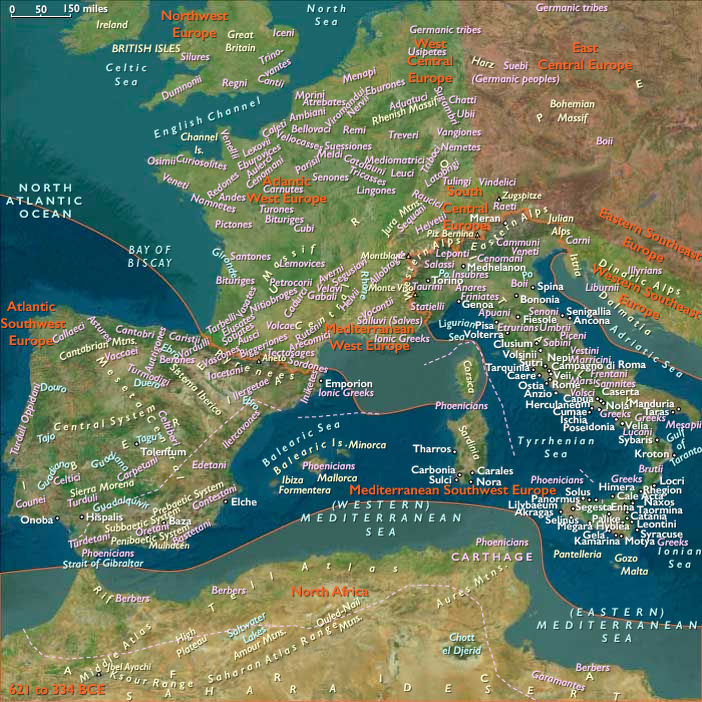
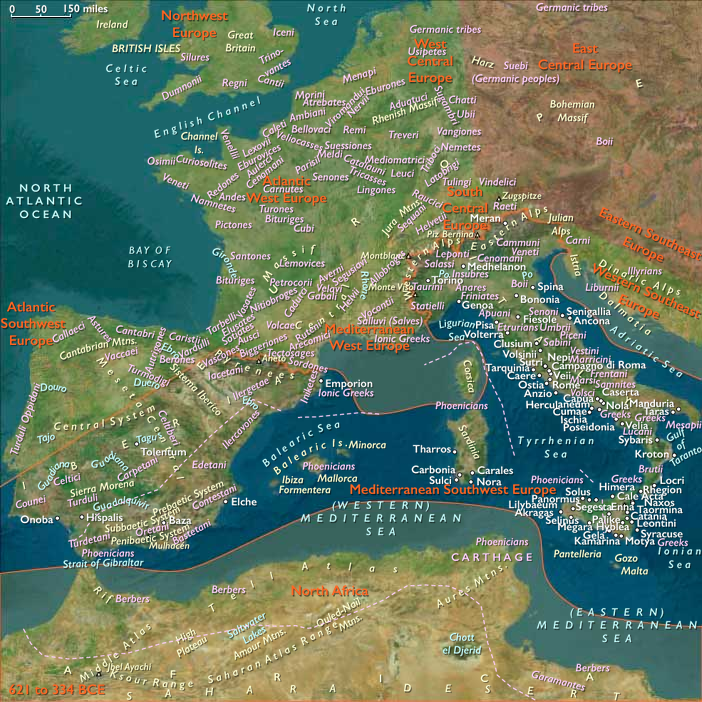
…Volterra (ancient Volaterrae) in their northern limits …
Years: 597BCE - 586BCE
…Volterra (ancient Volaterrae) in their northern limits and at the same time begun to push southward into …
Locations
Groups
Topics
Subjects
Regions
Subregions
Related Events
Filter results
Showing 9 events out of 9 total
Dominic (Domingo) De Guzmán consolidates a community of preachers, both voluntarily poor and learned in theology, as the Order of Preachers, the nucleus of the religious order that bears his name: the Dominicans.
Francis of Assisi consolidates a following to whom preaches the necessity of a poor, simple lifestyle based on the ideals of the Gospels.
Pope Innocent III grants him and his disciples permission to preach on moral topics, and has Francis ordained a deacon.
The followers increase, called by Francis friars minor—the lesser brethren, and soon become known as the Franciscans, with a women’s branch founded by Clare of Assisi and known as the Poor Clares.
The thriving commune of Assisi in Umbria had become an independent Ghibelline commune in the eleventh century.
Constantly struggling with the Guelph Perugia, it was during one of those battles, the battle at Ponte San Giovanni, that young Francesco di Bernardone, a native of Assisi, had been taken prisoner, setting in motion the events that eventually lead him to live as a beggar, renounce the world and establish the Order of Friars Minor.
Francis of Assisi was around twenty-four in 1206 when he renounced his father’s wealth and began to live as a hermit.
A sermon which Francis hears in 1209 on Matthew 10:9 makes such an impression on him that he decides to devote himself wholly to a life of apostolic poverty.
Clad in a rough garment, barefoot, and, after the Evangelical precept, without staff or scrip, he begins to preach repentance.
Francis is soon joined by a prominent fellow townsman, Bernardo di Quintavalle, who contributes all that he has to the work, and by other companions, who are said to have reached the number of eleven within a year.
The brothers live in the deserted lazar-house of Rivo Torto near Assisi; but they spend much of their time traveling through the mountainous districts of Umbria, always cheerful and full of songs, yet making a deep impression on their hearers by their earnest exhortations.
Their life is extremely ascetic, though such practices are apparently not prescribed by the first rule which Francis has given them (probably as early as 1209), which seems to have been nothing more than a collection of Scriptural passages emphasizing the duty of poverty.
Soon attracting followers, Francis preaches the necessity of a poor, simple lifestyle based on the ideals of the Gospels.
In spite of some similarities between this principle and some of the fundamental ideas of the Waldensians, the brotherhood of Assisi succeeds in gaining the approval of Pope Innocent III.
What seems to have impressed first the Bishop of Assisi, Guido, then Cardinal Giovanni di San Paolo and finally Innocent himself, is their utter loyalty to the Church and the clergy.
In approval, Pope Innocent III grants Francis and his disciples permission to preach on moral topics, and has Francis ordained a deacon, allowing him to read Gospels in the church.
The followers, who are tonsured, increase, called by Francis friars minor—the lesser brethren.
Innocent probably sees in them a possible answer to his desire for an orthodox preaching force to counter heresy.
Many legends have clustered around the decisive audience of Francis with the Pope.
The realistic account in Matthew Paris, according to which the Pope originally sent the shabby saint off to keep swine, and only recognized his real worth by his ready obedience, has, in spite of its improbability, a certain historical interest, since it shows the natural antipathy of the older Benedictine monasticism to the plebeian mendicant orders.
Francis, with the collaboration of eighteen-year-old Clare of Assisi—who, like Francis, left her noble Italian family for a life of austerity and prayer—establishes a branch of his order for women, called the Poor Clares, in 1212.
Although, according to tradition, Clare’s family wanted to take her back by force, her dedication to holiness and poverty inspires the friars to accept her resolution.
She is given the habit of a nun and transferred to Benedictine convents, first at Bastia and then of Sant Angelo di Panzo, for her formation.
Mediterranean Southwest Europe (1216–1227 CE): Expansion of Mendicant Orders, Reconquista Advances, and Imperial Conflict in Italy
The era 1216–1227 CE in Mediterranean Southwest Europe is characterized by the rapid expansion of mendicant orders, significant Christian advances against Almohad-held territories in Iberia, and heightened political tensions between northern Italian communes and imperial authority.
Growth of Dominican and Franciscan Orders
Following their founding in the previous era, the Dominicans and Franciscans quickly expand their influence across Europe, becoming integral to the spiritual and intellectual renewal of the Roman Catholic Church. Dominic de Guzmán (St. Dominic) and Francis of Assisi (St. Francis) actively promote their orders, sending preachers and friars throughout Italy, Spain, and southern France. Both orders establish influential schools and universities, contributing significantly to theological scholarship and education.
Christian Reconquista: Battle of Las Navas de Tolosa Aftermath
In Iberia, Christian forces continue capitalizing on the decisive victory achieved at Las Navas de Tolosa (1212), progressively weakening Almohad dominance in Al-Andalus. During this era, Christian kingdoms—particularly Castile, Aragon, and Portugal—press further southward, significantly shrinking Almohad territorial control and accelerating the fragmentation and decline of Muslim political authority.
Imperial and Communal Conflict in Northern Italy
Northern Italian city-states, organized under the Lombard League, remain embroiled in conflicts with the Holy Roman Empire, particularly under Emperor Frederick II. Tensions rise as Frederick intensifies efforts to assert imperial dominance over these autonomous communes. Cities such as Alessandria, Milan, and Brescia reinforce their communal liberties, resisting imperial control through strengthened political and military alliances.
Continued Cultural and Scholarly Exchange
Despite political and military turmoil, intellectual and cultural exchanges thrive. Toledo, Venice, and southern Italian centers like Naples and Palermo remain hubs of scholarly activity, supporting translations and dissemination of classical texts from Arabic and Greek into Latin. These efforts continue enriching Western intellectual life, laying essential foundations for subsequent cultural developments.
Maritime Republics' Sustained Prosperity
Italian maritime republics, notably Venice and Genoa, sustain their economic strength and maritime dominance. Their flourishing trade networks link Mediterranean Southwest Europe to Byzantium, the Levant, and North Africa, further enhancing regional prosperity and cultural interaction.
Legacy of the Era
The era 1216–1227 CE significantly impacts Mediterranean Southwest Europe through the expansion of influential mendicant religious orders, decisive advances of the Christian Reconquista, and ongoing communal resistance against imperial authority in northern Italy. These developments profoundly shape the region's political, religious, and intellectual trajectory throughout the following centuries.

Francis of Assisi, to whom Pelagio reluctantly gives permission to cross the lines, makes a famous but fruitless evangelistic attempt to convert the new Ayyubid sultan, al-Kamil, while the crusaders lay siege to Damietta, on November 5, 1219, finally taking the harbor.
Francis' visit to the East is a preliminary step in the establishment of a Franciscan province in the Holy Land, a step that will soon be imitated by the Dominicans.
Pelagio, convinced, by rumor, of the imminent approach of a legendary oriental Christian “King David,” is optimistic despite the lack of progress: he hopes that Frederick II, newly crowned Holy Roman Emperor, will arrive with a fresh army, but he never does; instead, after a year of inactivity in both Syria and Egypt, John of Brienne returns, and in July 1221 the crusaders march south towards Cairo.
This march is observed by the forces of Al-Kamil, and frequent raids along the flanks of the army lead to the withdrawal of some two thousand German troops who refuse to continue the advance and return to Damietta.
Al-Kamil is by now able to ally with the other Ayyubids in Syria, who had defeated Kaykaus I.
The crusader march to Cairo is disastrous; the river Nile floods ahead of them, stopping the crusader advance.
A dry canal that had been previously crossed by the crusaders floods, thus blocking the crusader army's retreat.
With supplies dwindling, a forced retreat begins, culminating in a night time attack by Al-Kamil that results in a great number of crusader losses and eventually in the surrender of the army under Pelagio.
The terms of this surrender mean the relinquishing of Damietta to Al-Kamil in exchange for the release of the crusaders.
Al-Kamil agrees to an eight-year peace agreement with Europe, an exchange of prisoners, and to return a piece of the true cross.
(However, the cross will never be returned as Al-Kamil does not, in fact, have it.)
The humiliating terms are far less favorable than those Pelagio had previously rejected.
Disillusioned critics blame Emperor and Pope as well as Pelagio.
The failure of the Crusade, the last in which the papacy will take an active part, causes an outpouring of anti-papal sentiment from the Occitan poet Guilhem Figueira.
The more orthodox Gormonda de Monpeslier responds to Figueira's D'un sirventes far with a song of her own, Greu m'es a durar.
Instead of blaming Pelagio or the Papacy, she lays the blame on the "foolishness" of the wicked.
Francis of Assisi had in 1221 established another branch of his order for lay people, called the Third Order.
As day-to-day organization is not among Francis’ strengths, he heeds the influence of more practical men, such as Cardinal Ugolino and Brother Elias.
Francis has retired from the government of the order to a life of contemplation, during which he reportedly receives the stigmata, the imprint of the wounds of Christ on his own body, and composes a celebrated poem, the “Canticle of Brother Sun.”
He dies at forty-four on October 3, 1226, by which time the Franciscan order, approved in 1223 by Pope Honorius III, has spread from Italy to England, the Holy Land, and all of Europe.
The friars, known as the people's preachers, wear a gray tunic with a white cord at the waist; hence, their English name Grey Friars.