
Wallachia has fallen into a somewhat chaotic …
Years: 1456 - 1456
July
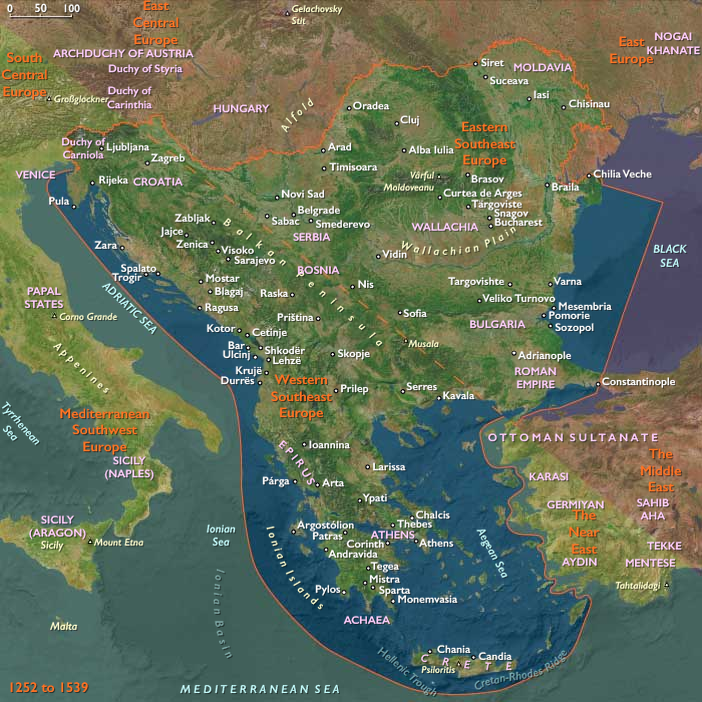
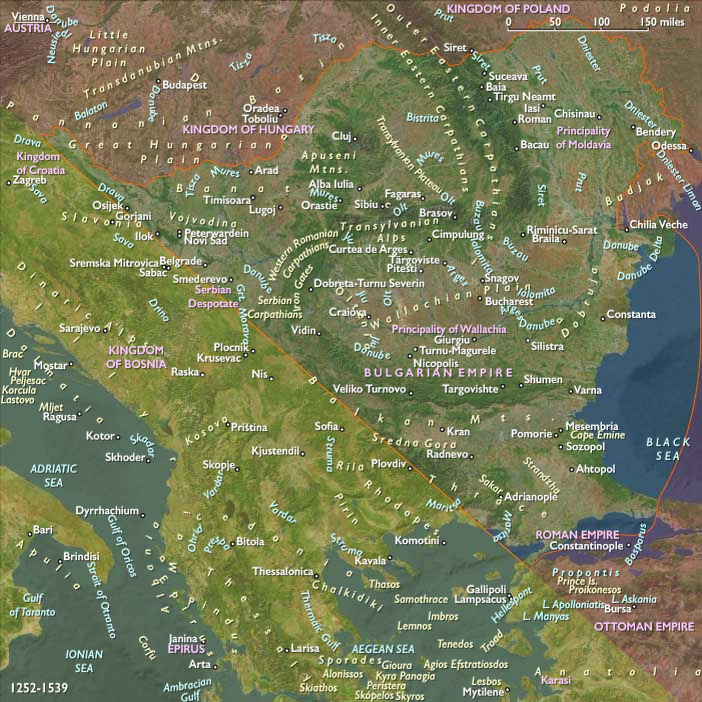
Wallachia has fallen into a somewhat chaotic situation since the death of Mircea the Elder in 1418 A constant state of war has led to rampant crime, falling agricultural production, and the virtual disappearance of trade.
After the rule of Alexandru I Aldea ended in 1436, Wallachia’s ruling House of Basarab has been split by the conflict between the Dăneşti and the Drăculeşti, both of which claim legitimacy.
After Constantinople succumbed, the Ottomans had cut off Genoese and Venetian galleys from Black Sea ports.
Trade has ceased, and the Romanian principalities' isolation has deepened.
When, in 1456, Hungary invades Serbia to drive out the Ottomans, Mircea’s grandson simultaneously invades Wallachia with his own contingent.
Vladislav II, who had assassinated Vlad Dracula II (Vlad the Devil) to become reigning Prince of Wallachia, is killed on July 22 in had-to-hand combat with Vlad’s twenty-five-year-old son, who succeeds him as Vlad III, also known as Vlad Dracula or simply Dracula (Drăculea in Romanian).
(He had ruled briefly also in 1448).
More commonly known as Vlad the Impaler (Vlad Ţepeş in Romanian), Vlad employs severe methods to restore some order, as he needs an economically stable country if he is to have any chance against his external enemies.
Constantly on guard against the adherents of the Dăneşti clan, some of his raids into Transylvania may have been efforts to capture would-be princes of the Dăneşti.
Several members of the Dăneşti clan, including Vladislav II, die at Vlad's hands.
Another Dăneşti prince, suspected to have taken part in burying his brother Mircea alive, is captured during one of Vlad's forays into Transylvania.
Rumors (spread by his enemies) say thousands of citizens of the town that had sheltered his rival had been impaled by Vlad.
The captured Dăneşti prince had been forced to read his own funeral oration while kneeling before an open grave before his execution.
Locations
People
Groups
Topics
Commodoties
Subjects
Regions
Subregions
Years: 1456 - 1456
July
Locations
People
Groups
Topics
Commodoties
Subjects
Regions
Subregions