
Wang and Lian score some successes against…
22 CE
Wang and Lian score some successes against the Chimei leader Suolu Hu in winter 22, capturing the city of Wuyan (in modern Tai'an, Shandong).
Rather than allowing their forces to rest, however, …
Locations
People
Commodities
Subjects
Regions
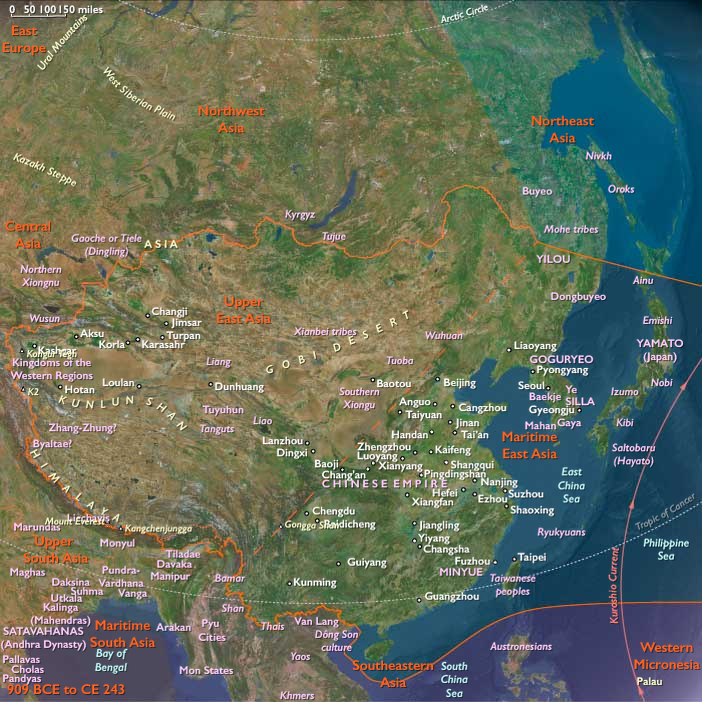
East Asia
View →Subregions
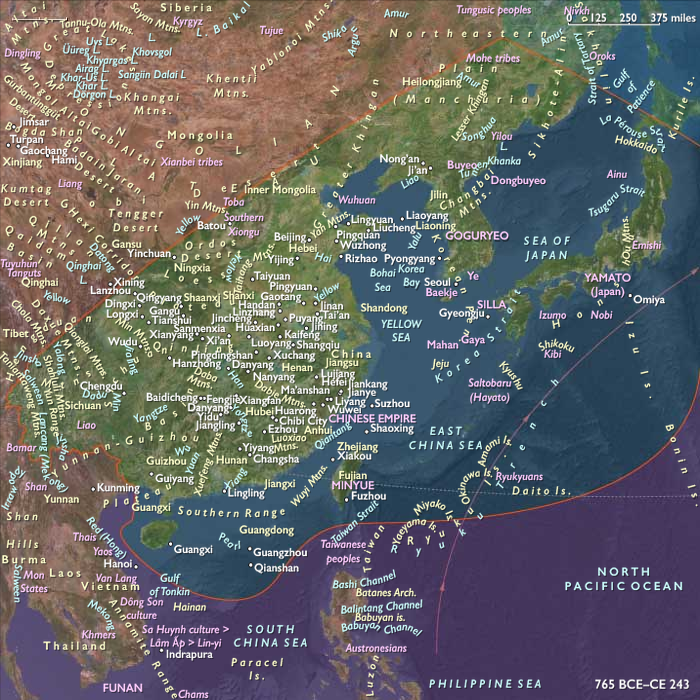
Maritime East Asia
View →Related Events
No active filters.
Showing 10 events out of 61955 total
The most ambitious of the rebels emerges in 22.
Liu Yan, a descendant of a distant branch of the Han imperial clan, who lives in his ancestral territory of Chongling (in modern Xiangfan, Hubei), had long been disgusted by Wang Mang's usurpation of the Han throne, and has long aspired to start a rebellion.
His brother Liu Xiu, by contrast, is a careful and deliberate man, who is content to be a farmer.
Around this time, there are prophecies being spread about that the Lius will return to power, and many men gather about Liu Yan, requesting that he lead them.
He agrees, and further joins forces with the branch of Lülin forces who have entered the area, and they begin to capture territory instead of simply roving and raiding.
(It was said that many of the neighborhood young men were initially hesitant to join the rebels, but when they saw that Liu Xiu, whom they considered wise and careful, joining as well, they agreed to.)
The forces led by Jing and Wang against Fan and other rebel generals are in shambles by 22, when Fan kills Jing in battle.
Wang Mang reacts by sending against these rebels two of his senior generals, Wang Kuang and Lian Dan with a massive (one hundred thousand-plus men) regular force.
Fan and the other rebel leaders, concerned that during battles it will become impossible to tell friend or foe, order that their men color their eyebrows red.
This is where the name Chimei—literally, "red eyebrows"—comes from.
Wang and Lian, while capable generals on the battlefield, fail to maintain proper military discipline.
…Wang decides to attack the Chimei stronghold of Liang (in modern Shangqiu, Henan), and Lian reluctantly attacks Liang with him.
Tiberius seems to have tired of politics at this point.
He shares his tribunician authority with his son Drusus Julius Caesar in 22, and begins making yearly excursions to Campania that reportedly become longer and longer every year.
The tired Xin forces are defeated by the Chimei at the battle of Chengchang (in modern Tai'an, Shandong), and collapse.
Lian dies in battle and Wang flees without his troops.
This ends any serious attempt by Xin forces against the Chimei, as the Xin dynasty will soon be confronted with the even closer Lülin threat.
The major military confrontation at Kunyang seals Wang Mang's fate in the spring of 23.
He sends his cousin Wang Yi and his prime minister Wang Xun with what he considers to be overwhelming force, some four hundred and thirty thousand men, intending to crush the newly constituted Han regime.
The Han forces are at this point in two groups—one led by Wang Feng, Wang Chang, and Liu Xiu, which, in response to the arrival of the Xin forces, withdraws to the small town of Kunyang (in modern Pingdingshan, Henan) and one led by Liu Yan, which is still besieging Wancheng.
The rebels in Kunyang initially want to scatter, but Liu Xiu opposes this measure; rather, he advocates that they guard Kunyang securely, while he gathers all other available troops in surrounding areas and attack the Xin forces from the outside.
After initially rejecting Liu Xiu's idea, the Kunyang rebels eventually agree.
Liu Xiu carries out his plan, and when he returns to Kunyang, he begins harassing the besieging Xin forces from the outside.
Wang Yi and Wang Xun, annoyed, lead ten thousand men to attack Liu Xiu and order the rest of their troops not to move from their siege locations.
Once they engage in battle, however, after minor losses, the other units are hesitant to assist them, and Liu Xiu kills Wang Xun in battle.
Once this happens, the Han forces inside Kunyang burst forth from the city and attack the other Xin units, and the much larger Xin forces suffer a total collapse.
The soldiers largely desert and go home, unable to be gathered again.
Wang Yi has to withdraw with only several thousand men back to Luoyang.
This is a major psychological blow to the Xin dynasty for which, after this point, all hope is lost.
The joint forces under Liu Yan's leadership have a major victory in 23 over Zhen Fu, the governor of the prefecture of Nanyang, killing him.
The coalition now besieges the important city of Wancheng (the capital of Nanyang prefecture, in modern Nanyang, Henan).
Many other rebel leaders have become jealous of Liu Yan's capabilities by this point, and while a good many of their men admire Liu Yan and want him to become the emperor of a newly declared Han Dynasty, the disgruntled leaders have other ideas.
They find another local rebel leader, Liu Xuan, a third cousin of Liu Yan, who is claiming the title of General Gengshi at the time and who is considered a weak personality, and request that he be made emperor.
Liu Yan initially opposes this move and instead suggests that Liu Xuan carry the title "Prince of Han" first (echoing the founder of the Han Dynasty, Emperor Gao).
The other rebel leaders refuse, and in early 23, Liu Xuan is proclaimed emperor.
Liu Yan becomes prime minister.
Emperor Gengshi is fearful of Liu Yan's capabilities and keenly aware that many of Liu Yan's followers are angry that he had not been made emperor.
One, Liu Ji, is particularly critical of Emperor Gengshi.
Emperor Gengshi arrests Liu Ji and wants to execute him, but Liu Yan tries to intercede.
Emperor Gengshi takes this opportunity to execute Liu Yan as well.
However, ashamed of what he has done, he spares Liu Yan's brother Liu Xiu, and in fact creates Liu Xiu the Marquess of Wuxin.
Emperor Gengshi now commissions two armies, one led by Wang Kuang, targeting Luoyang, and the other led by Shentu Jian and Li Song, targeting Chang'an directly.
All the people along the way gather, welcome, and join the Han forces.
Shentu and Li quickly reach the outskirts of Chang'an.
In response, the young men within Chang'an also rise up and storm Weiyang Palace, the main imperial residence.
Wang died in the battle at the palace, as does his daughter Princess Huanghuang (the former empress of Han).
After Wang dies, the crowd fight over the right to have the credit for having killed Wang, and tens of soldiers die in the ensuing fight.
Wang's body is cut into pieces, and his head is delivered to the provisional Han capital Wancheng, to be hung on the city wall.
Emperor Gengshi temporarily moves his capital from Wacheng to Luoyang after Wang Mang's death.
He then issues edicts to the entire empire, promising to allow Xin local officials who submit to him to keep their posts, and sends diplomats to try to persuade Chimei generals to submit as well.
For a brief period, nearly the entire empire shows at least nominal submission to Emperor Gengshi as the legitimately restored Han emperor—even including the powerful Chimei general Fan Chong, who, indeed, goes to stay in Luoyang under promises of titles and honors.
However, this policy is applied inconsistently, and local governors soon become apprehensive about giving up their power.
Some twenty-odd Chimei generals have gone to Luoyang and been created marquesses but have not been given any actual marches, and, seeing that their men are about to disband, they flee Luoyang for their base at Puyang.
Fan, in particular, leaves the capital and returns to his troops.
In response, Emperor Gengshi sends various generals out to try to calm the local governors and populace; these include Liu Xiu, who is sent to pacify the region north of the Yellow River.
The strategist Liu Lin suggests to Liu Xiu to break the Yellow River levee and destroy the Chimei by this manner, but Liu Xiu refuses.
The people begin to see that the powerful officials around Emperor Gengshi are in fact uneducated men lacking ability to govern; this further makes them lose confidence in his governance.
Emperor Gengshi's governance is in fact immediately challenged by a major pretender in winter 23.
A fortuneteller in Handan named Wang Lang claims to be actually named Liu Ziyu and a son of Emperor Cheng.
He claims that his mother was a singer in Emperor Cheng's service, and that Empress Zhao Feiyan had tried to kill him after his birth, but that a substitute child was killed indeed.
After he spreads these rumors, the people of Handan begin to believe that he is a genuine son of Emperor Cheng, and the prefectures north of the Yellow River quickly pledge allegiance to him as emperor.