
East Melanesia (1828–1971 CE) Missions, Labor, …
Years: 1828 - 1971
East Melanesia (1828–1971 CE)
Missions, Labor, War, and Emerging Nations
Geography & Environmental Context
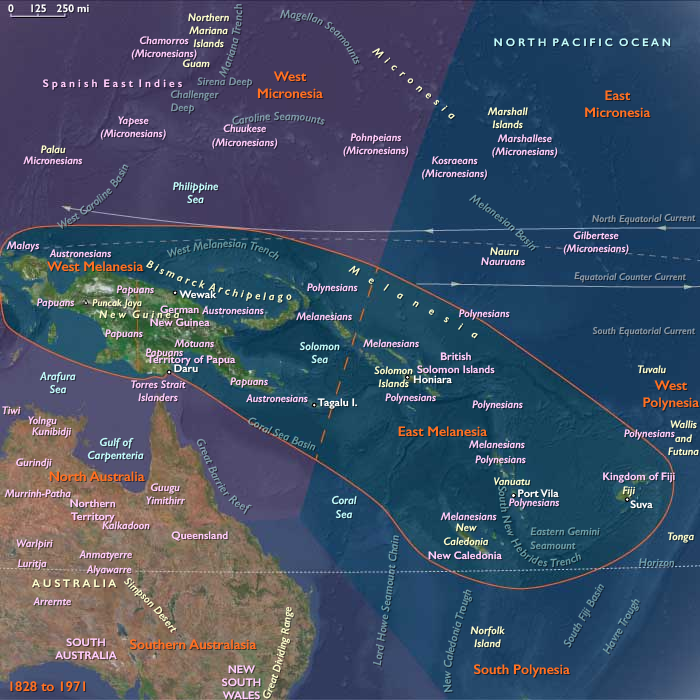
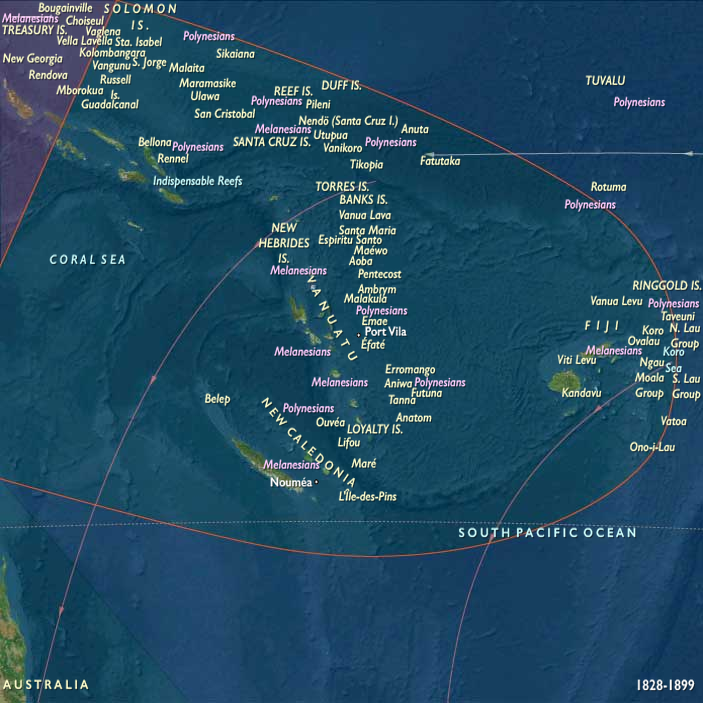
East Melanesia includes Vanuatu (New Hebrides), Fiji, New Caledonia, and the Solomon Islands (excluding Bougainville and Buka). Anchors include the high volcanic islands of Viti Levu and Vanua Levu, the coral atolls and uplifted reefs of Vanuatu and the Solomons, and the nickel-rich mountains of New Caledonia. The climate is tropical and humid, marked by seasonal rains, cyclones, and volcanic activity that alternately replenished and imperiled communities.
Climate & Environmental Shifts
Cyclones, floods, and earthquakes punctuated the 19th and 20th centuries. Volcanic eruptions (Ambrym, Yasur, Rabaul) reshaped coasts and soils. Colonial deforestation for plantations and mining accelerated erosion. After WWII, population growth and resource extraction heightened ecological strain; mangroves and reefs suffered from dredging and runoff, yet local subsistence systems remained resilient.
Subsistence & Settlement
-
Traditional life: Root crops — taro, yam, cassava, banana — and fishing underpinned island diets. Exchange systems (kastom economy) redistributed pigs, mats, and food during ceremonies.
-
Colonial economies:
-
New Caledonia: French rule (from 1853) developed nickel mining and convict labor.
-
Fiji: British colony (1874–1970) grew sugar using indentured Indian labor (1879–1916).
-
New Hebrides (Vanuatu): A British-French condominium (from 1906) fostered copra plantations under foreign ownership.
-
Solomon Islands: British protectorate (1893) turned to copra and tropical timber.
-
-
Urban centers: Suva, Nouméa, Port Vila, and Honiara became administrative capitals and magnets for wage labor.
Technology & Material Culture
Missions introduced literacy, carpentry, and printing; European tools, rifles, and textiles entered daily life. Indigenous crafts — woven mats, shell ornaments, canoes, and carvings — continued, often re-purposed for tourism and church use. After WWII, sawmills, radios, and mechanized transport penetrated even remote islands. Nickel and copper mining transformed New Caledonia and Bougainville (on the western margin).
Movement & Interaction Corridors
-
Labor migration: “Blackbirding” carried tens of thousands of Melanesians to Queensland and Fiji plantations in the 19th century. Later, inter-island migration followed colonial labor demand.
-
Mission and trade networks: Anglican, Catholic, and Presbyterian missions connected coastal villages through schools and schooners.
-
War corridors: WWII made East Melanesia a strategic Pacific theater—Guadalcanal (1942–43) became synonymous with fierce combat; Allied roads and airfields later served peacetime travel.
-
Postwar mobility: Soldiers, laborers, and students circulated between colonies and new regional centers such as Suva and Port Vila.
Cultural & Symbolic Expressions
-
Religious transformation: Christianity became dominant but intertwined with local cosmologies. Independent island churches blended hymns, dance, and ritual feasting.
-
Art and music: Ceremonial carving, drumming, and polyphonic singing persisted, often recast for mission or tourist audiences.
-
Political symbolism: Movements such as John Frum in Vanuatu and similar “cargo cults” expressed resistance to colonial control and faith in ancestral power.
-
Ethnic pluralism: Indo-Fijian communities developed distinct culture and political movements, setting Fiji apart within Melanesia.
Environmental Adaptation & Resilience
Islanders relied on polyculture gardens, inter-village reciprocity, and storm-proof architecture (palm-thatch houses, raised floors). After cyclones, kin networks rebuilt villages and redistributed food. Customary land tenure constrained plantation spread, preserving ecological diversity in much of Vanuatu and the Solomons.
Political & Military Shocks
-
Colonial partition: France in New Caledonia (1853); Britain in Fiji (1874) and the Solomons (1893); Anglo-French condominium in Vanuatu (1906).
-
World War II: The Solomons and Fiji hosted major Allied bases; Indigenous labor sustained logistics. Wartime experience fostered political awareness.
-
Postwar nationalism:
-
Fiji gained independence in 1970, balancing Indigenous and Indo-Fijian constituencies.
-
Vanuatu nationalist movements gathered strength under the Vanua‘aku Party (independence 1980).
-
Solomon Islands and Papua New Guinea moved toward self-government in the 1970s.
-
New Caledonia remained under France, where Kanak activism later rose.
-
Transition
From 1828 to 1971, East Melanesia evolved from a landscape of autonomous villages into a region of colonial outposts, mission networks, and rising nationalist movements. Plantations, mining, and war transformed economies, while Christianity, literacy, and migration redefined identity. Yet the heart of Melanesian life—communal gardening, exchange, and ancestral land—endured. By 1971, Fiji stood newly independent; other islands pressed for sovereignty; and East Melanesia entered the modern Pacific as both a cradle of cultural resilience and a frontier of decolonization.
Groups
- New Caledonia
- Fiji
- Vanuatu/New Hebrides
- Austronesian peoples
- Solomon Islands
- New Caledonia and Dependencies (French overseas Territory)
- Fiji, Kingdom of
- Fiji, Crown Colony of
- Solomon Islands (German protectorate)
- Solomon Islands (British protectorate)
- Fiji, Dominion of
Topics
- Oceania, Settlement of
- Little Ice Age, Warm Phase I
- Little Ice Age (LIA)
- World War, Second (World War II)
- Second World War in the Pacific
- Guadalcanal campaign
Commodoties
- Fish and game
- Glass
- Domestic animals
- Oils, gums, resins, and waxes
- Grains and produce
- Ceramics
- Strategic metals
- Sweeteners
- Lumber
- Money
- Aroma compounds
Subjects
- Commerce
- Symbols
- Watercraft
- Environment
- Decorative arts
- Faith
- Government
- Custom and Law
- Technology
- Human Migration
Regions
Subregions
Years: 1828 - 1971
Groups
- New Caledonia
- Fiji
- Vanuatu/New Hebrides
- Austronesian peoples
- Solomon Islands
- New Caledonia and Dependencies (French overseas Territory)
- Fiji, Kingdom of
- Fiji, Crown Colony of
- Solomon Islands (German protectorate)
- Solomon Islands (British protectorate)
- Fiji, Dominion of
Topics
- Oceania, Settlement of
- Little Ice Age, Warm Phase I
- Little Ice Age (LIA)
- World War, Second (World War II)
- Second World War in the Pacific
- Guadalcanal campaign
Commodoties
- Fish and game
- Glass
- Domestic animals
- Oils, gums, resins, and waxes
- Grains and produce
- Ceramics
- Strategic metals
- Sweeteners
- Lumber
- Money
- Aroma compounds
Subjects
- Commerce
- Symbols
- Watercraft
- Environment
- Decorative arts
- Faith
- Government
- Custom and Law
- Technology
- Human Migration
Regions
Subregions