The conquest of the three kingdoms is…
1684 CE to 1827 CE
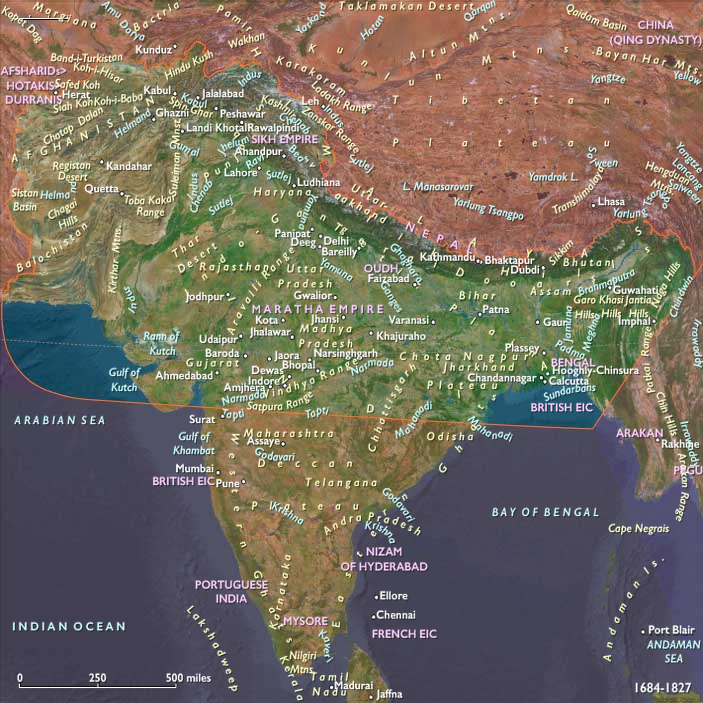
The conquest of the three kingdoms is only the beginning of a remarkable explosion of Gurkha military power throughout the Himalayan region.
Prithvi Narayan Shah quickly makes a movement toward the Chaubisi states in the west, but after encountering resistance in Tanahu, the Gurkha armies drive east into the Kirata country, overrunning all of eastern Nepal by 1773.
They are poised for the invasion of Sikkim, but because its rulers come from Tibet, Sikkim is viewed as a client of Tibet (and thus of the Chinese).
A warning from Tibet and the death of Prithvi Narayan Shah in 1775 stalls hostilities, but a full-scale invasion begins in 1779.
Resistance is encountered until 1788, when Gurkha forces drive the ruler of Sikkim into exile in Tibet and occupy all of western Sikkim.
Guerrilla warfare continues as the Gurkhas construct a base near Vijaypur to administer the eastern conquests.
In the west, a marriage alliance with the rajas of Palpa keep them quiet while General Ram Krishna Rana conquersTanahu and Lamjung (Gurkha' s traditional rival) and advances to Kaski by 1785.
By 1790 all rulers as far as the Kali River have submitted to the Gurkhas or haved been replaced.
Even farther to the west lies Kumaon, in the throes of civil strife between two coalitions of zamindar (large landowners responsible for tax collection in their jurisdictions), who struggle to control the monarchy.
One group invites the intervention of the Gurkhas, who defeat ocal forces in two battles and occupy the capital, Almora, in 1790.
The Gurkhas are poised for greater adventures, but by now they are irritating bigger players and begin to encounter resistance to their ambitions.
Locations
People
Groups
Topics
Subjects
Regions
South Asia
View →Subregions