
Bonaparte, recognizing his error in raising the …
Years: 1802 - 1802
May
Bonaparte, recognizing his error in raising the authority of the pope from that of a figurehead, produces the Articles Organiques (1802) wanting, like Charlemagne, to be the legal protector of the papacy.
To conceal his plans before their actual execution, he arouses French colonial aspirations against Britain and the memory of the 1763 Treaty of Paris, exacerbating British envy of France, whose borders now extend to the Rhine and beyond, to Hanover, Hamburg and Cuxhaven.
The Peace of Amiens (25 March 1802) with the United Kingdom, of which France's allies, Spain and the Batavian Republic, paid all the costs, has finally given the peacemaker a pretext for endowing himself with a Consulate, not for ten years but for life, as a recompense from the nation.
Bonaparte’s march to empire begins with the Constitution of the Year X.
On May 12, 1802, the French Tribunat votes unanimously, with the exception of Carnot, in favor of the Life Consulship for the leader of France.
This action is confirmed by the Corps Législatif.
A general plebiscite follows, resulting in 3,653,600 votes aye and 8,272 votes nay.
The Legion of Honor, or in full the National Order of the Legion of Honor (French: Ordre national de la Légion d'honneur) is a French order established by Bonaparte on May 19, 1802 to reward military and civil merit.
The Order is today the highest decoration in France and is divided into five degrees: Chevalier (Knight), Officier (Officer), Commandeur (Commander), Grand Officier (Grand Officer) and Grand Croix (Grand Cross).
By the Law of May 20, 1802, Bonaparte reestablishes slavery in France's colonial possessions, where it had been banned following the Revolution.
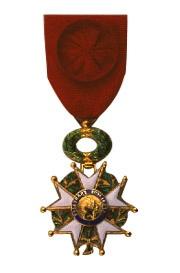
Officier medal of the French Légion d'honneur
Locations
People
Groups
- Saint Domingue, French Colony of
- French First Republic
- Britain (United Kingdom of Great Britain and Ireland)
Topics
- Haitian Revolution
- French Revolutionary Wars, or “Great French War”
- Toussaint L'Ouverture, Revolt of
- Saint-Domingue expedition
- Haitian French War of 1801-03
- Haitian Independence, Second War of
- French Revolutionary Wars: Campaigns of 1802
Commodoties
Subjects
Regions
Subregions
Years: 1802 - 1802
May
Officier medal of the French Légion d'honneur
Locations
People
Groups
- Saint Domingue, French Colony of
- French First Republic
- Britain (United Kingdom of Great Britain and Ireland)
Topics
- Haitian Revolution
- French Revolutionary Wars, or “Great French War”
- Toussaint L'Ouverture, Revolt of
- Saint-Domingue expedition
- Haitian French War of 1801-03
- Haitian Independence, Second War of
- French Revolutionary Wars: Campaigns of 1802
Commodoties
Subjects
Regions
Subregions