
The eleven-year-old William of of Orange-Nassau had …
Years: 1559 - 1559
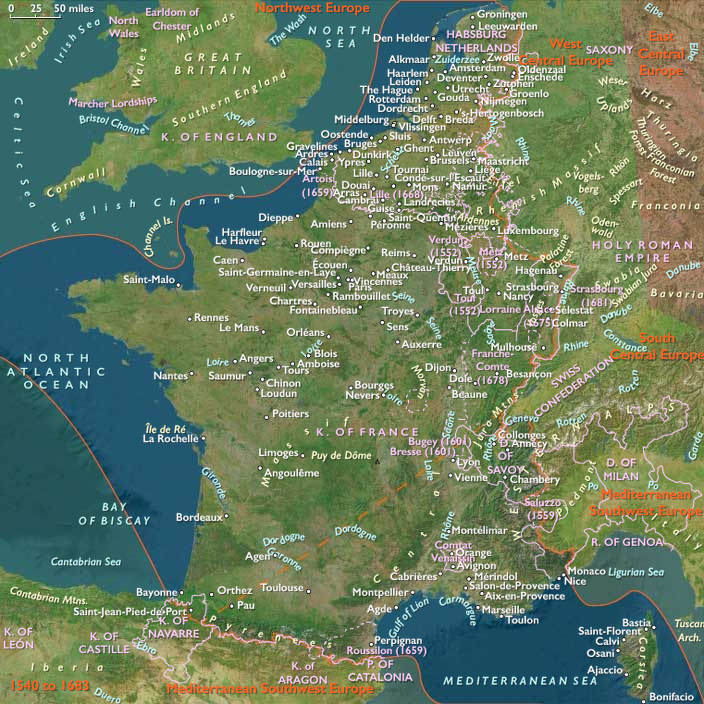
The eleven-year-old William of of Orange-Nassau had in 1544 inherited all the property of his childless cousin René of Châlon, Prince of Orange, including the title Prince of Orange and vast estates in the Burgundian Netherlands (present-day Netherlands and Belgium).
Because of his young age, Holy Roman Emperor Charles V had served as the regent of the principality until William was fit to rule.
However, Charles demanded that William, who had been raised as a Lutheran, receive a Roman Catholic education.
William had been sent to Brussels to study under the supervision of Maria of Austria, the sister of Charles V and regent of the Habsburg Netherlands (Seventeen Provinces); here he had been taught foreign languages and received military and diplomatic education.
He had in July 1551 married Anna van Egmond en Buren, the wealthy heir to the lands of her father, and William earned the titles Lord of Egmond and Count of Buren.
William was appointed captain in the cavalry later in that year.
Favored by Charles V, he made quick promotions, and became commander of one of the Emperor's armies at age twenty-two.
He was made a member of the Raad van State, the highest political advisory council in the Netherlands in 1555; the same year Charles abdicated in favor of his son, Philip II of Spain.
Philip names the twenty-six-year-old prince stadholder (governor) of Holland, Zeeland, Utrecht, and Burgundy, greatly increasing his political power.
Despite this appointment, William, although he never directly opposes the Spanish king, becomes the leader of the high nobility's opposition in the Raad van Stat to Philip's efforts to introduce monarchical absolutism and to repress Protestantism.
Cardinal Granvelle, his principal opponent, calls him "William the Silent" because, although he is an eloquent speaker, William keeps his inner thoughts to himself.
Locations
People
Groups
Topics
Commodoties
Subjects
Regions
Subregions

Years: 1559 - 1559
Locations
People
Groups
Topics
Commodoties
Subjects
Regions
Subregions