
William had faced more troubles in 1069 …
Years: 1070 - 1070
September
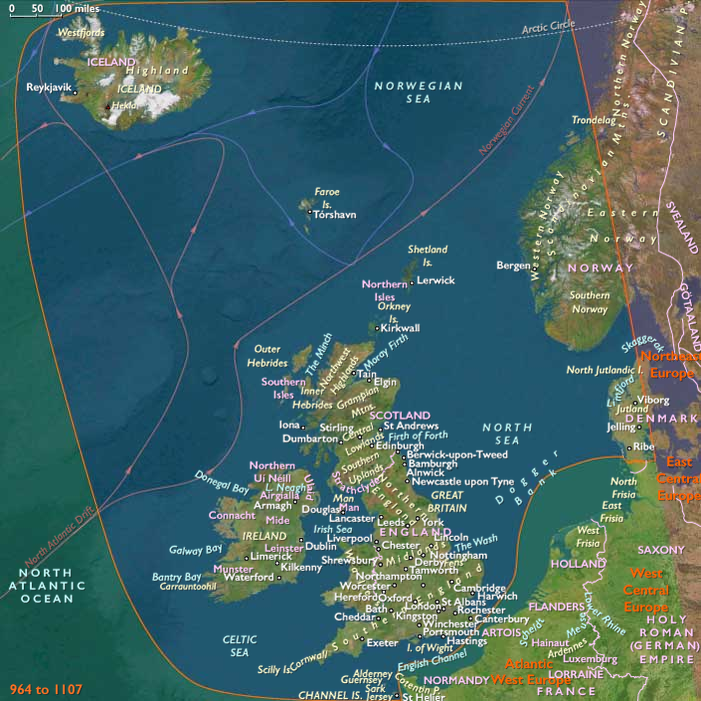
William had faced more troubles in 1069 from Northumbrian rebels, an invading Danish fleet, and rebellions in the south and west of England.
He has ruthlessly put down the various risings, culminating in the Harrying of the North in late 1069 and early 1070 that devastates parts of northern England.
Sweyn II of Denmark had in the autumn of 1069 invaded England, in support of the forces of Edgar the Atheling, the last remaining member of the House of Wessex with a claim to the throne of England.
The Danes with their English allies had been able to break the Norman hold on the north.
William's response has been to systematically devastate the countryside west and north of York, with the intention of isolating his enemies in the city of York.
William had made peace with the invading Danes and paid them off to return home.
With the Danes gone, William has continued his 'harrying' through the winter as far north as the river Tees.
It seems that the main objective of the harrying is to lay waste the northern shires and eliminate the possibility of further revolts.
To this end, William's army carries out a campaign of general destruction of homes, stock and crops as well as the means of food production.
Men, women and children are slaughtered and many thousands are said to have died due to the famine that followed.
Large areas of Yorkshire and other northern counties will still be lying in waste in 1086 according to the Domesday Book.
Although it is evident that William's army is responsible for a large portion of the death and destruction in the north, some historians have suggested that the damage incurred by William's forces may not have been as extensive as once thought.
William had been able to secure the departure of Sweyn and his fleet in 1070, allowing him to return to the continent to deal with troubles in Maine, where in 1069 the town of Le Mans had revolted.
Another concern is the death of Count Baldwin VI of Flanders in July 1070, which has led to a succession crisis as his widow is ruling for her two young sons, but her rule is contested by Robert, Baldwin's brother.
Matilda, even after she has been crowned queen, will spend most of her time in Normandy, governing the duchy, supporting her brother's interests in Flanders, and sponsoring ecclesiastic houses there.
She has just one of her children in England; Henry is born in Yorkshire when Matilda accompanies her husband in the Harrying of the North.
Locations
People
- Edgar (the) Ætheling
- Edith of Wessex
- Henry I of England
- Hereward the Wake
- Matilda of Flanders
- Sweyn II of Denmark
- William the Conqueror
Groups
- Anglo-Saxons
- Welsh people
- Denmark, Kingdom of
- Danes (Scandinavians)
- Flanders, County of
- Normandy, Duchy of
- Normans
- England, (Norman) Kingdom of
Topics
Commodoties
Subjects
Regions

Subregions
Related Events
Showing 10 events out of 50814 total
Years: 1070 - 1070
September
Locations
People
- Edgar (the) Ætheling
- Edith of Wessex
- Henry I of England
- Hereward the Wake
- Matilda of Flanders
- Sweyn II of Denmark
- William the Conqueror
Groups
- Anglo-Saxons
- Welsh people
- Denmark, Kingdom of
- Danes (Scandinavians)
- Flanders, County of
- Normandy, Duchy of
- Normans
- England, (Norman) Kingdom of
Topics
Commodoties
Subjects
Regions
Subregions