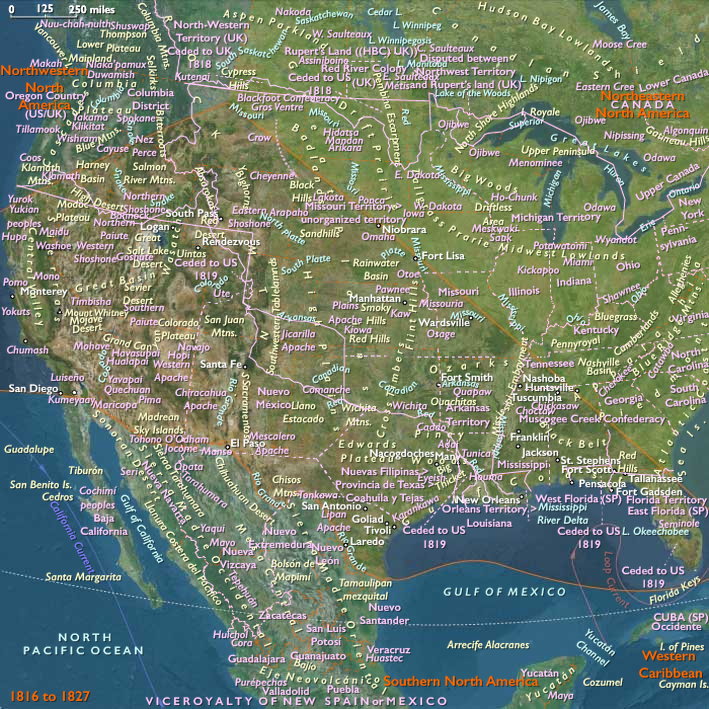
Several of Spain's colonies in the New…
March 1825 CE
The country had divided itself into several states, and the area known as Mexican Texas became part of the border state Coahuila y Tejas.
To assist in governing the large area, the state had created several departments; all of Texas was included in the Department of Béxar.
The department is further subdivided into municipalities, which are each governed by an alcalde, similar to a modern-day mayor.
A large portion of East Texas, ranging from the Sabine to the Trinity Rivers and from the Gulf Coast to the Red River, has become part of the municipality of Nacogdoches.
Most residents of the municipality are Spanish-speaking families who have occupied their land for generations.
An increasing number are English-speaking residents who had immigrated illegally during the Mexican War of Independence.
Many of the immigrants are adventurers who had arrived as part of various military filibustering groups, at least two of which which had attempted to create independent republics within Texas during Spanish rule.
For better control of the sparsely populated border region, in 1824 the Mexican federal government had passed the General Colonization Law to allow legal immigration into Texas.
Under the law, each state sets its own requirements for immigration.
After some debate, on March 24, 1825, Coahuila y Tejas had authorized a system granting land to empresarios, who would each recruit settlers for their particular colony.
In addition, for every hundred families an empresario settled in Texas, they would receive twenty-three thousand acres of land for cultivation and settlement.
During the state government's deliberations, many would-be empresarios had congregated in Mexico to lobby for land grants.
Among them was Haden Edwards, an American land speculator known for his quick temper and aggressiveness.
Despite his abrasiveness, Edwards was granted a colonization contract on April 14, allowing him to settle eight hundred families in East Texas.
The contract contains standard language requiring Edwards to recognize all pre-existing Spanish and Mexican land titles in his grant area, to raise a militia to protect the settlers in the area, and to allow the state land commissioner to certify all deeds awarded.
Edwards's colony encompasses the land from the Navasota River to twenty leagues west of the Sabine River, and from twenty leagues north of the Gulf of Mexico to fifteen leagues north of the town of Nacogdoches.
To the west and north of the colony are lands controlled by several Native tribes that had recently been driven out of the United States.
The southern boundary is a colony overseen by Stephen F. Austin, the son of the first empresario in Texas.
East of Edwards's grant is the former Sabine Free State, a neutral zone, which had been essentially lawless for several decades.
The boundaries of the new colony and the municipality of Nacogdoches partially overlap, leading to uncertainty over who has jurisdiction over which function.
The majority of the established settlers live outside the eastern boundary of the Edwards colony.
Commodities
Regions
Northern North America
View →Subregions