A large group of lesser Dutch noblemen,…
May 1568 CE
They had offered a petition on April 5, to Margaret of Parma, Governor of the Netherlands from 1559, requesting an end to the persecution of Protestants.
A wave of iconoclasm, known as the Beeldenstorm, had spread through the Low Countries from August to October 1566.
Calvinists (the major Protestant denomination), Anabaptists, and Mennonites, angered by Catholic oppression and theologically opposed to the Catholic use of images of saints (which in their eyes conflicts with the Second Commandment), had destroyed statues in hundreds of churches and monasteries throughout the Netherlands.
Unrest in the Netherlands had grown following the Beeldenstorm, and Margaret had agreed to grant the wishes of the Confederacy, provided the noblemen would help to restore order.
She had also allowed more important noblemen, including William of Orange, to assist the Confederacy.
It had become clear in late 1566 and early 1567 that she would not be allowed to fulfill her promises, and when several minor rebellions failed, many Calvinists and Lutherans fled the country.
Following the announcement that Margaret's half-brother Philip II of Spain, unhappy with the situation in the Netherlands, would dispatch his loyal general Fernando Álvarez de Toledo, Duke of Alba to restore order, William had laid down his functions in April 1567 and retreated to his native Nassau.
William had been (financially) involved with several of the rebellions.
As one of the most prominent and popular politicians of the Netherlands, William now emerges as the leader of an armed resistance against the Spanish rulers of the Netherlands.
He finances the Watergeuzen, refugee Protestants who form bands of corsairs and conduct sporadic raids on the coastal cities of the Netherlands (often killing Spanish and Dutch alike).
He has also raised an army, consisting mostly of German mercenaries, to fight Alba on land.
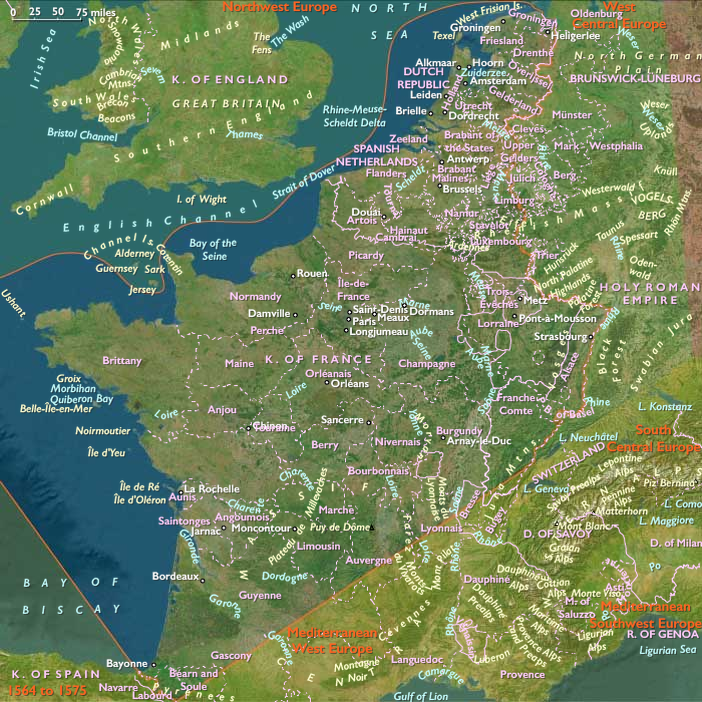
Led by his brother Louis, the army—thirty-nine hundred infantry led by Louis and two hundred cavalry led by Adolf of Nassau, another brother—invades the Groningen province of the Spanish Netherlands in 1568.
The stadtholder of the northern provinces, Jean de Ligne, Duke of Aremberg, commands a Spanish army of thirty-two hundred infantry and twenty cavalry.
Aremberg had initially avoided confrontation, awaiting reinforcements from the Count of Meghem, stadtholder of Gelderland.
However, on 23 May, Adolf's cavalry lures him to an ambush at the monastery of Heiligerlee.
Louis' infantry, making up the bulk of the army, defeats the Spanish force, which loses between fifteen hundred and two thousand men, including Aremberg, while the invading force loses fifty, including Adolf.
The rebels capture seven cannon.
Locations
People
Groups
Topics
Commodities
Subjects
Regions
West Europe
View →Subregions